Loopy Pro: Create music, your way.
What is Loopy Pro? — Loopy Pro is a powerful, flexible, and intuitive live looper, sampler, clip launcher and DAW for iPhone and iPad. At its core, it allows you to record and layer sounds in real-time to create complex musical arrangements. But it doesn’t stop there—Loopy Pro offers advanced tools to customize your workflow, build dynamic performance setups, and create a seamless connection between instruments, effects, and external gear.
Use it for live looping, sequencing, arranging, mixing, and much more. Whether you're a live performer, a producer, or just experimenting with sound, Loopy Pro helps you take control of your creative process.
Download on the App StoreLoopy Pro is your all-in-one musical toolkit. Try it for free today.
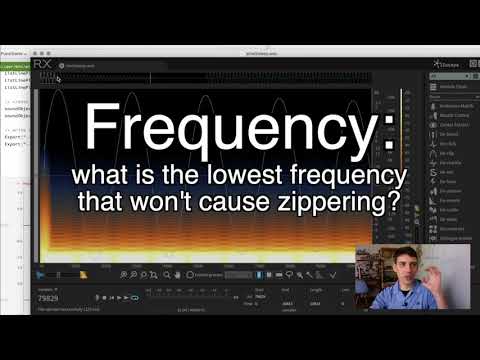
Video: How a noise gate works and why it distorts the signal when the release time is too short

Comments
While you're at it, please consider adding one parameter: Downward expansion ratio.
Or just use Apple's native "Dynamics" AU effect.
(kAudioUnitSubType_DynamicsProcessor)
Interesting and informative video, as ever.
In what situations do you use that downward expansion parameter? I was thinking to leave it out in order to make the app run lighter on the cpu.
Our current design has a closed gain control, so it can reduce gain without shutting off the audio completely.
Replacing that with a ratio control means the circuit has all the components of a compressor.
It's not about adding a compressor, not at all.

Have you seen Auria yet?
What I mean is the adjustable downward expansion ratio that is often fixed at 1:infinite in conventional noise gates.
Sometimes you can adjust the "closed gain" (like you apparently have in your code already) but only few good ones offer this kind adjustment which helps to get much more natural-sounding noise suppression without the disadvantages of a typical old-school gate.
Not offering this kind of adjustment is a missed opportunity IMHO.
Although it is not a compressor, but it has all the same components as a compressor. We have those components available and could use them to replace the closed gain control with a ratio control. But since that will significantly increase the complexity of the design, I am wondering how much different the sound would be if we do that replacement. Personally, I use a noise gate to silence the noise from my guitar pickups, and I don’t think the expansion ratio control would be worth the extra processor cycles in that context. Can you tell me about some contexts where downward expansion sounds better than the simpler noise gate design?
Absolutely. I'll record an example for you.
@Blue_Mangoo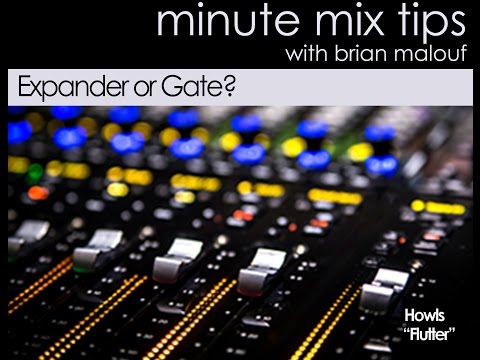
An even better example:
Thank you. I’ll look at this tomorrow and look into switching from gate to downward expansion
One good thing about the expander is that it’s less prone to that zippering problem and therefore doesn’t need such long release time. It might also allow us to use a simpler smoothing filter, which would partly make up for the time lost to computing the gain as a ratio.
More cool engineering disclosure... I hope there are engineering students soaking in this
information.
TL:DL The Noise Gate app will ship soon and well before the Saturator app.
Yes! I wanted to write exactly that, so I'm even more happy to see your reply now.
A downward expander can be set to act like a gate but not the other way around, so...
Edit: This is how Apple's free Dynamics Processor UI looks on MacOS when set to downward expansion mode (no soft knee though):

This morning I replaced the closed gain control with a downward expansion ratio control. It requires the addition of one log operation and one exponentiation per sample. DSP engineers of the past avoided those operations because of fear they would be too slow. But on modern hardware the speed doesn’t seem to be a problem. Especially if the code doesn't have the processor waiting for the output of a previous calculation before going on to the next one then it seems to be just fine. I think my intention to avoid those functions might be nothing more than a bad habit, so I went ahead and implemented the ratio control. Thank you for suggesting that change.
You're welcome and thanks for considering!
If you worry about CPU usage anyway (and low CPU is always good!), you could do two things:
1. Disable log/exp operations when the ratio control is at the "gate"/infinite position
2. Approximate the calculations by multiple linear segments, just as many as necessary to make the resulting sound indistinguishable. (Fast circle drawing in bitmap computer graphics has been done this way).
Good points. Thanks again.