Loopy Pro: Create music, your way.
What is Loopy Pro? — Loopy Pro is a powerful, flexible, and intuitive live looper, sampler, clip launcher and DAW for iPhone and iPad. At its core, it allows you to record and layer sounds in real-time to create complex musical arrangements. But it doesn’t stop there—Loopy Pro offers advanced tools to customize your workflow, build dynamic performance setups, and create a seamless connection between instruments, effects, and external gear.
Use it for live looping, sequencing, arranging, mixing, and much more. Whether you're a live performer, a producer, or just experimenting with sound, Loopy Pro helps you take control of your creative process.
Download on the App StoreLoopy Pro is your all-in-one musical toolkit. Try it for free today.
Fun with Triplets, Dotted ++

Quick demo of my new machine, enjoy-!
Comments
What machine are you referring to?
With Audiobus, StepPolyArp, Streambyter, and Xequence, i put together a drum setup that drives Nanostudio.
Instead of putting beats directly on the piano roll, this takes advantage of StepPolyArp's normal, triplet, and dotted note speeds.
A basic pattern is sequenced in SPAU, and instances are made for 10 drum sounds.
This allows me to place one long 'note' on the piano roll, and have the drum sound play the pattern at various speeds.
It also lets me mix up time signatures, and experiment with making new beats.
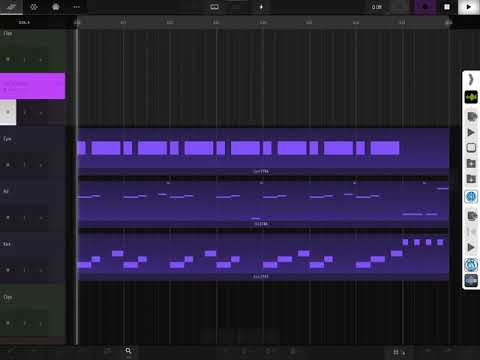
I've taken the beat grid of SPAU, and placed it as an abstraction within the grid of Xequence, so that I can make actual triplets or dotted beats on a 4/4 grid at will. It can then render the drum pattern onto another track to be saved or modified in the usual way.
In this vid, I play the command tracks (Kick, Hit, Cym) which drive SPAU using Streambyter, to record onto a new track. I have a look at the Streambyter code driving SPAU, and look at an instance as it switches patterns to send notes on time to Nanostudio. Then I mute the command tracks and solo the rendered track to have it drive Nanostudio, bypassing the setup in Audiobus. I open the rendered track to look at a triplet drumroll on the 4/4 grid, then switch back to muting the rendered track and have the commands drive again
Posted here to show the possibilities/capabilities, and hopefully inspire to think out of the box-!
Hope you like...
I do like. Very impressive, too. I'd never have thought of that but might have a need in s bit 👍
Excellent stuff here 👍