Loopy Pro: Create music, your way.
What is Loopy Pro? — Loopy Pro is a powerful, flexible, and intuitive live looper, sampler, clip launcher and DAW for iPhone and iPad. At its core, it allows you to record and layer sounds in real-time to create complex musical arrangements. But it doesn’t stop there—Loopy Pro offers advanced tools to customize your workflow, build dynamic performance setups, and create a seamless connection between instruments, effects, and external gear.
Use it for live looping, sequencing, arranging, mixing, and much more. Whether you're a live performer, a producer, or just experimenting with sound, Loopy Pro helps you take control of your creative process.
Download on the App StoreLoopy Pro is your all-in-one musical toolkit. Try it for free today.
Nembrini Audio PSA1000 demo on drums
![[Deleted User]](https://secure.gravatar.com/avatar/c8647d4cf3474456326a3c26d4492879/?default=https%3A%2F%2Fvanillicon.com%2F32f08b4a4ec2b2175c71da48f536e671_200.png&rating=g&size=200)
I tried this awesome saturator plugin on drums in AUM. I love it. Great work @NembriniAudio

Comments
Thanks so much @Faland ! This unit is used mainly for "colorize" drum, bass, synth etc.
For who interested we release the bundle:
https://itunes.apple.com/us/app-bundle/id1499310316#?platform=ipad
Igor
Does anyone use saturation on vocals? I was wondering if this is common and a part of compression - sorry for production newb comment, just thought it would sound cool on vocals during the video
Producers use saturation on everything from delicate to crushing.
It gets used on drums a lot as a means to add (pick your descriptor) warmth grit texture fuzz...
If you consider a simplified example like a kick drum which is, except for the initial hit, mostly low end sine-like (round) oscillations, adding a compressor can add harmonics and contribute to the overall loudness of the kick by literally turning the sine into more of a square wave (see also waveshaping).
Compression is similar in that it makes things “louder”, but not the same. Compression drops the volume of the loudest parts and the raises the volume of the quieter parts. This evens out the dynamics to keep everything at relative, audible level. You can over-compress and loose all sense of loud and soft. This is generally considered bad practice and can introduce clipping and other unwanted artifacts.
Somewhat paradoxically, while some of the best compressors are colorless and don’t add any character to the audio signal, other compressors have color, and add due to circuit design, signal processing, etc, their own personality.
My musical production vocabulary and technical correctness might be a little off, but I hope you get the gist.
TL;DR
SATURATION alters the waveform adding harmonics and can make a sound louder.
COMPRESSION evens out the dynamics of a sound and makes the relative volume more even.
Saturation
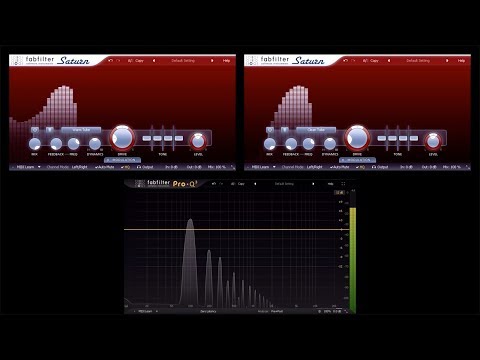
Thank you for taking the time to give a really clear explanation. I use compression a lot and am always chasing a certain vocal tone. Saturation has confused me in the past somewhat as it just sounds like gain to me (I come from a background of guitar amps etc) in description. Perhaps gain blows up the signal whereas saturation fills in the gaps, or perhaps theyre the same. I heard many people advocating the fabfilter saturator as an amp (I think it makes a poor one bit am used to a lot of real amps).
@wingwizard : gain and saturation are different. Real gain adjustment changes amplitude (volume) only with no change in relative strength of different harmonics.
On guitar amps, there often isn't a pure gain adjustment. What is labeled gain is often a circuit that results in some amount of harmonic distortion/saturation as it is turned up. Some amps are very clean and add only subtle amounts of harmonic distortion that we are as "warmth" but might not think of as distortion even though it is.
I tried to replicate this video with Poison-202 > Tonebooster equalizer > klevgr reamp (I thought it was a saturator) but I never saw the harmonic added. I then tried Nembrini screamer, still no harmonic. Am I missing something?
Wow I am such a noob!!! Guess the mistake I made 😂😂
Revamp isn’t a saturation effect. It’s an amplifier primarily with some options for adding harmonics down at the lower right based on what model you’re using tube, cassette etc.
Try and find something that has a dedicated saturation function or settings.