Loopy Pro: Create music, your way.
What is Loopy Pro? — Loopy Pro is a powerful, flexible, and intuitive live looper, sampler, clip launcher and DAW for iPhone and iPad. At its core, it allows you to record and layer sounds in real-time to create complex musical arrangements. But it doesn’t stop there—Loopy Pro offers advanced tools to customize your workflow, build dynamic performance setups, and create a seamless connection between instruments, effects, and external gear.
Use it for live looping, sequencing, arranging, mixing, and much more. Whether you're a live performer, a producer, or just experimenting with sound, Loopy Pro helps you take control of your creative process.
Download on the App StoreLoopy Pro is your all-in-one musical toolkit. Try it for free today.
Miniatures for Harp and Recorders
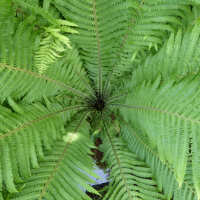
I’m a big fan of recorder music, a much maligned instrument in my opinion.
The recent release of the SWAM VariFlute app which includes four different recorders inspired this album of eleven little solos and duets. All of the recorder parts are played, some of the Harp (BeatHawk) parts are played, some generated.
As well as the late lamented David Munrow, Richard Harvey was my favourite player of the 1970’s.
Known now for his film and tv music, he was better known in the 70’s as being a member of the ‘medieval’ rock group Gryphon and being a virtuoso recorder player. His LP ‘Divisions on a Ground’ from 1975 was on my turntable a lot.
I stumbled across a YouTube video version of the LP a few weeks ago and it prompted me to have a go at playing one of the pieces, something I would never have even imagined a few years ago.
So after a lot time trying to work out what he was playing, made easier once I’d worked out I had to retune the recorder from 440hz to 444hz, here is my attempt at the second piece on the LP, Variations From "Der Gooden Fluyt Hemel" by Paulus Matthysz , published 1644.
Actually it’s only about a half of Mr Harvey’s version and played at something like half of the speed he plays it at 😊
For @McD here are the ‘stars’ from Der Gooden Fluyt Hemel , the last of the 11 tracks…
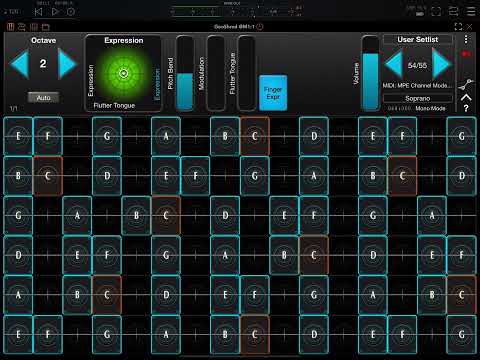
Here is the playlist in YouTube, all videos produced using Visual Synthesizer.
Here is the album in SoundCloud
Comments
I still have my set of three recorders (alto, sopran, sopranino) and love it. They play well together with a psalter.
I have a soprano, but rarely play it. I should definitely play it more as it really is a unique woodwind instrument.
@GeoTony great playing as always, and great to hear a different instrument from those we usually hear.
Thanks for the visual accompaniment. It's always a treat to follow the notes as you tap them out. I went to hear the recorder album of this and noticed how when the note stops the pitch falls off as the air pressure lessens... After a bit I had to come back to the pitch perfections of your modeled instrument. It's an improvement in pitch but the skills of the real deal are evident which makes sense. Purists would never sit through a human tapping on an iPad and accept the illusion as anything but a computer trick that takes the art out of it.... But we know there's art in your playing and the sound speaks for itself. I'm sure many recorder emthusiast would marvel at your tone
I used to have a tenor but got rid of it years ago… should have kept it ☹️
Thanks for listening and commenting @Phil999 , @michael_m and @McD 👍
As you say Michael, it’s nice to use an instrument that rarely gets an outing.
When you listen to the original @McD you realise a) the software still has some way to go to match the real instrument and b) the same is true of my playing 😊
the playing with GeoShred is very good. Congratulations. However, the sounds when changing octaves of a recorder, and many other small details, is difficult to emulate. I think it’s a good investment when you see a recorder on a flea market or thrift store.
In the 90’s I recorded with all three, a “petite danse”, and this tune is now my ringtone.
Sounds like a post of “petite danse” is required @Phil999 😊
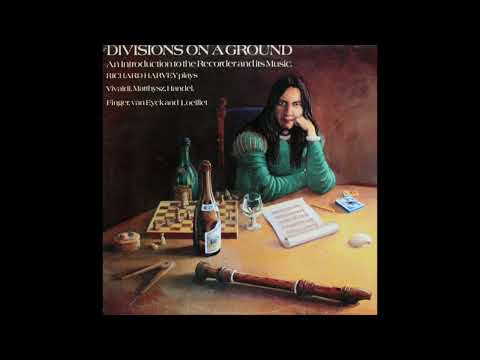
The piece I ‘borrowed’ for track 11 is 10:45 into this video… but the whole LP is all worth listening to imho.
These sound authentic! I, too, played recorder but not for a long while. I've got a really nice rosewood alto and a maple tenor. I used to play with informal trios and duets with classical guitar.
I have the Pianoteq harp and now I'm spoiled, the Beathawk harp doesn't quite do it for me. I've been planning something with that and the VariFlute too; no use trying to keep pace with you though. 🤠
PianoTeq 9 adds a third harp to the Harp Package called the “Triple Harp” which is described as follows:
>
Of course, the harps in PianoTeq (8 and 9) are capable of playing chromatic scales while the Celtic Harp cannot, I think. I should test that assiumption or wait for a correction in a reply.
I’ve always enjoyed a good, recordist? Kind of a guilty pleasure cause i thought they’re for children and renaissance faire nerds, which i partially am. I guess this enforces your opinion that they are maligned. Thanks for sharing your piece and i appreciate the history and enthusiasm in this thread.
@GeoTony , I’m curious if you use your pinky and or your thumb to land notes on Geoshred, or just your index, middle, and ring fingers?
Lovely album! I thoroughly enjoyed that. ❤️
I’m not sure I can justify Pianoteq @MrStochastic but I’ll try and listen to it to see if I can be tempted. I’d love to hear what you come up with !
I think it’s Thumb, Index, Middle and Ring on the right and Index and Middle on the left @Blipsford_Baubie … some more than others. I’ve always played two handed as I find some finger movements difficult due to arthritis . Also I’ve always played chords on GS which is almost impossible with one hand.
Thanks @jwmmakerofmusic , appreciate the like 👍
Thanks as ever for the information and support @McD 🙏
with pleasure. But the percussion is still not done, and the tape machine is no more working. I would need to start from scratch. Some day maybe …