Loopy Pro: Create music, your way.
What is Loopy Pro? — Loopy Pro is a powerful, flexible, and intuitive live looper, sampler, clip launcher and DAW for iPhone and iPad. At its core, it allows you to record and layer sounds in real-time to create complex musical arrangements. But it doesn’t stop there—Loopy Pro offers advanced tools to customize your workflow, build dynamic performance setups, and create a seamless connection between instruments, effects, and external gear.
Use it for live looping, sequencing, arranging, mixing, and much more. Whether you're a live performer, a producer, or just experimenting with sound, Loopy Pro helps you take control of your creative process.
Download on the App StoreLoopy Pro is your all-in-one musical toolkit. Try it for free today.
SuperFM6 - a synth project I'm working on, looking for testing and noodling

Hey, solo dev (I guess, don't know if I'd call myself that), decided to take a hardware project I'd never got off the ground and pull the code into ios so it might actually see the light of day. My first time developing on ios, but the dsp was all clean c++ - who knows maybe I'll still make the hardware someday. For now, I'm interested in getting some testing if anyone is interested.
It's an FM based synth with some fun extras - two complex filters (morphable with spawnable additional resonant peaks, comb filter, and a modal pipe filter that's a generator in its own right), simple pin matrix routing of operators with multiple waveforms and continuous morphing of those waveforms, mod-anything mod section with 3 lfos, 2 envelopes (all envelopes are ADSR or loopable 4seg, including the per operator envelopes), with per destination postitive or negative mod, ramp or gate delay for the LFOs and unipolar or bipolar modulation. The FX section has 4 fx slots that can be routed in any combo of serial or parallel and pretty much everything down to the operators has independent pan for a stereo first approach.
It's not an everything synth, but it was originally going to be part of a bigger groovebox with multiple synth engines and sequencing, so I took the best parts of the synth and fx to port over.
I'm not great at demos, I was building this primarily to make an instrument I wanted, but a few examples are up on youtube.
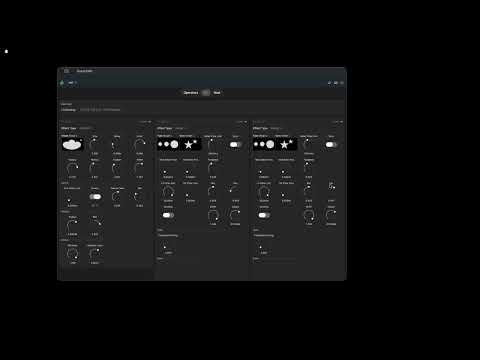
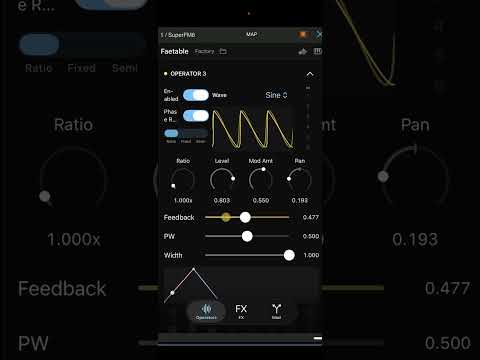
From a design standpoint I wanted something that really worked well on an iphone, so everything is built to collapse into a single column but responds out to 3 columns for ipads. I'm pretty anti-ai so the design is simple and some of the graphics are ios stock for now or my own ugly figma vectors, but I'd rather get it working than pretty.
I have a new build that adds the reverb freeze and improves the morphing convolution going up in a bit. It's a side project so I work on it when I can. This is still very much a work in progress, but I think it's at a good point to share and get feedback. Check it out if you feel like messing with something new. Works as an AU and in standalone, preset saving is simple json files that can be exported and shared easily - and please share any cool presets you make - if I launch this you'll 100% get credit for anything included. You can also import dx banks - they're not one to one since the architecture is different but they can be a fun starting point.
https://testflight.apple.com/join/WhJvjgUr
In progress documentation is here https://docs.google.com/document/d/1Tti9eIztFvNXbyFAJpZfNSiRHHd5REjl0dGBc4pmskQ/edit?usp=sharing
Comments
Just posting this to bump the thread back to a more visible position so doesn’t get missed.
I’m rather enjoying this @nouso. Hopefully some of the FM aficionados around here will also be taking it for a spin.
Thanks for checking it out! It spent too many years sitting on my drive as a "someday" project. Looking forward to what people come up with. I've been working on tightening the usage and designing more presets, but like so many things this is one of those projects that turns into a wonderful excuse to not actually make music!
This sounds like it’s going to be fun, please keep it going, I’m sorry your hardware fell apart.
Just been playing around with the filters. Really love the fact that there’s basically a physical modeling synth hidden in there, so good.
Lots to like generally. The included effects all have interesting modes and the inclusion of convolution reverb is really nice in itself. I think there’s only two other dedicated iOS FM synths (NFM and Nambu, neither of which I have) which allow you to set up your own bespoke algorithms so it’s great that this doesn’t limit you there.
I feel the interface could do with some work. Maybe the different panels should be subtly different colours to differentiate them visually more easily.
Clicking to open one of the operator’s extended controls doesn’t quite feel right to me in the way it happens. You click and then the larger interface for that operator opens off to the left of where you clicked. It feels awkward to me, it feels like the larger interface should open ‘under your finger’, at the place where you are looking when you press the Open icon rather than opening somewhere else completely. Hopefully that makes sense?
I really hope you do take this forward, it seems pretty solid to me already. I also really hope that others who have more expertise with FM than myself check it out to give you a more knowledgeable idea of how it compares to the other iOS FM synths available. I’ll keep playing with it and let you know if I have any other thoughts. Cheers.
Thanks, really helpful feedback on the interface, it's been a struggle to balance something really good on a phone and still responsive. The version I tested on tablets that might be closer to what you're describing is that the open detail view does drop in place and pushes the condensed cards in either direction. The challenge is when all 6 operators are open it fills two rows. So the reason I compromised with the "to the left" was to keep visibility until three are open and then the second row takes the collapsed cards. I think a "push out of the way" where the collapsed cards spread in either direction could be closer to what you're describing and a bit more natural without getting confusing when a second row is needed. On a phone it does exactly what you describe, opens right under your finger, on a tablet, I'm not giving the same result. I'll keep tinkering with it to see if I can solve for both device types elegantly.
What do you think about what's displayed on a condensed card? Obviously not a tone of room, but it felt like the waveform, ratio, level and mod amount were the most likely to be grabbed for quick adjustments, very willing to be off-base there!
100% on the coloring, I had started this a little bit with the waveforms and labels. I was kicking around maybe an outline rather than totally painting the cards, and definitely making the modulation sources more explicit in their coloring as well since you get color-coded halos when you apply mod to let you know who's doing what. Really appreciate the feedback really on point!
Just a quick note - received anonymous feedback and can't respond to it. Hopefully it's a forum member and if not hopefully this helps someone.
The feedback was that there need to be per-operator envelopes: there are. At the bottom of each expanded operator, each has its own dedicated envelope that can be switched between ADSR and a loopable 4 seg mode (any two segments can be looped or sustain can be toggled on to mimic dx 4segment envelopes). I'll look into the design if this isn't discoverable or maybe not clear that you can expand the operators to gain access to all their settings.
The other comment was that the keyboard can't be removed, there is a button on the top right to toggle the on screen keyboard on and off. I'm working on the documentation in the initial post, and wish I could respond to anonymous feedback since it sounds like this really negatively impacted the experience. I'm nowhere near having a built in quick start inside the app to walk through everything especially since I'm still working on the design and it might change a lot so hopefully this helps someone, especially since not accessing the envelopes or being able to remove the keyboard in AU could make things useless.
I'm looking into the one bug reported in the feedback if you're out there.
The current documentation is in the top post. Shoot me an email at the email in that doc to 1:1 on any feedback, it's appreciated!
Just spent some time with the synth. Sound design is super fast with the Oscillator lay out. The effects are very flexible and just like the synth engine can go from subtile to over the top and everything in between. I haven’t gotten into the modulation section yet but this synth is deep. One thing to note, I don’t really click with FM synthesis but this is amazing and comparable to how quick I can edit in FM4. ANY other FM synthesis engines and I get bogged down but the way things are laid out in this little gem just clicks immediately and for an FM idiot like me that’s magical . Will keep making some noises and see if I can find any thing buggy but so far I really like it.
Yeah, I think the condensed card options are the correct choices and most likely to be needed for quick adjustments.
New build populating now. There's a lot to test in this one.
Industry standard wavetables (i.e. serum compatible 32 bit 2048 wav) can now be selected as the waveform for any operator.
We can set mod amount per destination (this was overdue) but connections can be made from the op card so we don't have to use the matrix unless we want to. On the other hand, amounts for everything can also be set from the matrix if you happen to be there, just long press to type in the value.
FX racks and individual effects can now be saved and loaded separately from presets, or named inside presets and loaded independent of the rest of the preset. Mono modes have been added, and I added a few other performance tweaks. Fixed a big with the per operator envelopes in 4 seg mode when the release ended in a non 0 amount and a few other enhancements.
I'm 70% happy with wavetables but am going to be locking in on the interpolation. All of your FM tools work on wavetables except the wave morph "PW" parameter controls WT position in that mode, and the display focuses on the waterfall and doesn't update to show how the waveform is being modulated. Small trade off, but open to thoughts. Here's a quick and dirty demo of some of this.
So far I've had 100s of sessions in testflight and only one crash (but was not reported as to why), so stability seems good, please keep any feedback coming so I can keep tightening this up.
Some big new features to test - I expect bugs, keep the reports coming!
TLDR: In addition to FM we can now modulate with Ring mod, Amp mod, a Carve mode and a distortion modulation. Each modulation source can set one type. Wavetables are equal citizens in this and can now toggle between the waterfall view and the waveform preview so their mods can be seen in realtime too. Phase position is added to all waves - with phase reset on for modulation this means you can precisely use one waveform to sculpt exactly where it falls on another waveform in modulation. Motion sequencer and arp added (host transport is honored) up to 64 steps of between 1/32 notes and full bars with per step gate up to 16 steps and in addition to notes, this is a parameter locking mod where each step can modulate any parameter you've added to the motion sequencer. Lots of other stuff under the hood. I'm probably spent on features for now. This is almost all of the non full-sequencer features of the groovebox project this came from (there is still a synth drum machine and an advanced multi-playhead sequencer, but those will be other projects if I port them). For now, I think this is as broad a sonic playground as we can get.
Mentioning it again because I keep getting this feedback: Every operator has its own amp envelope right on the card below the main controls. Definitely reach out if anyone is having trouble seeing that - I'm curious how people find the new envelope sync for building non FM-style patches.
Saw wave - polarity flip added to change the ramp direction.
All waves: Phase position added (including wavetables). With Phase reset on this let's you precisely sculpt your modulation by shifting the cycle placement of the modulator against the carrier. I also added a toggle for the wavetable view so you can either see the traditional waterfall view of the whole wavetable, or the same morphable view of our other waveforms which shows you how the waveform is being shaped by modulation. Which leads to the big one:
More modulation modes: In addition to "FM" default, now labeled "Phase/FM," I have added Ring mod, Amplitude Modulation (Amp Mod), Carve modulation (carving our part of a waveform with another) and distortion modulation. This is set at the modulator operator. So a single modulator commits to a single form of modulation to apply to carriers/destinations. This means that a destination can be modulated in more than one way. You can still control the amount of modulation applied to any given destination. I've already gotten some really lovely organic and classic sounds with this (modulating a saw with carve modulation from a square wave set just right creates a classic "Saw 2" scooped saw from the "what the" patch)
Arp and Motion sequencer: This was added for bench testing so I could precisely run my offline tests, but since I was building it I added it as a feature. It's somewhat minimal right now, and I will likely continue to water it and give it plenty of sun. The motion sequencer can be between 16 and 64 steps (you can run any subset of steps), and the sequence can be any speed (or when host synced the steps can be set to different musical lengths from 1/32 notes up to 1 bar). Transport sync is respected from hosts. Each step can be gated individually from from 0 to 16 steps with three decimal precision for odd gating. To program the sequencer with notes the synth will remember the last note or chord played, so play a note or chord and tap a step to activate it. If that doesn't work you can type in your notes with a long-press on the step and using natural midi definitions like c2, e2, g2, b2 for a Cmaj7 chord.
You can also "add destinations" to the motion sequencer. Once you do you will have per step modulation control for any parameter you added. You access this inside the step modal. It will hold the modulation for the gate length of the step. These are not note dependent and so steps with no notes can still modulate parameters.
Unison Mode added - 2 or 4 voice (drops polyphony to 16 or 8 voices - still tweaking to see if I can get more) - includes phase, detune and drift. Really happy with how much extra life this brought to the synth.
Envelope Sync: Each of our operators has its own amp envelope, for FM and complex patches that's great. Sometimes you might just want to build a big subtractive patch and modulate the whole output with a single envelope. With sync mode - any operator can sync to any other operator's envelope allowing all chained operators to share a single amp envelope.
Global Pitch mod: Added and a modulation target. Needed for some FM patches.
Third modulation Envelope added. Works like the other two but brings us to parity with 3 LFOs and 3 Envelopes.
LFOs are now per voice and don't reset globally when reset on note is chosen.
UI: Operator cards now maintain their ordinal position when expanding. This provides better usability and more of an "open in place" feel.
Wavetable preview can now toggle between the waterfall view and the waveform preview that shows realtime modulation changes to the wave. Collapsed view is locked to waterfall so you know at a glance which slots are using wavetables.
Bug Fixes: Among others I finally fixed a bug interfering with the use of sustain pedals in AU mode. Also removed the hard coding for users who need to change the default settings for any controls.
I probably haven't caught everything for everyone with feedback, I had time off work this week so put a lot in. Looking forward to hearing what you do with it. Probably getting close to a release.
wow, this looks cool!
couldnt test it, because the flight is full.
don't know if already discussed, but would you consider adding a randomizer?
like the one the korg opsix has?
Hey, if you DM me your TestFlight email I’ll get you added (or email me at the email in the documentation on the first post if you rather).
I’m looking into a randomizer right now actually - with all the different modulation types and sources my efforts have produced unusable noise so I’m trying to figure out how I can seed a randomizer with some rational building blocks to keep the results in the zip code of sound anyone would ever want.
So intriguing but as mentioned testflight is full
noise or silence:)
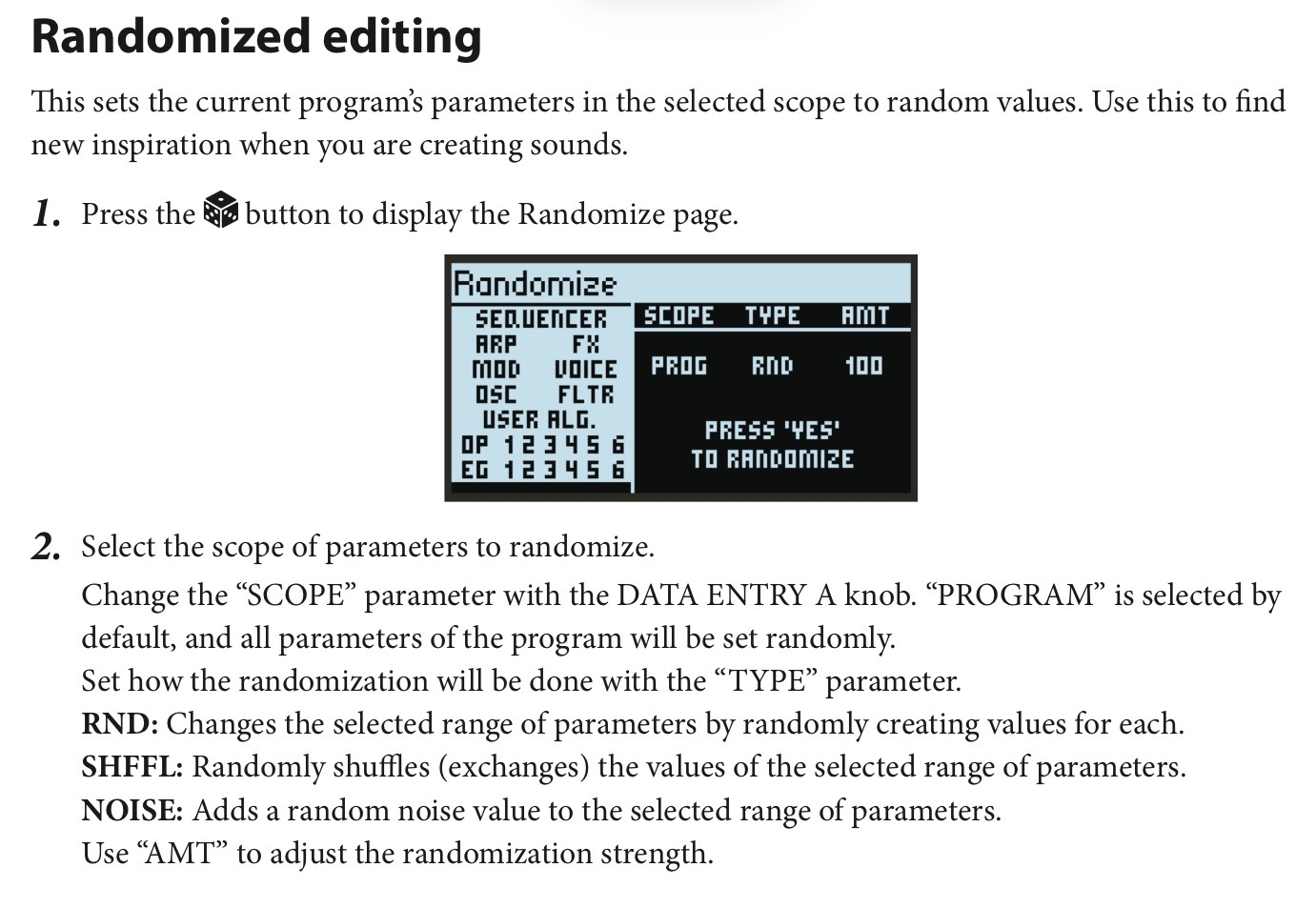
i paste a screenshot from the opsix manual
Just added a few more slots to the link. Anyone who misses out just shoot me an email and I’ll get you added.