Loopy Pro: Create music, your way.
What is Loopy Pro? — Loopy Pro is a powerful, flexible, and intuitive live looper, sampler, clip launcher and DAW for iPhone and iPad. At its core, it allows you to record and layer sounds in real-time to create complex musical arrangements. But it doesn’t stop there—Loopy Pro offers advanced tools to customize your workflow, build dynamic performance setups, and create a seamless connection between instruments, effects, and external gear.
Use it for live looping, sequencing, arranging, mixing, and much more. Whether you're a live performer, a producer, or just experimenting with sound, Loopy Pro helps you take control of your creative process.
Download on the App StoreLoopy Pro is your all-in-one musical toolkit. Try it for free today.
Comments
Thank you!
Focusrite Clarett Thunderbolt edition (not in production anymore) has 1.83ms RTL and I have that one and I can confirm it. On my MacBook pro late 2013 with TB2 I play PianoTeq or GuitarRig with 2,5 ms overall latency with like 256 buffer size and 96khz - 192k still available (connection and computing - I know there are different names for this I just forget them) witch is completely different story… Man you can monitor vocals with effects like reverb and delay on, eq and compression - perform it on stage.. like with normal analog ones. The scientific research prove that latency under 3ms is unnoticeable for humans (under it neurones have more latency any way) 5 or 6 ms are still fine - but really this 2,5 ms feels like playing actually real piano or normal sample base yamaha prs keyboard - you got what I mean, but you can apply various effects, layer it with other instruments etc.) and…
…in my opinion… 5ms RTL is really maxium you can have for comfortable and professional live play - everything above - even this what you shared 6,7 or 8 ms I would use just for recordings and post production. I know if the latency is constant (wich is more on Macs with core audio - on windows even with a great of its time Creative E-MU with asio drivers on windows it was fluctuating once 18ms once 24ms etc depends of the background apps and Windows itself) you can use to even 25 ms and play stable - but your reaction wont be as quick as possible could be - depends of style, genera and do you improvise or just play well know lines/riffs it could matter more or less.
So I suggest try to play on TB interface with MacBook - even air, or wait for more support on iPad. Ive bought iPad pro M2 - and I am afraid about possibility of connecting the Clarett TB to it…so I am looking for alternatives even I didn’t test it yet - not sure should I buy adapter just for test. I cant find anything on the Internet. Some reddit topic sugest there are few TB interface can already connect to iPad pro. I am going to use it mainly for midi keyboard so… I thing just usb-c to minijack adapter with audio synthesis on this M2 chip will give me better results than 8ms usb audio interfaces. Actually just a USB2 buss gives around 11 ms of latency - I see that motu has a special USB drivers to lower it (probably other companies too), nevertheless is this driver works on iPads? Only issue would be recordings/playing (amp and effects) of mics, and guitars that I play too Then you need the actual audio interface for inputs. Midi keyboards has the USB connection
oh.. and I ave been using MIDI cable connection for the 2,5 ms pianoteq settings - maybe it is important too if you thinking about playing the keys on stage (and I know I can use to even up to 25 ms stable latency for those who stands for their motu or other similar USB around 10ms latency is unperceptible or so - you need to try to play it under 3ms). Sorry for my English. Good luck!
Do I need an app to check latency? Can I just send a signal out, record it, then check the time difference between the original file and the recording?
You will find people using both methods in this thread.
Ok great, thanks. I'm going to do some tests today.
ESI Neva Uno

Pretty good results for such a cheap interface. Be aware that Hi-Z input is only 0.5MΩ.
Zoom AMS-22

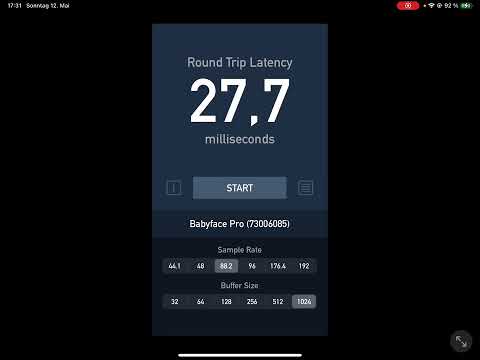
RME Babyface Pro FS, going through all sample rates and all buffer sizes:
Thank you for that report.
Interesting info
How would you see the latency on this
https://www.fender.com/en-US/guitar-amplifiers/contemporary-digital/mustang-micro-plus/2311600000.html
I CANT believe modeling went from the Kemper lunchbox to now what is the size of an e bow or like the size of a slide guitar - AND it’s an interface!!!
(@Gravitas look at this! Fender brand modeling and interface in your pocket dude, $130 quids)
I’m excited about this - like I have the best amp in the world but it’s in my studio and sometimes I just wanna connect my guitar to my op1F in my bedroom: and this would be perfect
@dokwok2 This test was made half a year ago. Yesterday the Zoom UAC-232 was delivered but for whatever reason (running now iOS 18.1.1) I was not able to capture a precise test. Could be the interface, could be an iOS bug, not sure: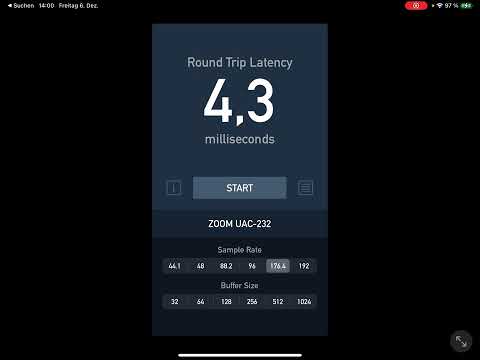
Btw the input dynamic range of the Zoom UAC-232 is impressive, see the video of Julian Krause: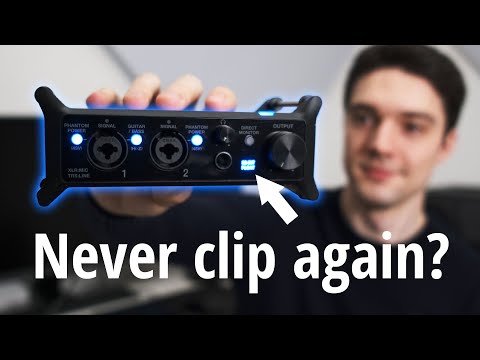
But I still would prefer an RME audio interface for routing options and built quality. Wondering if and when RME will build 32-bit float audio interfaces with lightweight small form factor.
I've just had a look and it does look very handy indeed.
I wonder if it has hum removal as well.
Added to my shopping basket.
Ooooh. Interesting.
There's a one-line reference to "Bi-directional USB recording". I wonder exactly what that means. There's no reference to anything other than Bluetooth audio in the video.
This should mean that this device is capable of working as a conventional audio interface.
https://www.thegearpage.net/board/index.php?threads/fender-mustang-micro-plus-stealing-boss-thunder.2587368/#post-39483347
I can verify it is not only an incredibly accurate modeler,. (Especially for fender amps ) it’s a very good interface
I was able to record both on iOS and directly into my op-1f
There are many options out there, but a compact, all in 1 modeler + interface + more , the size of your thumb , for only $130 - this is really above the competition atm
Fender knocked it out of the park, and they are slowly becoming a new favorite
Anyone who loves fender amps, needs a portable interface, no a micro interface, and a modeler - this is literally a game changer for me
@yellow_eyez You probably don't have the Onyx app, right? I guess I'm not the only one wondering how this Fender is doing with RTL values
Sorry dude. I don’t and wasn’t even familiar with that until you mentioned it but that’s why I asked here…it’s VERY low latency, but I wish I could say how much
So to measure the roundtrip latency without that app. I would play a audio sample from my DAW, take the audio output and feed it back in the input and record that sound. Is that right ?
Someone does have the Neumann MT 48 and can do an Onyx app latency check please?
Yes, it is.
If you have AUM, you can see the input and roundtrip latency listed.
Are you sure it is a real RTL value there? Because you need to measure whole audio path including audio interface output and input (loopback). I know that some apps are showing latency values but it is just measurement of software path.
I don't have AUM so I can't compare it with Onyx latency meter.
Yes, I doubt this is doable. I think this is only measurable with the cable method. Out > cable > input
Many audio interfaces are super profane and I wonder an all without the cable method would measure? Am I missing something?
I’ve been using u22 and u24 for ages now and at least for the last 5 years I haven’t been noticing much latency on latest iOS devices.
I agree with @KPazik that the reported latencies are often misleading because they’re not constant in time. I’ve played my guitar at 512 hardly noticing it and at other times 256 having an unplayable lag. This was often due to incorrect latency reporting with some apps.
This fortunately hasn’t been the case with serious apps.
Loopy Pro and Drambo have super lean engines with everything streamed out and on most recent devices they’re comparable to hardware in terms of latency IMO.
Latency is such a subjective subject though. I see people completely satisfied with of bluetooth midi on Korg nano series that to me is absolutely unplayable other than perhaps auditioning sounds.
We’re very blessed atm as things have moved a long way in iOS as well as interfaces and second hand market is saturated with very usable devices like Audient EVO 4 that I recently bought for £50. I also bought Alesis io 2 express for £20 which is not too shabby either although preamps are clearly better on the former.
Good times all around.
I like AUM for a lot of things, but I tested a number of interfaces about this time last year, and AUM's roundtrip numbers were optimistic. See page one of this thread for my history with testing...
Tx.
The only latency measurement equipment I care about are my fingers and my ears. I don't give a rip about reported numbers either way if I can play comfortably. Fortunately that's generally fine with my iPad for my purposes as long as I don't go overboard with the FX. If I do go overboard it's usually not for tight playing anyway, but for weird-ass noises and ambient textures where latency isn't a big factor anyway.
I'm gonna have to get this one at some point. It's just too tempting. I won't be too surprised if it goes back though. I have never been satisfied with any hardware modeler before. But it's worth a try.
(btw, there's something to be said in the latency discussion for offloading the amp modeling to the device. I wonder what the measurements would look like if compared to a signal path that includes software modeling overhead.)
@wim It’s definitely worth a try…I’m satisfied with these tones and I have an axe Fx iii…the fender tones are exceptionally well done. I like their mesa as much as tonex. Mind you my issue was portability, minimalism, and compacting form factor so this is a clear winner in this arena. I mean for once I don’t have to try multiple products or go hunting for something. I literally was like “damn man,..I wish I had a miniature modeler and interface that just plugged into the guitar and right directly into my op1F” and …..
Sure enough I didn’t know micro amps existed at all (been around 2-3 years or so? Someone please correct me if I’m wrong) but they have been advancing as a new niche for guitarist, and Boss has a great product but supply chains failed and then Fender came out with this micro plus [I was gonna get the irig Hd X w/tonex and amplitube for $100 but it requires connection..fender is self contained and BT]
It really is fantastic…I never thought I could just grab my guitar of choice , throw a thumb drive sized “tuner” in my pocket , throw in some buds/cans, and be totally equipped for either practicing solo or to plug into an amp; or even start recording with the interface into the iPad
Anyway, I think almost every guitarist should grab one of these; especially if you’re a fan of Twin Reverb, prince reverb, they even have decent hi gain
Oh.btw this also works as a DI preamp basically - fairly flat neutral signal to your plugin of choice on iPad (ie Nembrini)
FWIW, AUM uses the input/output latency reported by the interfaces. It is possible that some interfaces aren’t accurately reporting their latency.
yeh, gonna have to get one eventually. Shoot. Thought I was done with all that stuff.
I've managed to talk myself out of even getting the inexpensive Joyo American based on telling myself I didn't want to bother hooking it up and powering it. But just plugging the little sucker into my guitar and having it battery powered is tempting indeed. I'll never use the Bluetooth audio, but other than that it's right up my alley.
Now, if they just add in a 5.8Ghz wireless transmitter and receiver, we're really in business.