Loopy Pro: Create music, your way.
What is Loopy Pro? — Loopy Pro is a powerful, flexible, and intuitive live looper, sampler, clip launcher and DAW for iPhone and iPad. At its core, it allows you to record and layer sounds in real-time to create complex musical arrangements. But it doesn’t stop there—Loopy Pro offers advanced tools to customize your workflow, build dynamic performance setups, and create a seamless connection between instruments, effects, and external gear.
Use it for live looping, sequencing, arranging, mixing, and much more. Whether you're a live performer, a producer, or just experimenting with sound, Loopy Pro helps you take control of your creative process.
Download on the App StoreLoopy Pro is your all-in-one musical toolkit. Try it for free today.
Comments
About expressivity, I cannot resist to share here what sound designer and composer Lucas Goret did with Exquis and the Swam instruments ;-)
https://www.youtube.com/shorts/zeedfTEc9Ek
Yeah, as I say, Roli stuff wasn't problematic for latency but it did have other problems, including connection problems. I don't know if that's just always going to be a problem with Bluetooth mpe or whether it's due to something they didn't implement well.
If you really have a thing against batteries, I totally respect that. But yeah, cables are definitely not very appealing to me when using a midi controller with the iPad. I guess I'll stick to the touch-screen controllers we have, then, even though they don't have pressure sensitivity. Anyway, your device looks very nice, good luck with it, I hope you manage to be one of the few rare mpe success stories, as it's a niche full of abandoned controllers and companies, sadly.
And by the way for those who can have a cahnce to pass by the Knobcon in Chicago, Mike, our representative in the US will be there ;-)
Thank you for your support.
Yes, we don't want to deal with battery. it would have significantly increased the price of the Exquis (for all, even those who don't care), it's a big problem when it is at the end of its life, and even more, the Exquis LED are very powerful, because they have been chosen so you can play under the sun (hello producers who had to play on stage in summer with their Push). So the battery should have been very big, and also increased the weight of Exquis... .
But if you don't want cables between your Exquis and your iPad, I think CME did a nice job making a wireless MIDI connection, and then you just need to plug your Exquis to a regular power pack like the one uses to charge phones on-the-go.
Yes, I didn't want to go in that point, because it's been a long time we experimented with this. But that another good reason we stay away from wireless connection. 10 fingers on 10 keys, sending each millisecond three parameters at the same time... .
And just to be clear: Exquis was finally released with three axis of control: pressure, right/left bend (pitchbend) and up/down bend (CC74). We started the project with only two axis in mind and at the (almost very) end of the project, our 3-axis prototype was working so well that we quickly moved for a 3-axis device.
Wow, that looks really nice, especially for the price point.
As for BT, people can always get Bluetooth dongles. There not much more expensive than what that would add to the price, and are more flexible in that you can use them with other things.
That looks great! Let me clarify my point about expressivity: it's not that slides are necessarily better in that regard than the Exquis implementation, it just may be more natural for some and I think it's worth pointing out the differences to those considering their first MPE controller.
Personally, I was looking forward to the Aodyo Loom because of its size and price, I hope someone picks up the idea at some point.
This is probably the wrong place to put this but for anyone interested, I have a mint condition Exquis available in the U.S. Works great but doesn't fit my personal workflow as well as the Striso, which is a very different controller but fits me better for what I need it to do. Message me if you want more details. Or mods can delete this if it is out of bounds.
about configuration, in my case it is like @Bruno_intutive said. You don’t need to change configurations often. I think I just looked at the options in the desktop application, but didn’t change anything. Since then I used it mostly with the iPad with default setting.
The important things can be set in the Exquis itself. Sometimes I switch Pitch Bend Range off to focus on y-axis for specific sounds, and then back to 24 or 48.
Like all MPE controllers, there is a learning curve. It can sound horrible with high Pitch Bend and not fitting patch. Sound patches have to be adapted, etc. But I am glad to be past the initial phase, and start to play more intuitively. I think the design and firmware is very well made.
About the LED’s. They are very good. Good to see in daylight, and not too bright when dimmed down in the studio.
one thought about the hexagonal structure. It is somehow beginner friendly, because one can choose a certain pattern, let’s say a three-finger pattern, and translate this pattern up or left etc., which leads to changes or progressions that I wouldn’t dare to play, or wouldn’t find out easily on a piano keyboard. I can’t really play the piano keyboard, and for chords the hexagonal structure is advantageous for me.
On the other hand, for playing melodies, or expanding melodies (where I know the note I am going to play, but must hit the right key with certainty), the hexagonal structure often leads me to a wrong note. Melodies go easier on a piano keyboard, we are certainly more used and educated in these black and white keys. There was a feature request, to have the played notes dimming slowly instead of on/off, to make it easier to remember the keys.
This structure is another aspect of Exquis, which we don’t have in the Linnstrument, and in Sensel Morph only with custom layout (you have to fabricate it yourself) and programming. It’s a joyful new approach, attractive for beginners as for professionals.
Vibrato I find rather difficult to play. And you hear it in many demonstrations of the Exquis, Linnstrument, Morph, Continuum, Osmose, etc. It doesn’t sound bad, but it has this distinctive MPE controller vibrato, if you know what I mean. Except the player is well trained or simply a natural talent.
Thnx for the feedback Phil. Haha 'this distinctive mpe controller vibrato' 👍. In fairness that sound is really only the fault of the players. It's because you can push that vibrato so hard that many people do. They just need to listen a bit more to the way that vibrato sounds on acoustic instruments and to try not to go wild just because they can.
About the Exquis, which things need to be adjusted in the app because that can't be adjusted on the device?
Oh wow, I find much easier to play chords on piano than on the Exquis. I'm not trying to do on the Exquis the things I do on piano, but instead I love how they complement each other because, as you said, opens up ideas which normally I wouldn't have on the piano.
I also find vibrato pretty tricky to perform in the way I like.
Anyway, this is the new feature I was talking about. Amazing on some synths, like ATOMS.
https://youtube.com/shorts/YQI17z7f0lc
colourful custom layouts (never tried them myself), and some other things I don’t remember. In my case they are not relevant for using the controller. Sorry, I’m a bit lazy with testing all features as usual. I focus on learning how to play the silicon tabs (keys) of the Exquis, as well as have fun with new chord combinations.
At the Exquis forum there are examples of custom layouts.
@Gavinski the app is needed to define custom layouts and scales and order them for quick access in standalone mode. It is also used to set the sensitivity/velocity curves. Apart from that the app can be used for performances on desktop, but this is irrelevant for an iPad setup.
Thanks - curves are actually something it can often be useful to tweak, so it would indeed be nice if there was an iOS app or if that was possible on the instrument itself. Thnx again!
I had one and sold it a couple months later - the hardware was decent but the software still felt too “beta”. Put the funds toward a ROLI Seaboard M. It’s worked flawlessly with the PC and iPad via BT.
We are happy to announce that the Exquis 2.2.0 update has been released!
@vitocorleone123 you'll be happy to know the software had a lot of improvements.
New Features in Firmware 2.2.0
MPE Key Freeze: Captures the expressive state of a key or chord (X/Y/Z) to freeze a gesture and hold it indefinitely, allowing textures and sequences to be layered without losing the initial nuance.
MIDI Score Display: A feature that receives MIDI notes to display a score directly on the illuminated keys, making learning and visual accompaniment easier.
Pedal Compatibility: Supports sustain, expression, portamento, and soft pedals via the MIDI input, with corresponding CCs sent to MIDI OUT and USB.
New Sensitivity Curves
Better Handling of Off-Center Presses
Display of Internal Tempo and Firmware Version directly on the keyboard
Scripts for Ableton Live, Bitwig, and Reaper
Ableton Live Remote Script: A Python-based script integrates Exquis with Live 12’s native control system, enabling:
Clip and scene management without a mouse
Track arming, muting, and soloing
Access to volumes, panning, and effect sends
Automatic selection of layouts and presets
Display of MIDI notes from a clip directly on the keyboard
DrivenByMoss Scripts for Bitwig Studio and Reaper: Jürgen Moßgraber enhanced his DrivenByMoss extensions using Intuitive Instruments’ developer tools. These scripts provide smooth navigation between tracks, devices, and parameters, as well as direct control over clips, scenes, and mixing.
I purchased and like this device, I haven’t tried the new firmware yet. I shall tomorrow. For the $ I find this kinda hard to beat. I;Ike that it has a different vibe, it makes me write differently. An iPad editor would be nice.
Fantastic! It’s a device with a lot of promise and it makes me happy to see the continued development.
It’s definitely worth checking out for people who haven’t. I wouldn’t even rule out buying one again sometime down the road.
@Bruno_intutive Time to change the header of the thread as it's starting at an additional €100 now, quite a big difference, at least for me.
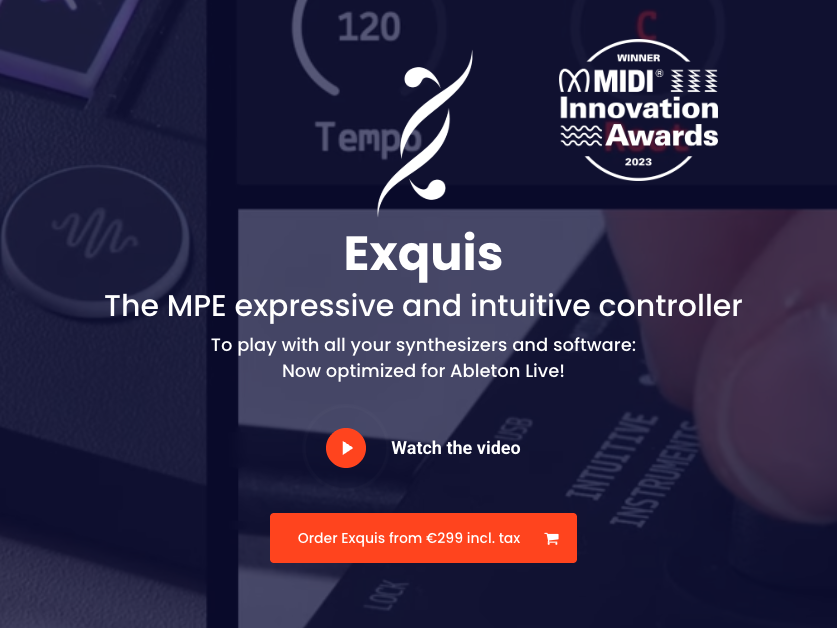
Thank you, it's now done. Yes the price was for the Kickstarter. Still at 300€ it's a bargain and each time we make demonstration, people think the price would be between 400€ and 500€. There is no competitor at this price, neither considering MPE compatibility nor hexagonal keyboard.
And unfortunately, the USD price will soon raise because of the current exchange rate.
Thank you! Yes we are thinking of a more compatible editor for any plateform.
Anyone have one ever use one?
https://dualo.com/en/
Seems pretty cool for a nonstandard music interface
[merged duplicate threads]
I'm Bruno from Intuitive Instruments, and if I can answer honestly to your question, I'll be happy to.
Hey @Bruno_intutive !, I really dig the Exquis, just one question: It can also work as a MIDI and CV interface for my iPad right? I think it should work, but Just want to be shure before I buy
could I get microtonal tunings out of that Exquis from my iPad to control a synth with CV/Gate?
speaking of microtonality, there are two modules and an example patch for Exquis in VCV.
https://library.vcvrack.com/PitchGrid/MicroExquis