Loopy Pro: Create music, your way.
What is Loopy Pro? — Loopy Pro is a powerful, flexible, and intuitive live looper, sampler, clip launcher and DAW for iPhone and iPad. At its core, it allows you to record and layer sounds in real-time to create complex musical arrangements. But it doesn’t stop there—Loopy Pro offers advanced tools to customize your workflow, build dynamic performance setups, and create a seamless connection between instruments, effects, and external gear.
Use it for live looping, sequencing, arranging, mixing, and much more. Whether you're a live performer, a producer, or just experimenting with sound, Loopy Pro helps you take control of your creative process.
Download on the App StoreLoopy Pro is your all-in-one musical toolkit. Try it for free today.
Loop Science

https://www.instagram.com/reel/DO3XOVogHHR/?igsh=MW5wNXFwdnZrOGhqdA==
Music looping improves pattern recognition. I mean the reality is loops are patterns. I have found this to be true with listening to minimal techno. Same with really catchy hip hop beats. I find myself super focused and productive in other aspects of my life 🙌
What are your thoughts?
Comments
While I believe and have experienced that learning and practicing any discipline will have some transferable residue of problem solving, the way that this AI voiceover makes it sounds like cutting samples would turn you into something out of the movie, Limitless, is laughable.
Just making sure what i posted isn’t intended as a dis. Maybe it is. So I’ll be fair and put myself out there. My personal experience listening and working with certain loop/pattern based music is more fleeting moments of spiritual and supernatural. Also seemingly quite laughable to others, i imagine.
Working with Drambo however…has helped me achieve promotions, troubleshoot complex machines, and has improved my sex life.
You know the craziest thing? When I googled to try to find info about research behind this, the Google AI blurb that appears at the top of the page seemed to confirm the idea expressed in the insta post. But then I clicked on the link which Google was using as evidence for the claim. What did it link to? Nothing other than that damn Instagram post lmao. I'd expect it to set the bar for evidence a little higher.
The AI blurb:
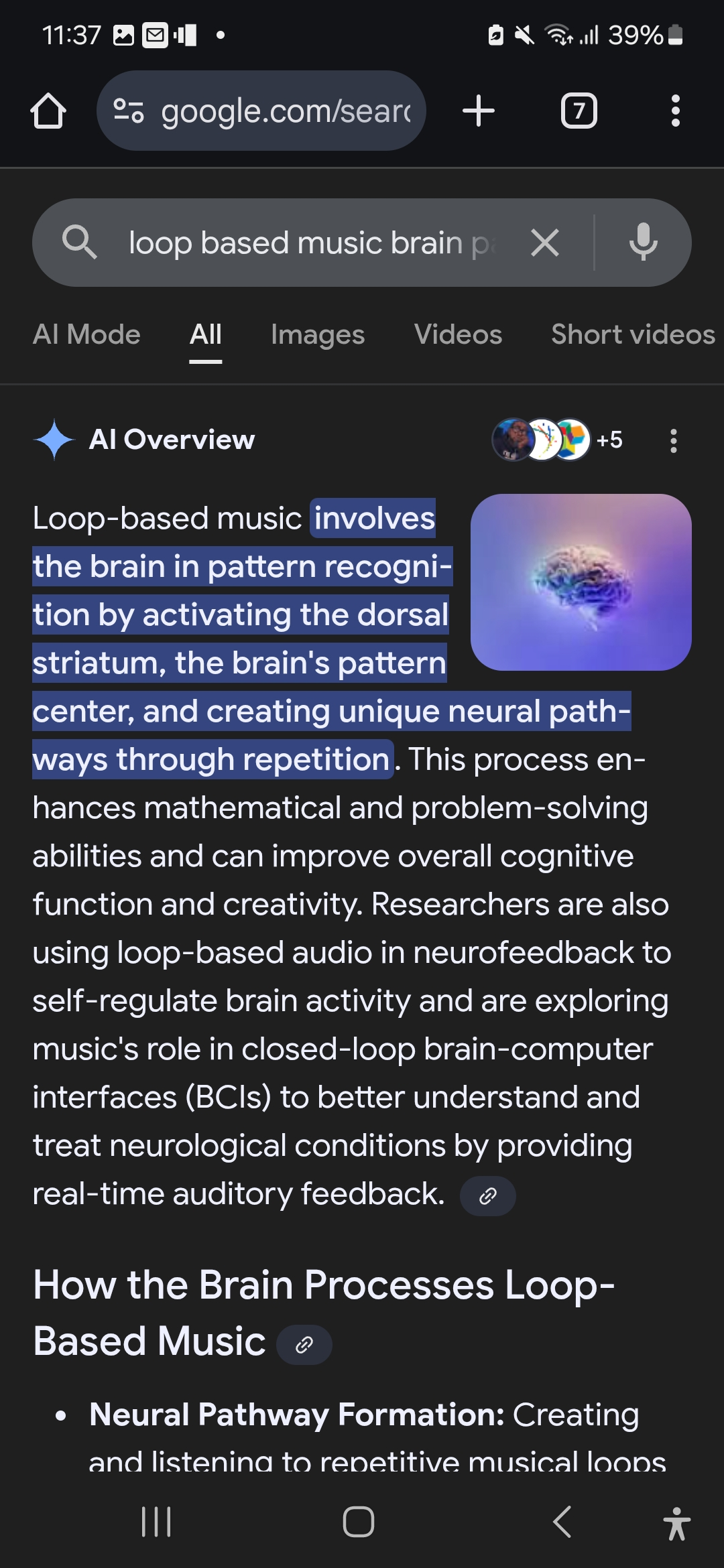
First link in the blurb:
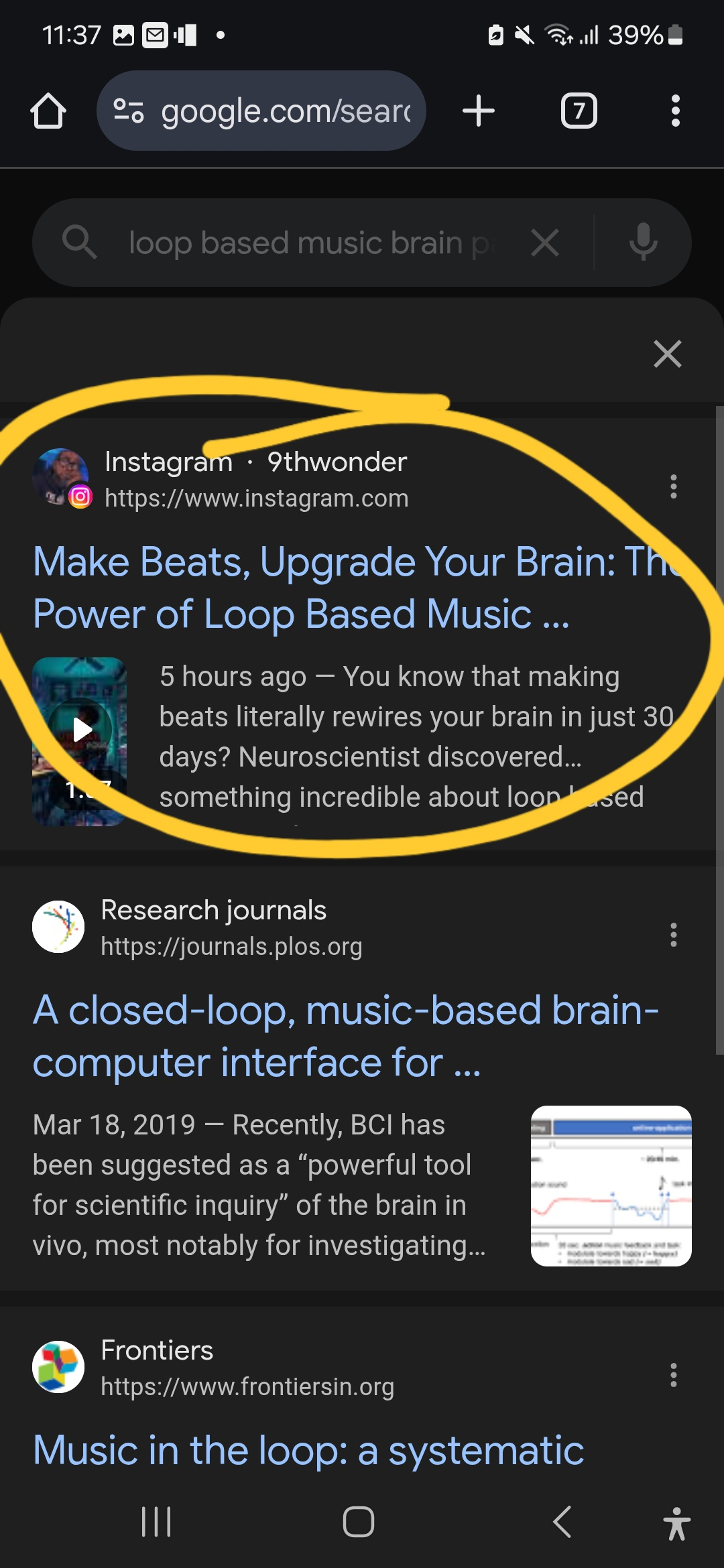
Again, not to say there's no truth to the claims in the video. Just that they sound a bit over-egged.
Oh wow @Gavinski, that’s hilarious!
This AI age will be interesting…
I agree with you and @Blipsford_Baubie.
I feel like we all see residual benefits from our music adventures, but AI could be amplifying questionable “scientific” findings.
I have found myself figuring out stuff I struggled with before and I attribute it to music making as well as figuring out synths and routing. But, it goes to what you said @Blipsford_Baubie its residual benefit from discipline itself.
I've always been taught that loop based music produces less frisson emotions, but it has shown to increase executive function.
OS-TI-NA-TO (on A)
"A continually repeated musical phrase or rhythm"
Looping can put us into a trance. But if the same thing loops over and over without some kind of evolving, notes or beats, that would get pretty tedious.
I’ve been interested in how long a loop can be before you can’t tell it’s a loop. I think there has been some research on that. Maybe it’s different for each person.
Pauses/rests or subtle timing changes can compliment a repeating phrase very nicely without the tension/anxiety that it prevelant in cyclical loops. A lot of classical music will use this timing offset to frame their compositions.
You guys need some aka pygmies in you life
Their rhythms in 24 are ootw
I mean, if you like brain tease and activating your "local stradivarius" then check out this chart I made a couple of year ago (it's mostly based off "The Geometry of Musical Rhythm" with a few tweaks). The aka pygmies are at the bottom under 24.
forgot to mention: steps/fill are the values to get these rhythms from drambo's euclidean sequencer
edit: updated picture because it wasn't the latest version
Heh, my brain has always worked in loops. So much so that when I first saw the rc-505, I realized that was for me. Loopy Pro feels like it was built for my brain from the jump
And working in restaurants, I've always repeated any calls in my head, over and over. It's the rhythm of syllables hitting that helps me remember
And it's been like this for me since I can remember
(Both my folks were music majors in college when they met and I'm an only child, so I'm certain music-related life lessons have been going on for decades without realizing xD)
The caretaker made science of loops and what they do to the mind.
Beautiful stuff.
So it's like brainwashing? For tweakers?
I also found that comment and went to the article.
I don't know how these AI posts still gets so many likes etc, I wish people would vote with their feet on this stuff, it's ruining the already ruined internet...
Even if that's all false AI-generated claims, the beauty is, it becomes true, when you believe in it(;
Speciffic about altzheimer.
Really good ambient.
@Gavinski bro, the internet is utter trash rn. My algorithm is absolutely infuriating.
i've been hating on this youtuber lizardchaser or something.
he goes around exploiting young drug addict homeless women and now my fyp is full of terrible shit.
@pedro that is a great cheat sheet. Thank you.
Just had a quick conversation w/Gemeni and got an interesting response:
When comparing looping (highly predictable) music to continuously evolving (novel) music phrases, the neurological benefits relating to executive function appear to be different, serving distinct cognitive goals:
Looping Music: Enhanced Focus and Reduced Cognitive Load
Looping music (such as lo-fi, trance, or familiar repetitive tracks) is often associated with a positive impact on sustained attention and focus because it requires minimal executive function resources for processing.
* Reduced Cognitive Load: The predictability of looping or repetitive music means the brain expends less energy processing new auditory information. This can reduce cognitive distraction, allowing the brain to allocate more resources to a demanding task, which is a key component of executive function.
* Aiding Focus: For individuals who find silence distracting, the steady, predictable rhythm and melody of looping music can act as a mental anchor, filtering out internal or external chaos and promoting a focused state.
* Emotional Stability: Familiar, repetitive music releases dopamine in the brain's reward centers, providing a consistent source of comfort and emotional stability, which can indirectly support better executive control.
Evolving Music: Sharpened Anticipation and Working Memory
Continuously evolving music (highly novel, complex, or continuously shifting) primarily engages the brain's prediction and working memory systems.
* Prediction and Anticipation: The brain is constantly working to predict the next note, rhythm, or harmony in complex or evolving music. When the music violates or confirms these expectations, it engages areas involved in attention, prediction, and event segmentation—processes that are central to executive function.
* Working Memory: Processing complex or unfamiliar music requires holding and manipulating multiple streams of information (melody, harmony, rhythm) simultaneously. This constant processing acts as an exercise for working memory and cognitive flexibility, which are core executive functions.
* Neuroplasticity (via Training): While mere listening to evolving music has benefits, formal musical training (which involves reading, interpreting, and performing complex, evolving pieces) is strongly associated with long-term, structural, and functional changes in the brain that enhance inhibitory control, working memory, and cognitive flexibility.
In summary, looping music is often beneficial for maintaining focus on a separate task by providing predictable background stimulation, while evolving music is better at actively exercising and sharpening core executive function skills like working memory and cognitive prediction.
I like Craig Anderton's (GOATed for computer-based music production, in my book) take that a loop and a riff are the same.
Looping and pattern recognition are both subjects of interest for me. I have this course, but haven't taken it yet - https://www.kadenze.com/courses/loop-repetition-and-variation-in-music-v/info
Video game soundtracks and lo-fi hip-hop are very popular for study music and background music when coding.