Loopy Pro: Create music, your way.

What is Loopy Pro?Loopy Pro is a powerful, flexible, and intuitive live looper, sampler, clip launcher and DAW for iPhone and iPad. At its core, it allows you to record and layer sounds in real-time to create complex musical arrangements. But it doesn’t stop there—Loopy Pro offers advanced tools to customize your workflow, build dynamic performance setups, and create a seamless connection between instruments, effects, and external gear.

Use it for live looping, sequencing, arranging, mixing, and much more. Whether you're a live performer, a producer, or just experimenting with sound, Loopy Pro helps you take control of your creative process.

Download on the App Store

Loopy Pro is your all-in-one musical toolkit. Try it for free today.

Blue in Green
Improvisation of the Miles Davis (or was it Bill Evans?) track.

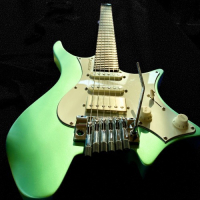
Strandberg Classic -> Nembrini Faceman -> Delay3000 -> IR Loader (YA Bassman cab) -> MagicVerb

Comments

  • Superb stuff, lovely playing…
    I had to dig into my memory banks (and YouTube) to remind myself of the version that John McLaughlin did on My Goals Beyond.
    I think I prefer your version 👌

  • Thanks, @GeoTony. Hadn't heard that version before, really cool interpretation and feel with the acoustic guitars. It's great that he's still around and playing so well at 83.

  • Beautiful. Great runs, too. Not familiar with this tune.

  • Great Miles Davis story about how this tune was created and who got credit and financial benefits. Of course, playing with Miles launched many jazz musicians into a very high tier in the world of Jazz. Miles gave pianist Bill Evan’s the chords G minor followed by A augmented and asked him to come up with something. Evan’s went home and wrote the 10 bar melody and complete chord progression. Miles treated the result in the way a corporation treats Intellectual Property generated by employees and claimed his ownership on the album.

    Who Wrote "Blue in Green"?
    The "recording story" is inseparable from the dispute over who composed the tune. This controversy is the real story behind the song.

    On the Album: Miles Davis
    On the original 1959 release of Kind of Blue, the composer credit for "Blue in Green," like all the other tracks, went to Miles Davis. For decades, this was the official record. In his autobiography, Davis claimed he wrote the song, stating he gave Bill Evans sketches for "Blue in Green" and "Flamenco Sketches."
    The Counter-Claim: Bill Evans
    Pianist Bill Evans and many of his peers told a very different story. Evans claimed that he wrote "Blue in Green" almost entirely. 
    • Evans's Account: According to Evans, Miles gave him two chords (G minor and A augmented) and simply asked, "What would you do with that?" Evans went home and wrote the entire 10-bar harmonic sequence and melody. 
    • The $25 Check: When Evans later approached Davis about a co-writing credit (and royalties), Miles allegedly wrote him a check for just $25. 
    • Later Recordings: When Bill Evans recorded "Blue in Green" on his own album Portrait in Jazz (also in 1959), he gave the writing credit as "Davis-Evans," a clear public statement of his contribution. 
    • Other Musicians: Drummer Jimmy Cobb, the last surviving member of the session, later confirmed Evans's version, stating, "It was Bill Evans's tune... Bill had wrote the tune 'Blue in Green'." 
    The Evidence
    Over time, the evidence has overwhelmingly tilted in favor of Bill Evans as the primary composer. 
    1. Harmonic Style: The sophisticated, introspective harmony of "Blue in Green" is considered a signature of Bill Evans's "impressionistic" style, which is distinct from Miles Davis's melodic and rhythmic focus.
    2. "Peace Piece": The composition is very similar in concept to "Peace Piece," a solo piano improvisation that Evans had recorded for his 1958 album Everybody Digs Bill Evans. 
    3. The "Chet" Intro (The "Smoking Gun"): The strongest evidence appeared three months before the Kind of Blue sessions. In December 1958, Bill Evans was in the studio with trumpeter Chet Baker. On their recording of the standard "Alone Together," Evans plays a long, improvised piano introduction. That intro contains the exact harmonic structure and core feeling of "Blue in Green." 
    Today, it is widely accepted in the jazz community that "Blue in Green" is a Bill Evans composition, even though Miles Davis was the one who conceptualized the album, brought the musicians together, and ultimately gave the tune its final shape and title. The Miles Davis estate has since officially recognized Evans's co-authorship.

  • I like this. It has a lightness and is looser than the McLaughlin. There’s a version for 5-string bass by Pierluigi Balducci that I tabbed. If I had another finger I might almost be able to play it.

  • I wanted to give you a “Like” on SoundCloud but it’s not playing nice at the moment, so… I like it! I’ll try later. I just listened to the Bill Evan’s Trio version. I like it on guitar, and your interpretation. Have you ever thought about adding an acoustic bass and making it a duet? I’m reminded of a night at Jazz Showcase in Chicago with John Abercrombie and Eddie Gomez.

  • Very nice, I wish I could play like you!
    Cool tone you’ve given it too, more drive than I was expecting but sounds great

  • @LinearLineman said:
    Beautiful. Great runs, too. Not familiar with this tune.

    Good to hear from you Michael. It's a beautiful tune and I love that it breaks the norm with a 10 bar head. Would love to hear your take of it. Thanks for chiming in.

  • @GeoTony said:
    Superb stuff, lovely playing…
    I had to dig into my memory banks (and YouTube) to remind myself of the version that John McLaughlin did on My Goals Beyond.
    I think I prefer your version 👌

    I didn’t remember that he had recorded this until reading your comment. Will have to listen to it.

    This is a lovely rendition of course.

  • @McD said:
    Great Miles Davis story about how this tune was created and who got credit and financial benefits. Of course, playing with Miles launched many jazz musicians into a very high tier in the world of Jazz. Miles gave pianist Bill Evan’s the chords G minor followed by A augmented and asked him to come up with something. Evan’s went home and wrote the 10 bar melody and complete chord progression. Miles treated the result in the way a corporation treats Intellectual Property generated by employees and claimed his ownership on the album.

    Thanks for the backstory, very interesting read and musical detective work.

  • @AndyHoneybone said:
    I like this. It has a lightness and is looser than the McLaughlin. There’s a version for 5-string bass by Pierluigi Balducci that I tabbed. If I had another finger I might almost be able to play it.

    Thanks Andy! I can't find that version online. Do you have a link?

  • @pbelgium said:

    @AndyHoneybone said:
    I like this. It has a lightness and is looser than the McLaughlin. There’s a version for 5-string bass by Pierluigi Balducci that I tabbed. If I had another finger I might almost be able to play it.

    Thanks Andy! I can't find that version online. Do you have a link?

    Here you go
  • Cheers Andy. That is beautiful!

  • Great to hear your excellent take on that.

    @AndyHoneybone said:
    Here you go

    Nice to hear this version. The percussion was interesting too.

  • @Paulieworld said:
    Have you ever thought about adding an acoustic bass and making it a duet?

    Thanks for liking and listening. That would be great - I forget that others can't hear the band playing along in my head. It would be good to have a real bassist, failing that any suggestions for a good double bass sound?

  • @MistaG said:
    Very nice, I wish I could play like you!
    Cool tone you’ve given it too, more drive than I was expecting but sounds great

    Thanks for the listen and the kind words, there's no better compliment. Yes, for a jazzy tone I like tweaking the Faceman to get just a little bit of breakup if I dig in, it's great for that and definitely my most used amp sim.

  • @pbelgium said:

    @Paulieworld said:
    Have you ever thought about adding an acoustic bass and making it a duet?

    Thanks for liking and listening. That would be great - I forget that others can't hear the band playing along in my head. It would be good to have a real bassist, failing that any suggestions for a good double bass sound?

    There is a great little app called Session Band. It provides actual professional session guys playing real instruments. There is a series of Jazz related versions with real acoustic bass samples. There are 4 Jazz versions, aptly titled Jazz 1 thru 4. You can select the chords on a measure by measure basis, similar to charts in The Real Book, and build out your bass accompaniment. It may not give you exactly what you want, but you can improvise and get some unexpected results. I have used it a few times and have thought… I wish I thought of that!

    I just posted something called “Where The Great Ones Run” that uses some tenor sax bits from the Jazz 4 package. I spent a few hours trying different things and I was reasonably satisfied with the results.

    Of course, there is another option. Enable downloads and let me play with it!

  • Thanks @Paulieworld. I'll take a look at Session Band. I didn't play with a click and my timing leaves a lot to be desired, so might be a bit difficult to sync. I enabled downloads, so feel free to play.

  • Thanks for listening @michael_m @MrStochastic glad you enjoyed it, much appreciated.

  • @pbelgium said:
    Thanks for listening @michael_m @MrStochastic glad you enjoyed it, much appreciated.

    I don’t come here every day, but I do check out your music when I see something new. Always good listening!

  • @pbelgium said:
    Thanks @Paulieworld. I'll take a look at Session Band. I didn't play with a click and my timing leaves a lot to be desired, so might be a bit difficult to sync. I enabled downloads, so feel free to play.

    Got it!

    I don’t have a chart for this. Can you tell me the approximate tempo and a few chords? If not, no problem. I’ll just wing it. That’s fun too, and the results can be unpredictable. Here is a similar collaboration that I did with @LinearLineman a couple years ago. He plays from the heart, and I can’t imagine him using a click track either. It’s still one of my favorites.

  • edited November 2025

    I had forgotten about this one. Good un.

    Btw, I usually play with a click track. Have a great weekend, Paul

  • @pbelgium : Nice chordal concept ! I’ve got some underground tapes of me playing with Bill Frisell back in the day. I’ve also recorded w Red Rodney and Chris Potter .
    Is that strat? Beautiful touch and I like those hammer ons at the end

  • @Paulieworld said:
    I don’t have a chart for this. Can you tell me the approximate tempo and a few chords? If not, no problem. I’ll just wing it. That’s fun too, and the results can be unpredictable. Here is a similar collaboration that I did with @LinearLineman a couple years ago. He plays from the heart, and I can’t imagine him using a click track either. It’s still one of my favorites.

    Yes indeed, that's a good one!
    The tempo is meandering around 78bpm, and the chords were from memory, but very similar to any real book version, such as this one.

  • @LinearLineman said:
    I had forgotten about this one. Good un.

    Btw, I usually play with a click track. Have a great weekend, Paul

    I can understand a click when you are arranging for multiple parts, but for pure piano improv I just thought you closed your eyes and let go. I have imagined you swaying back and forth as you play.

    We’re going to see the early matinee of Nuremberg this afternoon at Hollywood Boulevard. It looks like Russell Crowe put on 100 pounds to play Göring! I’ve read some good reviews. It’s a touchy subject. Should be interesting. I’ll be having my usual.

  • @pbelgium said:

    @Paulieworld said:
    I don’t have a chart for this. Can you tell me the approximate tempo and a few chords? If not, no problem. I’ll just wing it. That’s fun too, and the results can be unpredictable. Here is a similar collaboration that I did with @LinearLineman a couple years ago. He plays from the heart, and I can’t imagine him using a click track either. It’s still one of my favorites.

    Yes indeed, that's a good one!
    The tempo is meandering around 78bpm, and the chords were from memory, but very similar to any real book version, such as this one.

    Toots Thielmans? I don’t recall this being in my Real Book, but I haven’t looked at it in decades. I don’t even know where it is. This works. I’m finishing up a few other things and I’ll probably get into it next week or so. Thanks. Should be fun.

  • @Paulieworld said:
    Toots Thielmans? I don’t recall this being in my Real Book, but I haven’t looked at it in decades. I don’t even know where it is. This works. I’m finishing up a few other things and I’ll probably get into it next week or so. Thanks. Should be fun.

    Didn't notice Toots, will have to listen. This was the first image from google search. Look forward to hearing what you come up with.

  • @Telstar5 said:
    @pbelgium : Nice chordal concept ! I’ve got some underground tapes of me playing with Bill Frisell back in the day. I’ve also recorded w Red Rodney and Chris Potter .
    Is that strat? Beautiful touch and I like those hammer ons at the end

    Thanks for listening - you kept some real good company! What do you play? (I remember watching your rap video before.)
    It's a Strandberg Boden Classic NX6, which is basically an extremely light, ergonomic, headless Strat.

Sign In or Register to comment.