Loopy Pro: Create music, your way.
What is Loopy Pro? — Loopy Pro is a powerful, flexible, and intuitive live looper, sampler, clip launcher and DAW for iPhone and iPad. At its core, it allows you to record and layer sounds in real-time to create complex musical arrangements. But it doesn’t stop there—Loopy Pro offers advanced tools to customize your workflow, build dynamic performance setups, and create a seamless connection between instruments, effects, and external gear.
Use it for live looping, sequencing, arranging, mixing, and much more. Whether you're a live performer, a producer, or just experimenting with sound, Loopy Pro helps you take control of your creative process.
Download on the App StoreLoopy Pro is your all-in-one musical toolkit. Try it for free today.
Question re midi cc

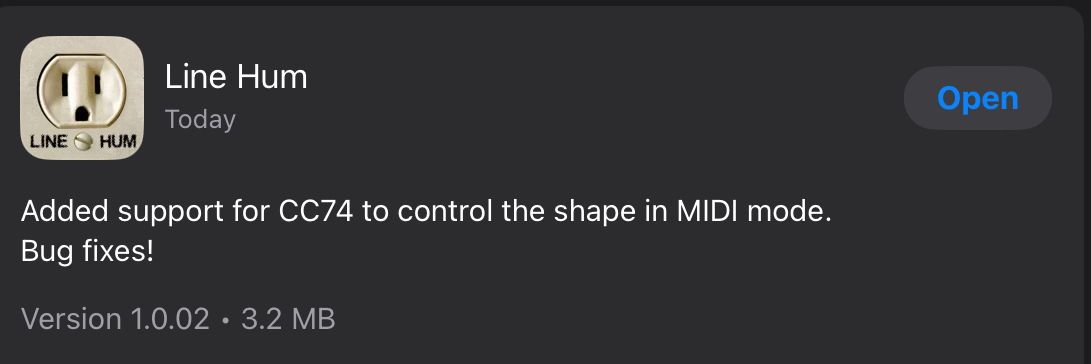
Can anyone help me understand this? I was under the impression that CC values were functionally identical, and that you could assign any one of them to any CC-mappable function. But why is CC74 specifically mentioned?
I know there are some standard assignments, but I assumed that was just a proposed mapping you could use if you wanted easy uniformity across devices… thx
Comments
It may be mentioned simply because the developer elected to hard-code it rather than to provide a midi mapping/learn functionality.
I'm guessing your question has more to do with AUv3 parameters, which can be mapped to any CC, than with this direct CC control. The difference lies in whether you send the CC to the plugin itself or you send the CC to the host's parameter control system.
MIDI originally had recommended purpose names for all the CC numbers. Compliance wasn't required for these assignments, but they were somewhat generally adopted. CC 74 is "filter cutoff" in the original schemas, and is still commonly used for that. The wave frequency shaping is pretty similar to what a filter does so I'm guessing that's why it was chosen.
btw, CC 74 is the most commonly used CC for MPE expression, though MPE has no applicability here.
https://anotherproducer.com/online-tools-for-musicians/midi-cc-list/
Thanks for the explanation. Where would I find in (for example) AUM or Loopy Pro an indication that there is that hardwired association? I assume that both AUV3 parameter control and direct CC control can be implemented in both, right? And is the latter a higher resolution? Sorry, a lot of questions, haha
Couldn’t the purpose of this be to accommodate MPE controllers that send CC 74?
Could be, but I don't really see how MPE is applicable to an app like this.
You wouldn't find that indicated anywhere in any host. A host has no way of knowing what internal CC mapping a plugin might implement. As far as I can see, the only place this is documented at this time is in the release notes for the update. The online manual for the app is pretty complete, however, so I'm guessing it'll updated there as well.
AUv3 parameter mapping is free-form as you already have seen, so that's a separate route to automate the plugin, and behaves the same no matter the plugin.