Loopy Pro: Create music, your way.
What is Loopy Pro? — Loopy Pro is a powerful, flexible, and intuitive live looper, sampler, clip launcher and DAW for iPhone and iPad. At its core, it allows you to record and layer sounds in real-time to create complex musical arrangements. But it doesn’t stop there—Loopy Pro offers advanced tools to customize your workflow, build dynamic performance setups, and create a seamless connection between instruments, effects, and external gear.
Use it for live looping, sequencing, arranging, mixing, and much more. Whether you're a live performer, a producer, or just experimenting with sound, Loopy Pro helps you take control of your creative process.
Download on the App StoreLoopy Pro is your all-in-one musical toolkit. Try it for free today.
A thread of improvised orchestra sketches
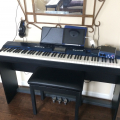
I go to the Casio and improvise a MIDI performance into PainoTeq 9. Then move the MIDI file
Created into LK in AUM and assign instrumen apps with added reverbs and EQ.
THIS IS MY FIRST EFFORT:
I loved the chord progressions of the early Joni Mitchell songs from the “Ladies of the Canyon” era when she lived with Graham Nash and played with David Crosby.
I improvised chords and a melodic thread that reminds me of her early songs where the chords informed the lyrics in very unique ways. Then I imported the MIDI file into AUM and assigned a collection of apps.
Comments
👂🏻 👍🏻
Sound great ! Worth developing further more !
Emoji to the rescue!
Thanks.
THIS IS MY SECOND:
I picked the G Phrygian Scale as my binding theory and let ‘er rip.
Well, dang. The first one is really nice--organic and flowing but still interesting and provocative. The second one has major mood added to all the same characteristics as the first one. I love what you are doing here. More please.
Thanks for the positive feedback!
I didn’t play today but I thought I’d place one from my past that follows this improvise at the piano and later rendered the resulting MIDI into an orchestra sounding project:
I do recall I “fixed” a few notes in the MIDI and rendered using StaffPad but the core notes all come from that piano improv:
I decided to create a mental movie that needed a score. I choose a Shark Attack on a Scuba Diver. The shark wins.
It’s hard for me to believe that comes from this:
And another…
After all of the effort you put into orchestrating these my favourite is the piano version of shark vs scuba 😊
You can hear (or better relate to) the human making choices… I’ll upload both so you can just point to them one based on preferences. I’m sure only a couple diehards like yourself will bother… but I prefer sharing your n assets neglected thread so I can check on my progress.
Assigning apps is easy because I have just the one midi source. I reuse the AUM project and swap midi performances and tweak app choices or mix the recording adding brass, etc.
Keep going, bro. You need some percussion as you’re a percussionist.
Thanks for checking in.
As you may recall… MIDI expects sync to a clock for these piano improvs and I don’t so the MIDI sync to a drummer would drive me crazy. Now… I did recently purchase some e-drum (table top) so I could add drums as a realtime exercise.
I think I might turn on a drummer loop on the Casio and making something that I could add a Lumbeats app or 3.
I support that endeavor.
Very instructive to hear the before and after @McD. I think I’ll steal your idea of using Pianoteq’s capture feature - very immediate and unobtrusive.
You’ve got me thinking. Does the intention to orchestrate influence your keyboard improvisation style?
Knowing your previous sketches have used StaffPad and traditional orchestration, that was what I was expecting but your approach here is a much more direct way of adding colour.
‘Sunrise’ particularly reminds me of playing a Crumar Multiman back in the wild pre-MIDI days. It layered piano with strings, paraphonic brass and a sub bass. I wonder how your pieces would sound if you setup AUM with that kind of palette and improvised directly with those sounds?
Thanks for sharing your workflow.
How the heck did I miss this thread?
I’m working my way through, but gotta say I really like the first track ‘Thinking of Joni’.
That shark DEFINITELY got that scuba diver! Haha
It’s wild the ideas we can get across simply with sounds.
Lovely thread, keep um comin @McD
I have a WIDI (Bluetooth) adapter on the USB output of the Casio so there are no cables needed to capture a MIDI file… the use of PianoTeq does provide a quick review before moving the file to the iPad to try assigning apps.
I have almost always played alone… the one time I played with a bass player he complained saying “I feel like there are 2 bass players”. So, my left hand just lays down root-5th-octaves and it’s a weakness but it’s also general practice for orchestrating chords. I’d say my accompaniement style of keyboard to support singing pop songs and jazz ballads really makes this transfer of ideas work.
But @linearlinemans almost 100 albums of piano/keyboard improvised projects proves there’s no limits if you can really but both hands to work and play more polyphonically using more techniques like scalar runs, arpeggios, chordal movements and so much more than my rudimentary piano techniques.
I just got tired of using the pencil and the hours required to polish up a complete work that approaches film music. The range of articulations and fine finish details in StaffPad is still the best approach for the money. Poor StaffPad ran out of revenue and “merged” with Muse Group and were waiting to see if they do anything to advance the product. So far the only gesture is allowing libraries purchased to be credited on the Windows/Mac MuseScore installs after you send them proof of purchases from the App Store… a handful of people have reported getting that done. I have almost every library on IOS but do NOT care to give up the touch/pencil app interface. So. not much value for me yet after the “merge”. They basically got the technical benefits of the StaffPad tech team to give MuseScore articulation support which cannot be communicated via MIDI unless the tech team invents CC mappings to switch instrument recordings on the fly. Imagine hand coding CC events to add accents, staccato, legato, etc. So mich more pain than just writing traditional notations which is obviously how the orchestra still functions. But I do wonder how much music on Film/TV is computer generated and only one person was required. Video Game scores tend to go this way since sound engines are a part of their world and the music should just be times along with sound effects or dialogue.
I know that I have at the point a half dozen AUM projects that I could then leverage to try new improv’s that are rendered right now into my headphones… keyboard/WIDI Bluetooth in AUM/midi assignments already in place. I wonder how that might influence my “realtime” composer vs hearing the piano.
Feel free to add anything you generate to this thread… I like the idea of threads based on group contributions and until someone else does this will remain a vanity project but we can encourage each other by sharing work.
My piano efforts for years were intended to include those “Joni Mitchell” open tunings that create beautiful harmonic ideas of the French impressionist composers like Debussy, Satie, Ravel, etc.
She fingers out that adding jazz musicians to make a band her music could advance way beyond her instrumental capabilities and become a group experience… Pat Matheny, Tom Scott, Jaco, John Guerin, etc.
I considered the treatment of the shark from “Jaws” but decided NOT to do the shark bassline.
The story of the first shark attack in that movie inspired some myths (research via Google Gemini… searching with plain language prompts is great but is severs the link to the information sources) so Google trades ad revenue for paid searches and the information repositories only get scrapped and integrated into that AI database):
The swimmer in the iconic opening scene of Jaws (1975) was Susan Backlinie, a professional stuntwoman and actress.
Contrary to the long-standing Hollywood urban legend, she did not win a lawsuit—nor did she ever file one—because she was not actually injured during filming.
The Reality vs. The Myth
For decades, rumors have circulated that Backlinie suffered broken ribs or a broken hip due to the harness used to pull her through the water, and that her screams of "It hurts!" were real.
• The Legend: The harness was pulled so violently by the crew that it caused physical trauma, leading to a massive legal settlement.
• The Fact: Susan Backlinie herself debunked these rumors many times throughout her life. She maintained that while the shoot was exhausting and the water was cold, she was a trained professional and was never injured.
• The Technique: To get a genuine "startle" reaction, Steven Spielberg did not tell her exactly when the first tug on the underwater cable would happen. However, the side-to-side thrashing was a coordinated stunt she practiced and performed intentionally.
About Susan Backlinie
• Role: She played Chrissie Watkins, the shark's first victim.
• Background: She was a champion swimmer and animal trainer, which is why she was cast for the physically demanding role.
• Legacy: Spielberg later paid homage to her iconic scene by having her "attacked" by a submarine in his 1979 comedy 1941.
• Passing: Susan Backlinie passed away recently on May 11, 2024, at the age of 77
I really love your piano improvisations. Unexpected chord changes that evoke strong emotion. As I listen, I think… Damn, I wish I thought of that! I have been jumping back and forth between them and can’t help but think they are all part of a much larger composition. Similar to what we did with the “Sketchbook” collaborations a few years ago.
Any plans for the weekend? We are going to a place called Cooper’s Hawk for their famous Brunch and Bubbles. They have a steak and egg dish that is to die for. They also make their own wine. It’s also extremely good. After that, I will probably spend the rest of the day putzing around with a few new things. It’s a bit chilly, but the sun is out and the grass is getting green. Hoping to sit outside and get started again after a long winter.
I recently posted a remix of Tribes that we collaborated on a few years ago. I made it a bit “heavier” and it’s been getting a few plays. Have a nice weekend!
You have described the intention of my piano excursions… I seek surprises in chord choices and tend to use the upper color notes like 7ths and ninths or neighbor resolutions. Eventually you get a handful of “tricks” or rather a vocabulary. I can exhaust my vocabulary pretty quickly and they do tend to repeat these tricks but I’m still searching for new ones or hoping to stumble on a useful mistake.
Thanks for listening and asking questions too… which at this point are long past due for a reply.
And so there’s another…
Brass this time…
And another… I hear echoes of the first effort “Thinking of Joni”. The similarities come from the knowledge embedded in my fingers from years of repeated hand movements. Really good pianists have a lot more movements due to playing more piano music or practicing the rudiments of music: scales, broken chords, patterns as applied to scales and chords.