Loopy Pro: Create music, your way.
What is Loopy Pro? — Loopy Pro is a powerful, flexible, and intuitive live looper, sampler, clip launcher and DAW for iPhone and iPad. At its core, it allows you to record and layer sounds in real-time to create complex musical arrangements. But it doesn’t stop there—Loopy Pro offers advanced tools to customize your workflow, build dynamic performance setups, and create a seamless connection between instruments, effects, and external gear.
Use it for live looping, sequencing, arranging, mixing, and much more. Whether you're a live performer, a producer, or just experimenting with sound, Loopy Pro helps you take control of your creative process.
Download on the App StoreLoopy Pro is your all-in-one musical toolkit. Try it for free today.
Is swing standardized?

Simple question: is tempo swing standardized or does each developer apply their own interpretation/solution?
Will a certain percentage of swing applied in one app be compatible with the same percentage applied in another app?
I realize that swing can be applied based on different note increments in some cases (sometimes with an option to switch between them) and presumably that could cause problems but as a basic principle, is it standardized?
Comments
in my experience across desktop, hardware, iOS: no
it may line up, but there's no guarantee (and that's not necessarily a bad thing!)
week or two ago I was studying info about this topic ... thing is basically all DAWs are following method invented by Roger Linn in 1979 for LinnDRUM .. which means shifting second 16th note insite 8th note.. not "official" standard but basically everybody follows this idea ... Some then add next layer to it - "groove templates" where with some UI user can intentionally choose the shit offset / randomnes of shift for selected notes
Amongs intentional swing described above, there is also "jitter" caused by HW imperfection of old machines, which is basically random shifting from precise grid - that's what some people reffer as "speciffic groove of machine XY" ...
Just to add to that, as far as standard or not standard, Linn's approach is pretty much standard but how its labelled is not. So in some software what Linn labelled 50% they label 0% as an example of those differences, because to Linn, half way between the 8th note was 50% and that is equal to no swing, lol. It's worth sticking to just a couple of implementations for a while, and measuring what the settings actually do to the exact midi timing in your DAW, such as in Logic, where the A B C D E F amounts of 16th swing add 20 (out of the total 120) to the exact position. Some swing implementations don't let you go far enough I've also found, if you ever aimed for LA beat scene post-dilla wonky mayhem. Ableton Live interestingly specifically implements MPC grooves so you can check these out. The Linn percentages went up by 4% each time, but if I remember correctly, and I don't have Maschine in front of me to test, if you implemented those percentages in Maschine they are not the same amount. I could be wrongly remembering that though, and it might be another platform, but certainly from platform to platform what they call things are not the same. If some vendor decides that 66% is totally swung someone else comes along and calls that 100% but then lets you go up to 200%.
Yes. But can you explain why the focus is on swinging 16th notes?
The term "swing" originates from jazz rhythm, I believe, and in jazz I think swung eighth notes are probably an order of magnitude more common than swung sixteenths.
https://en.wikipedia.org/wiki/Swing_time
Why in the DAW world does the focus seem to be sixteenths?
Mostly because that's where you hear, or more importantly, feel it. It's all about the off-beat stuff - that's where the swing is. The 1/8, and 1/4 are on the on-beat.
Fun aside, 52% is great for not obviously sounding swung, but just gives something enough of a feel to get people moving. I think Roger Linn may have even said something along those lines.
Edit: should have clarified, in the context of implementing swing in a 16 step sequencer.
Further thoughts...
The 16th note swing thing is probably a compromise in the context of a 16 step sequencer that can't apply swing to individual tracks / lanes - basically early drum machines.
So by applying swing to only the alternate (2, 4, 6, etc.) 16th notes, you get the desired effect, whill retaining the main groove of your beat, i.e. anything on the 1, 3, 5, etc., like your kick or snare.
So 16th note off the back of a hardware compromise / limitation, and we just got used to it, so expect it I guess.
Interesting Topic!
Has more to do with Dilla (swing) but nonetheless interesting read:
https://www.brltheory.com/analysis/dilla-part-ii-theory-quintuplet-swing-septuplet-swing-playing-off-the-grid/
I wish I could choose that, but my shit offsets my state of flow at random. Oh wait, you meant shift offset. 😂
🤣🤣🤣🤣🤣🤣🤣
Thanks to everyone who’s commented so far, I really appreciate the thorough answers - I had no idea that the implementation of swing in this context was largely based on work done by Roger Linn - really interesting, thanks for the education.
I totally get why the topic comes up, but it seems so, so strange to talk about swing in such mechanical terms. Swing is about feel, not precision, and definitely not consistency.
It feels like discussing standardizing the mechanics of kissing. 🤙🏼
That said, I'm as lazy as the next guy, and use mechanical swing all the time. I really appreciate GR-16 and Prism sequencer that have loads of options for different swing grooves.
Aw, @wim, I didn’t realize you were such a romantic old hippy!
Whilst I agree it’s ideally about the feel, I’m clearly asking about swing as applied in software. Whatever those chat bots are telling you, the machines can’t feel the groove man! They rely on the zeros and ones behind the scenes.
As such, it’s not strange to ask whether this approximation of swing is standardized is it? I just wanted to know whether swing applied in one app would be compatible with swing applied in another.
As for discussing standardizing the mechanics of kissing, unfortunately I bet the people making the sex robots of the near future are constantly having such discussions!
All you gotta do is ever have played the blues for it to feel ... weird to think of "standardized" swing.
No, it's not a strange thing to ask about in the context of how most of us make music these days. I get it.
It's just ... paradoxical? And a little sad too, for some reason.
Yes, I agree, it’s definitely paradoxical. Machines trying to emulate something that is instinctive to us by trying to tie it down and quantify it is definitely a little sad, especially with the way things are heading.
Personally, I think of swing as it is implemented in software as something, frankly, different from swing as it is when music is performed by people. That little swing dial or slider in software is, to me, just something which does something to the feel of the rhythm: if it gets closer to what I want, great, if not, I’ll leave it off. I don’t think of it as actually adding swing such as you’d get with a group of live performers. As such, I was curious as to whether this thing in software was standardized?
Yes, of course it’s ridiculous to think of standardized swing in the real world. But my viewpoint is that what is in software is not really swing at all, it’s just a function that has very optimistically been called swing. Standardized or not, it’s not the same thing.
Loopy Pro's groove quantize feature is one of its coolest, though largely overlooked features. You can use it to analyze an audio or midi file and create a groove from it that can be applied to other tracks to quantize it. It works better with MIDI but can work to quantize audio too. It's a great way to steel a feel.
Ha ha! ... steal a feel ... I just realized what I said there. 😂
Oh, cool. I wasn’t aware of that feature; I’ll definitely be checking it out, thanks for highlighting it. Cheers.
And, certainly in electronic musics its a very significant dimension, the sound of so much of both house and hip-hop is foundationally underpinned by machinic swing. Just now I heard Blaze "Journey", and it couldn't be more apparent, it needs to be a groovy machine at work, sometimes duetting with then what the human plays along to the swinging machine, which is not exactly the same as two groovy humans at work, I believe.
Yes, although not the same thing as swing in real life performers, it certainly can yield results and those machines can indeed be extremely groovy in their own way!
I think 8th vs 16th swing is a stylistic thing. Modern dance music always (well maybe not but probably) has 16th not swing. Older slower swing jazz is often 8th note. If you think of that kind of music, it's generally 8th note. Think of the feel of something like the pink panther theme. Neither is right or wrong. A lot of sequencers only offer 16th note though. I'm alway pleased when there's 8th not swing coz I love the vibe.
Yes, it’s a shame that having both options is rare.
Patterning 3 has some pretty unique ways of playing swing. There is a video somewhere...
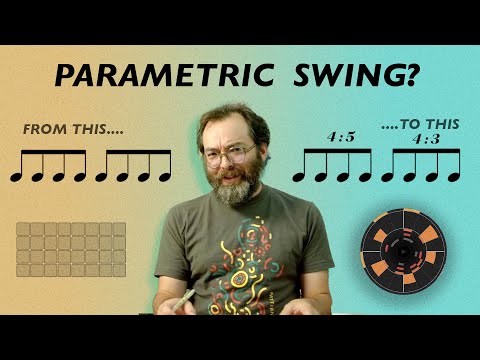
Yeah, I remember being interested in this when it was released. Too expensive for me so I haven’t tried it myself yet!