Loopy Pro: Create music, your way.
What is Loopy Pro? — Loopy Pro is a powerful, flexible, and intuitive live looper, sampler, clip launcher and DAW for iPhone and iPad. At its core, it allows you to record and layer sounds in real-time to create complex musical arrangements. But it doesn’t stop there—Loopy Pro offers advanced tools to customize your workflow, build dynamic performance setups, and create a seamless connection between instruments, effects, and external gear.
Use it for live looping, sequencing, arranging, mixing, and much more. Whether you're a live performer, a producer, or just experimenting with sound, Loopy Pro helps you take control of your creative process.
Download on the App StoreLoopy Pro is your all-in-one musical toolkit. Try it for free today.
Mela 7.11: Build Flexible Effects with Splitter

TL;DR: Mela 7.11 introduces Splitter, a powerful module for multiband, stereo, and parallel processing. Get 40% off Collections until July 16.
Mela 7.11 introduces Splitter, a new Mela Lab module for building flexible signal-processing chains. It works like a Stack, but submodules at alternating positions act as splitters: each one processes the incoming audio, passes its output to the following submodule, and sends the remaining signal to the next splitter. The final output combines all processed signals with any residual left at the end.
This design makes it easy to build multiband processors with filters, process left/right or mid/side signals independently, crossfade between processing chains, or separate transient and sustain processing with an Envelope Follower. The update also adds a Free mode to Arpeggiator, improves the Stack and Unison interfaces and signal flow, refreshes Chorus, Flanger, and Phaser, and includes several patch and workflow refinements.
For the full details, check out the Changelog.
Splitter Tutorial
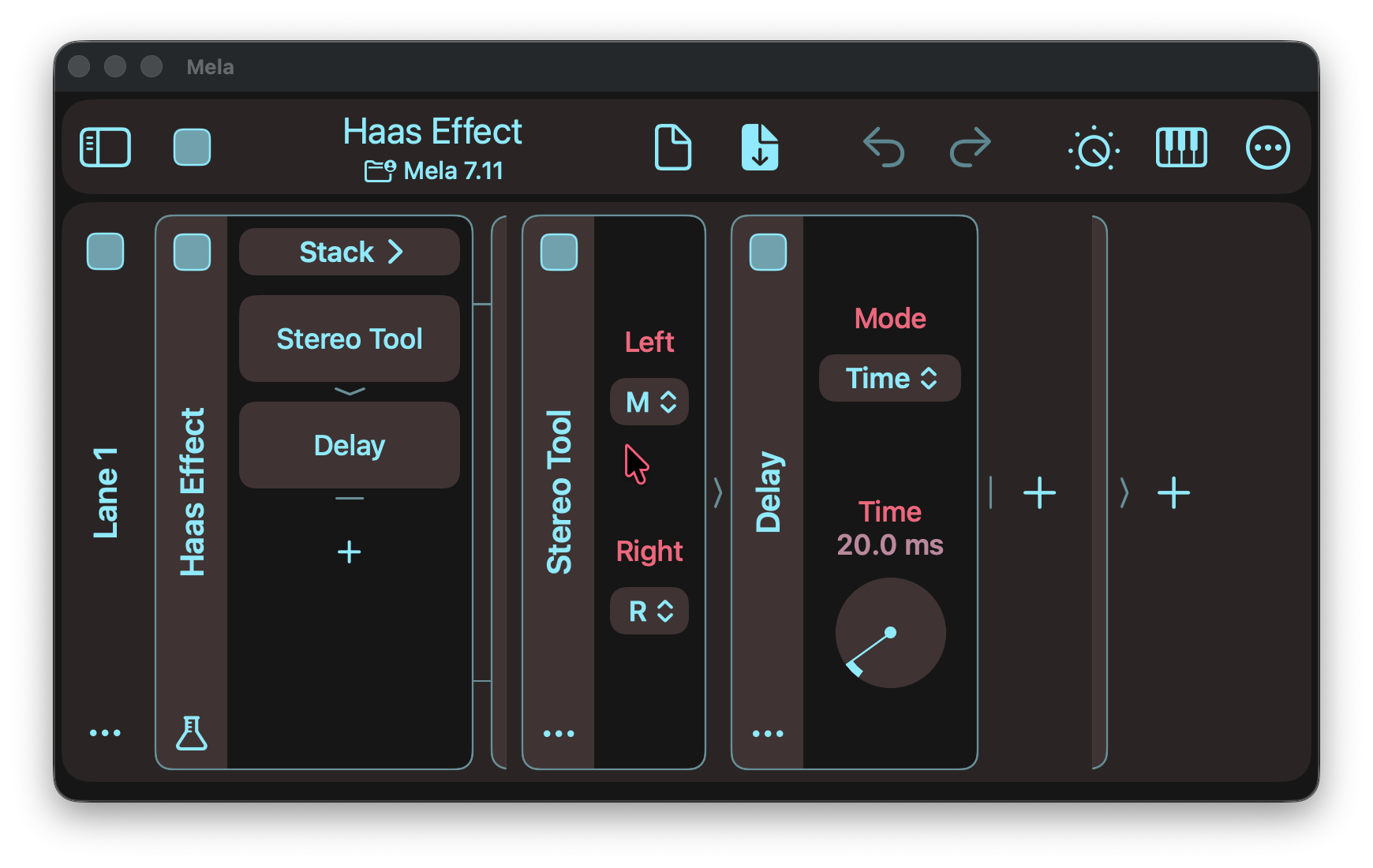
This tutorial demonstrates three ways to use Splitter: building a two-band processor, creating the Haas effect by independently delaying the left channel, and separating transient and sustain processing by using an Envelope Follower to modulate a Level module.
Splitter
- The Splitter module works like a Stack, but the submodules at odd positions, starting with the first, act as audio splitters.
- A splitter processes its input and passes its output to the following submodule.
- Subtracting that output from the original input leaves a residual, which is passed to the next splitter and processed in the same way.
- The module's output is the sum of all processed signals and any residual remaining at the end.
- The Splitter module can create many types of effects.
- Using filters at odd positions creates a multi-band processor.
- Stereo Tool or Mid-Side modules enable independent left/right or mid/side processing.
- A Level module can act as a crossfader between two processing chains.
- Modulating the Level module with an Envelope Follower makes it possible to process transients and sustain independently.
- Added Splitter as an option to the Nest submenu.
- Factory Patches: Added a “Haas Effect” subpatch demonstrating how easily the effect can be created using the Splitter, Stereo Tool, and Delay modules.
- Splitter is a Mela Lab module and part of Collection 4.
Other Changes
- Arpeggiator: Modelled after Mod Steps, the Sync parameter now includes a Free mode, letting you instantly play and hold the note selected by Position, ignoring Mode, Gate, Offset, and Retrigger.
- Arpeggiator: Smoothed the animation when switching to and from Manual mode.
- Unison and Stack: Improved interfaces with stack item selectors now also showing signal flow indicators and the add module button, allowing modules to be quickly appended to the stack.
- Unison and Stack: Modulators, Audio Out, and MIDI Out now respect the On parameter of their containing Stack or Unison module.
- Frequency Shifter: The Mix parameter now defaults to 100%.
- Chorus, Flanger, Phaser: Updated their layouts to match newer modules, improving their appearance and making them more compact.
- Nest Submenu: Added Digital Delay as an option to quickly insert the selected module inside a Digital Delay's sublane.
- Level Meter: Now correctly displays an empty meter and −inf before the host starts processing audio.
- Patches: Empty Untitled and restored patches no longer show a discard confirmation when selecting another patch.
- Patches: Saving a factory patch now asks for confirmation before overwriting a patch with the same name in the destination folder.
- Modules: Dropping a module back into its original position no longer creates an undo action.
Grab Mela from the App Store.
As always, let me know if you have follow-up questions 🙏
Comments
Awesome, thanks!
🙏
Mela 7.12 simplifies its core concepts by renaming the Group module to Lane. Since Group already represented a lane in practice, a top-level lane is now simply a Lane submodule of the root Stack. MIDI Group has likewise been renamed to MIDI Lane, making the terminology more consistent throughout the app.
The update also expands Mela’s polyphony from 8 to 16 voices and updates Voice Activity to display all 16. Collapsed lanes now remain in signal-flow order, Arpeggiator’s Manual and Free modes keep the active note indicator visible, and several patch-handling and stability issues have been addressed.
Changelog
Renamed Group to Lane
Group already represented a lane in practice, so renaming the module to Lane greatly simplifies the core concepts. A top-level lane is now simply a Lane submodule of the root Stack. For consistency, MIDI Group was also renamed to MIDI Lane. Note that the patch migrator will not rename modules with "Group" in their title, although the module type will change to Lane.
Other Changes
Grab Mela from the App Store
I asked to increase the poly and you did it! @Nikolozi You are the best!
Sorry it took me a while : )
Woohoo, more polyphony! Thank you, Niko. 🤗 Does that also mean more colors in the near future? 🤦♂️😅
Haha, the colouring feature remains an unsolved problem. But as always, I'm optimistic that a good solution will present itself as Mela keeps evolving. I don't want to rush unless I have something good.
My personal preference is to get rid of themes completely, maybe just have a dark and light mode. And then the user can select highlighting colours for modules in a patch, from a selection of 8 or 16. Similar to how you can rename any module.
Similar to how Logic Pro works (on Mac, at least), you can't change the theme, but you can select colours for regions, tracks, and channels.
Everything other than a fixed color theme sounds good to me. Because of how much content and how many updates you’ve released recently, I feel like a spoiled brat for just asking about this feature. So, just stick to your plan, everything will come together sooner rather than later. 🤗