Loopy Pro: Create music, your way.
What is Loopy Pro? — Loopy Pro is a powerful, flexible, and intuitive live looper, sampler, clip launcher and DAW for iPhone and iPad. At its core, it allows you to record and layer sounds in real-time to create complex musical arrangements. But it doesn’t stop there—Loopy Pro offers advanced tools to customize your workflow, build dynamic performance setups, and create a seamless connection between instruments, effects, and external gear.
Use it for live looping, sequencing, arranging, mixing, and much more. Whether you're a live performer, a producer, or just experimenting with sound, Loopy Pro helps you take control of your creative process.
Download on the App StoreLoopy Pro is your all-in-one musical toolkit. Try it for free today.
iOS Synths VS. Desktop Synths Redux
A while ago I posted a question about the quality of desktop synths vs iOS synths. Again, I'm not a synth guy, so I'm just curious. But this is a demo of the one of the popular desktop synths, Nexus. It's a Rompler. The samples in it sound amazing to me. Maybe I don't know what I'm talking about, which is quite possible, but can iOS synths sound this good? This is the latest demo.
Comments
@rickwaugh
The vs. question is maddening and fun. That's a great sounding demo for sure.
One thing: running Posiedon into the desktop via Musicio sounded better (same cans) as it sounds on my Air 2.
Which says nothing except how odd I am.
Personally I can't hear anything there that could not be done on an iPad. Maybe not by one app, but a few apps and some fx etc.
Part of it I'm sure is that that's got some pretty stellar production done on it. Someone has written/mixed/tweaked, who really knows what they're doing. Which is of course perfectly possible on the iPad. But synth music is not my favourite, and that demo makes me listen.
Yes they can!
(but i don't like Nexus's sounds really...)
But since we again in such a thread... i would like to have Dune 2 really on an iPad Pro for some reasons.
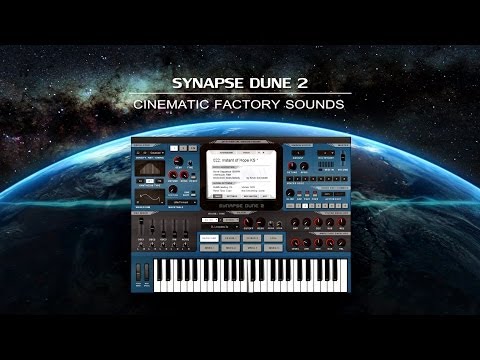
It´s of course a matter of taste but as a fan of cinematic sounds i found this here one of the best single synth demos ever:
The creator, Kevin Schröder is one of my favourite sound designers as well.
You compared it to the sound that's coming out of your ipad heaphone jack?In this case,it's true.There is a highpass filter on the output that developer can bypass since iOS 7.1 but practically it seems almost nobody is doing this.Auria has a setting for it and it's the only one i know of.
here's some insight:
http://auriaapp.com/forum/viewtopic.php?f=19&t=13384
That's some gorgeous stuff, @Cinebient.
It´s my favourite synth today (with my new toy Equator). I know there is also a huge update coming soon... I created myself some patches for it and i can confirm that there is no iOS synth in this league. Then you have of course synth like Zebra HZ, Falcon, Omnisphere..... hehe but for some reson i really love Dune 2 more then those.
The UI could fit for a touch screen too
I'm not a user of desktop synths really, but from a logical point of view there are (to my mind anyway) two big differences between IOS and desktop software. The first is raw horsepower - and I think that IOS is catching up quickly on this, and machines such as the iPad Pro probably have the power to run most desktop synths, if they were made for it. The second is that many desktop instruments have huge sample libraries, and with the more limited storage on IOS systems, this is a major difference. Heck, the biggest IOS storage is 128Gb which is still very small by today's desktop standards.
To add another to what Phil said. iOS also limits single app ram use.
I agree here. But there also some amazing sample instruments which have just a few GB f.e. like Kinetic Metal (Kontakt Library) or fantastic sounding physical modeling synths like Sculpture or Prism.
But i think the main reason why we don´t see such tools is still the bad "pro" apps market on the store without demos etc. etc. .... see another thread.
Ios' ecosystem lets you explore quirky https://en.m.wikipedia.org/wiki/Quantum_discord entanglement by nature.
Thanks @Crabman That makes total sense (thanks for not saying how obvious this was!)
"Sound this good" or "sound as good" … A rather broad way to put it.
A ROMpler is just playing back samples from storage media. If the same software instrument were available for both platforms with the same sample size/rate, etc. it is generally going to sound exactly the same. We see this with instruments like Synthmaster or other instruments that offer both a desktop and mobile version. Sometimes a company will make their iOS version limited compared to the desktop version (like iMaschine vs. desktop Maschine -- that is because NI basically just wants to make their iOS instrument a teaser version to try to get you to interest in their expensive software/hardware hybrid, Maschine ). But in other cases, like Synthmaster, or some Korg products, and others, companies offer equivalent products. Occasionally there may even be a product made for iOS that offers something you can't get on desktop. Case in point: Oriental Strings. I wish they would make a desktop version of it.
The comparison of iPad vs. computer increasingly makes less sense. The iPad is a computer. It may have less storage and memory, and a less full featured operating system, but it is only a matter of time until the iPad offers the kind of power of today's laptop. The Macbook Air and iPad Pro are already getting close to parity. One of the biggest limitations has been the i/o. If Apple were to offer a USB-C port or Thunderbolt port on a tablet … It will happen eventually.
Currently desktop systems are more "powerful," and more versatile and that translates into "sounds better" in a general sense. But if an iPad had the same specs and i/o, you could run full DAWs, plugins, ProTools, etc… It's all just a question of production costs, Moore's Law, etc. Computers will continue to get cheaper, thinner, lighter, and more powerful. Tablet vs. desktop will eventually come down to a mouse vs. touchscreen UI preference.
Yes, exactly. Connectivity is the main issue.
But will Apple set the IOS devices free by using a standard interface like USB-C or Thunderbolt ? I think not...
@Lady_App_titude, the economics also don't make it simple. Nexus is close to $300 for the basic package, and the complete deal with all sample packs is $3k. And people buy it, and the new sample packs that come out. That company is not going to have much interest in porting their stuff to the iPad, where they'd be lucky to get a tenth of that. And I fully understand Moore's law, I'm an old IT guy. I also understand that at some point, it really doesn't matter any more, because the human ear is not going to be able to detect the difference.
So, the interesting question is, at this point in time, for a hell of a lot less money for software, can you get that quality of sound from the iPad. If Apple makes it easier to work with the iPad, (such as being able to move more files around and off and on the platform, faster I/O, more input ports, etc.) and there is no discernible difference in quality, it's going to at some point kill the desktop market. I don't know if Apple cares one way or the other. Or whether other things would keep that from happening.
Still the problem is the appstore and iOS.... and for some interesting tools a desktop will always have more power, space and ram.
And who will create an awesome solo instrument over years and sell it where people complain if it's over 20 bucks?!
These are still 2 very different markets and i don't see a change here soon.
How could i download huge libraries.... from the app store!
So, where is the full Synthmaster f.e.?
I must say i didn't saw any major steps forward in the last years in iOS. It's still a (good) smartphone OS!
Fabfilter's Twin 2 costs $154 on desktop, and on iOS comes with Auria Pro for $50. Thor is on the desktop with Reason for $399 , and $15 on iOS. I don't know how many differences there are between the different versions, but I would argue there are "desktop" quality synths on iOS (even though I would hate to define what that actually means). Certainly, less computing power on iPad can cause limitations, but how much longer will that be true.
In the end, it is the maker of the sounds that will influence the song more than the tools.
Well, at this point in time, in some cases you can, like with Synthmaster, or Korg iM1. I don't know Nexus, but that demo just sounds like pretty common EDM type synth sounds -- that is to say, it isn't using massive orchestra or piano libraries, where desktop still has a clear advantage. It seems like you could get pretty similar sounds w/ Synthmaster for a lot less money.
Basically at present, there are pros and cons (and price is a big one) on both platforms. For me, I use both desktop and iOS. I have a lot of $ and learning invested in desktop (NI Komplete Ultimate, UAD, etc.), so I am not going all iOS anytime soon. At the same time, there are some really cool iOS products... The big hurdle for me was i/o, and MusicIO (which I use) or Studiomux was the big break-through there. Hopefully the next iPad Pro will offer something better than Lightning. For the present, I like how KV331 rolls, so I recently bought both the desktop and iOS versions of Synthmaster for cheap and can use both as needed.
The baseline for iOS apps started out as FREE utilities for a phone, so that's how we got to the point were $25 looks super pricey for iOS but an incredible bargain for desktop. The desktop DAW started out as a replacement for hundreds of thousands of dollars of hardware studio gear, so $399 looked like an incredible bargain. Who knows how technology and economics will sort out things out in the future. For the digital-age composer/musician, the far bigger economic problem is how to make money from the completed recording, however it was produced.
I see the argument of economics a lot when comparing IOS with the desktop - you can get X for the desktop at $200 but it only costs $20 on IOS, so how can developers afford to make great things for IOS. But that is only half the story. The cheaper an app is, the more it will sell, and 10 sales at $200 is the same revenue as 100 sales at $20, or indeed 1000 at $2. There are no unit costs with software, so all of that revenue contributes to your margin. Plus there is negligible piracy on IOS, certainly not true of Windows (I don't know about Macs).
To use Osidenick's examples above, and a very limited sample base (ie. Me!), I have Thor on my iPad, I don't have it for the desktop. I will soon be getting Auria Pro, but I don't have FF Twin 2 on the desktop. Why? Bacuase they are cheap enough to justify as a relatively casual purchase, which is not true of the desktop equivalents. So lower prices don't necessarily mean lower total revenues. Just something to keep in mind.
It would be interesting to do sales comparisons between, for instance, the desktop DAWs and iOS DAWS. Obviously, aside GarageBand, and Cubase, (sort of,) they would be different products. But I wonder how many folks are purchasing on iOS.
True, but also true that i don´t had to even spend money for zillions of VST. I mean i could use all the demos (most of them have full functionality beside save presets etc.) and record them as audio.
Of course a great part is the direct contact you have with some developers which you havn´t inthe app store..... beside forums like this here
The fact is, we have one Desktop grade synth inside Auria Pro (Twin 2), and one in the App Store (Thor). That's the current state of things. There are the Korg ones, good in quality but still lacking functionality, so that couldn't really compete. On the other hand, touch interaction has, in itself, lots of potential (think about Geoshred, and also how many iOS synths has quite useable X/Y pads - which are hell to use with a mouse if you don't have a proper controller for them). Honestly, i think that when the HW gets there, synths on touch devices will actually a superior overall experience.
P.S.: about the two Desktop grade synths for iOS, I am not really sure Thor is a full port. Twin 2 is, and it really pushes the iPad's CPU to the limit.
P.P.S.: Synthmaster is a synth just like Sound Canvas is a sampler. That is, it's not a synth but a player of synthesised sounds (a good one, while a bad one would be Novation's Launchkey).
Many of Virsyn's synths are also ports of desktop synths: Poseidon, Cube and Tera.
Full ports, with the same complexity and power?
Z3ta+ is my fav. port. Full power etc. But the big boy ports (Thor, Z3ta, Cube, etc are mostly of 10 year old synths...)
Is this really true ? From memory, I've seen audiophile sites commenting on the ipad's headphone output with no reference to this.
@Igneous1 there is some internal processing on the iPad headphone out according to multiple devs that have mentioned it in the past. On my iPad 4 running iOS 7 it was extremely noticeable: the same headphones plugged in to the iPad headphone socket had a lot less bass than when plugged into the Scarlett 2i4 via the Lightning port. These were Senn HD25s, so easily driven phones that don't require an amp.
However on my iPad Air 2 running iOS 8 I can no longer hear the difference - not sure if it's the iPad model or the OS that has caused the change.
Did you read the link i've posted?If Rim doesn't know it...who else in the iOS world? That said,i never made a real comparison in Auria.I'll do that soon (or maybe anybody else) and report back.