Loopy Pro: Create music, your way.
What is Loopy Pro? — Loopy Pro is a powerful, flexible, and intuitive live looper, sampler, clip launcher and DAW for iPhone and iPad. At its core, it allows you to record and layer sounds in real-time to create complex musical arrangements. But it doesn’t stop there—Loopy Pro offers advanced tools to customize your workflow, build dynamic performance setups, and create a seamless connection between instruments, effects, and external gear.
Use it for live looping, sequencing, arranging, mixing, and much more. Whether you're a live performer, a producer, or just experimenting with sound, Loopy Pro helps you take control of your creative process.
Download on the App StoreLoopy Pro is your all-in-one musical toolkit. Try it for free today.
Comments
Did the new Hillman Synth inspire this thought experiment?
What the dvck! 🦆 If this technology gets into the wrong hands, we could wake up one day surrounded by an army of robot ducks! For the sake of future generations, we must act now... 😂🦆🦆🦆
[...]
Wavefolding, waveshapping, wave multipliers. Lots of stuff like this in West Coast synthesis if that's the idea you are getting at.
I remember seeing a demo of an analog synth that did something like this. It inserted portions of triangle waves into PWM square waves. I can't remember what synth it was though. It sounded cool.
Nope. I was just thinking about different ways of mixing sounds together to make new sounds. Then I started to wonder about other ways sound could be mixed, and that led to wondering about the four different speakers playing four different waveforms.
That in turn led to thinking about ways of constructing waves that didn't involve much "mixing".
Then I started to think about stringing single cycles of different waveforms together, and what that might sound like.
Now because of the Duck, I'm thinking about the sound of a duck quacking.
It begins...
Thanks! Though I’m proud of the 23 subscribers to my YouTube channel. (Actually 9... if you subtract family and friends).
Ok. This musing made me think of that new app, with its 4 oscillators.
I am thinking the mixing part kind of happens naturally, no matter what you do.
As soon as sound hits the air, it becomes single complex waveform.
Even if you remove all electronics from the scenario, a string quartet all playing at the same time produces a single complex composite sound wave.
That's cool.
Now I'm thinking about an iOS synth that has an oscillator section that you can press a button, and it opens up a waveform editing sequencer .
At the top of the waveform editor are squares with all the standard waveform shapes, and room to import custom ones too.
Below is a grid of squares.... Lets say the grid is 4 rows deep, and each row is 16 squares long.
It works like a step sequencer, and as you push the waveform symbols at the top of the screen, they appear in the squares in the grid starting with the upper left. Then you keep adding any waveform shape you want, and string them together one after the other.
Each row represents a separate oscillator. So this synth has 4 oscillators.
You can enter waveform shapes into all 4 rows (oscillators) the same way.
There are buttons you can push while editing the oscillators. One button at the beginning of each row will let you hear what your combination of waveforms sounds like in that row. And another button at the top that says "Sound All" which lets your hear all four oscillators together.
You can program just one or two oscillators if you'd like.
After you exit, the synth uses your oscillators to make patches same as other synths do.
It amazes me that old fashioned vinyl records could use a squiggle little groove and a record needle (stylus) to reproduce the sound of an entire orchestra.
Ducks are cool. My grandmother used to give me stale bread to feed the ducks at a nearby lake when I went to visit her as a kid.
Vector synthesis is effectively just a four channel mixer. It might be arranged like a joystick pot, but you'd get the same result with four separate mixer knobs. In fact, slightly better, as you'd be able to reach into the corners.
Incidentally, my old wtfknobs on ivcs3 explored an area quite close to this topic, I looked at the adding of signals and the levels controls, and suchlike. Ivcs3 is ideally suited to these sorts of thoughts as the levels are controlled as they go out of a module, rather than as hey come in to another module, and you can just mix signals on the patch matrix by plugging them together on the same bus.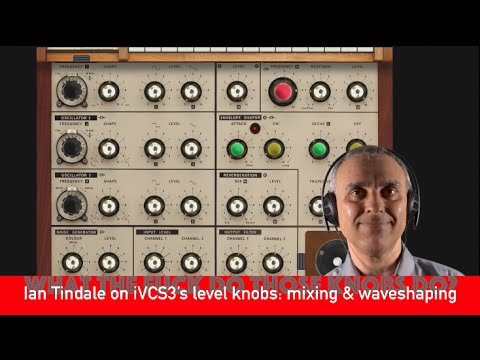
On modular synths you could make a step sequencer go through its steps fast enough to make audio frequencies, to draw a custom waveform, and make a custom shape vco. In theory it sounds a lot more exciting than what it sounds like in practice- an analog synth with some interesting eq applied. The reason, seems to be how we hear tones, as fundamentals and then various overtones at diminishing volumes as you get to higher harmonics.
You might have already learned that you can make say, a square wave, by starting with a sine wave (the waveform with no overtones/harmonics) and adding in another, quieter sine wave at 3 times the frequency of the original, and a quieter one at 5 times, 7 times, all the way up to ~32, something close the limit of human hearing.
https://lpsa.swarthmore.edu/Fourier/Series/WhyFS.html
Which is the basis of additive synthesis (like Addictive Synth), you make your synth waves out of sine waves tuned to be various overtones (“partials”)- it sounds the same, but you have control over the amount of each overtone. The weird thing, and feel free to disagree, this is a personal observation, is that it seems like the phase relationship between the fundamental, and the overtones isn’t very important, to the ear, as long as the phase relationship isn’t shifting. It changes the shape of the waveform on an oscilloscope dramatically but pretty much sounds the same. I think that’s why it doesn’t sound super unique to use a step sequencer at audio rates to make custom vco shapes, you’re just kind of shifting the volume of different overtones/partials, but it still makes a constant tone.
AnalogKit is very cool for these kind of projects, I built a sort of tutorial synth that added all of the sine waves together to get square and triangle waves, but you have a switch to turn each overtone off and on to get mutant waveshapes. Cool, Casio kind of tones from taking some out and leaving others. It would be straightforward to build your waveform switching vco in AnalogKit, you would just use an analog switch to switch between VCOs, at half the frequency of the vco. Casio actually did this in the CZ series synths from the 80’s, it sounds cool, but again, just an analog synth sound with a different eq feel.
Suming of different waves is something completely totally different than FM synthesis. Not ever remotely similiar.
This is crucial. Yes, listening at a distance - it would be totally same. No chance you can pass blind test and distinguish between one speaker / multiple speakers configuration. No chance.
You can, at least if you stand off-axis because the four speakers in the described configuration will have a more directional effect. But anyway, what's the point?
Depends on distance .. i think there is some math combined with neuroscience which can tell you exact distance breakpoint, where it is physically not possible for brain to distinguish it .. some ratio between distance between speakers and distance of you from speakers ..
something like breakpoint, at which, if you are watching sound source (let's say you wathing somebody claping hands) you stop "see" and "hear" in sync ...
anyway, nerd stuff, of course
Ignore the spatial separation of the separate speakers, that's a red herring. I'm sure the original poster would have specified four magic speakers which magically occupy exactly the same space, if they felt it would make sense without subtracting credibility.
Ah yes, thanks, of course. It was so obvious I forgot to specify this in case it wasn't obvious.
This is quite possible in case they are in form of tesseract. In that case then really occupy same space in our 3D world...
That's correct.
My premise for the hypothetical experiment is to compare a listener's perception of different waveforms mixed either by an electronic mixer Vs. the same waveforms each connected to it's own sound emitting device.
For the experiment to be perfect all four speakers would have to occupy the same space simultaneously, yet the sound emitting elements would remain completely independent from each other without mechanically interfering.
By summing I mean....
Example. Take two waveforms, a sign wave. and a square wave, both playing in the same phase and frequency.
Draw each waveform on a piece of graph paper with time measured horizontally, and amplitude measured in voltage vertically. With positive voltages above the center "-0-V line", and negative voltages bellow it.
Working with a third piece of graph paper. Sum the voltages of the two waveforms by each time interval, plotting the result on the third piece of graph paper.
Would the resulting wave shape on the third piece of graph paper be the sum of the two waveforms?
Sure it's a pulse. But isn't the resulting exact wave-shape the sum of the voltages of the sign wave and the square wave?
(EDITED)
Let's say were looking at "440 cycle per second" wave forms.
We want to divide our graph into 20 intervals of time per cycle.
440/20 = 0.00227
1 second divided by 0.00227 = 2.27 milliseconds for one cycle.
2.27 milliseconds divided by 20 = 114 microsecond intervals.
We proceed down the graph interval by interval, filling the sums of the voltages of the sign wave and the square wave at the same time interval from there respective graphs.
When we are finished, we have the sum of our two waveforms plotted on a third piece of graph paper.
Is this correct or not?
>
You'd be entering the realm of chip-tune sound-design where the sound shaping parameters are rapidly changed in 1ms-20ms intervals using tables or the realm of wave-table and wave-sequencing with changed happening at slower speeds...
PPG WaveGenerator does exactly what you've described and well...
...If the snippets are short and somewhat 'random' it would sound like metallic noise and if the same waveform repeats it gets rhythmic elements
I messed up the math but I fixed it. (I think)
Yeah, and having control over what gets played and when
(This is why I'm picky when it cones to control over start-phase of oscillators and lfos. It's all about having absolute control).