Loopy Pro: Create music, your way.

What is Loopy Pro?Loopy Pro is a powerful, flexible, and intuitive live looper, sampler, clip launcher and DAW for iPhone and iPad. At its core, it allows you to record and layer sounds in real-time to create complex musical arrangements. But it doesn’t stop there—Loopy Pro offers advanced tools to customize your workflow, build dynamic performance setups, and create a seamless connection between instruments, effects, and external gear.

Use it for live looping, sequencing, arranging, mixing, and much more. Whether you're a live performer, a producer, or just experimenting with sound, Loopy Pro helps you take control of your creative process.

Download on the App Store

Loopy Pro is your all-in-one musical toolkit. Try it for free today.

Guitarists’ Guide (news & all things guitar related)

11516171921

Comments

  • @Ailerom said:
    //video//

    I tried, but after about three minutes I started to have a stupendous urge for heavy drugs, I mean heroin like. Then I started to jump around but no .. I can't listen to him. He's probably very knowledgable and all that but the enthusiasm or, the lack there of just kills me.

    Could you maybe do a summary of where's he's going and why it might be important. I guess it's about not using DI for recording guitar? I don't mean to be obnoxious or provoking in any way, I do like to know .. things 🙃😃

  • wimwim
    edited August 2025

    @Pxlhg said:
    Could you maybe do a summary of where's he's going and why it might be important. I guess it's about not using DI for recording guitar? I don't mean to be obnoxious or provoking in any way, I do like to know .. things 🙃😃

    I managed to listen to about 18 minutes of it by keeping myself visually entertained watching some paint dry.

    So for those first 18 minutes: "Recording guitar amp output by mic-ing the speaker misses the contribution of the sound out the back of the speaker. DI bypassing the cabinet is worse." That's some damn fine stretching out of a wee bit of actual content right there. I wish I had that guy to help me write some of my term papers in high school.

    Clicking around the scene markers later on it looks like he might get around to some things to do about it around the 28 minute mark. Kinda looked like he was adding in some delay. I don't think that'd really cover what he's after though since the sound from the back of the cab is way different than from the front. Maybe he eventually gets around to that.

    He does have a point though I suppose.

  • edited August 2025

    @Pxlhg I'm struggling as well. But basically it is:

    Most guitar speaker cabinets are open back, meaning in the mid to far field where people typically hear it, there is a near equal but slightly delayed contribution from the rear of the loudspeaker combined with what is arriving from the front. As they are out of phase, there is cancellation and reinforcement that occurs, which gives it a characteristic sound. That is missing in typical guitar recordings because of the way it is recorded.

    The contemporary approach results in a guitar sound with too much bass and a less distinct upper mid-range. This can easily be remedied using a delay line and some effects channel routing in a typical DAW.

  • wimwim
    edited August 2025

    I think there are some IR sets that include front and back mic captures. I must have 'em somewhere.

    Personally I think it's a whole lotta over thinking. We guitar players are nothing but an utterly ridiculous bunch constantly trying to compensate for our lack of chops by hunting perfect tone. 🙄

  • @wim said:
    I think there are some IR sets that include front and back mic captures. I must have 'em somewhere.

    Personally I think it's a whole lotta over thinking. We guitar players are nothing but an utterly ridiculous bunch constantly trying to compensate for our lack of chops by hunting perfect tone. 🙄

    Not to mention many collections come with different duration IRs of each capture. I think what Paavo was getting at though is the listener perspective. A rear IR and Speaker IR would not result in the same outcome from the listener perspective unless the delay was incorporated. And even then, a mic at the rear would provide a very different result to hearing millions of slightly delayed reflections.

    I think his idea is that the mic in front of the amp is picking up these reflections, delayed and at reduced amplitude. I'm probably wrong but I think a room mic further out from the cone placed mic would do a better job than a delay. But in the absence of that maybe a delay is a close second.

    I do have some IR plugins that have room mics to mix in.
    https://ggd.co/products/ggd-studio-cabs-cali-oversized-edition

  • @Ailerom said:

    @wim said:
    I think there are some IR sets that include front and back mic captures. I must have 'em somewhere.

    Personally I think it's a whole lotta over thinking. We guitar players are nothing but an utterly ridiculous bunch constantly trying to compensate for our lack of chops by hunting perfect tone. 🙄

    Not to mention many collections come with different duration IRs of each capture. I think what Paavo was getting at though is the listener perspective. A rear IR and Speaker IR would not result in the same outcome from the listener perspective unless the delay was incorporated. And even then, a mic at the rear would provide a very different result to hearing millions of slightly delayed reflections.

    I think his idea is that the mic in front of the amp is picking up these reflections, delayed and at reduced amplitude. I'm probably wrong but I think a room mic further out from the cone placed mic would do a better job than a delay. But in the absence of that maybe a delay is a close second.

    I do have some IR plugins that have room mics to mix in.
    https://ggd.co/products/ggd-studio-cabs-cali-oversized-edition

    A listener that can hear and care about that though, it's gotta be a rare specimen* of maybe one in a thousand?

    *for sure another guitar player.

  • @Pxlhg said:

    @Ailerom said:

    @wim said:
    I think there are some IR sets that include front and back mic captures. I must have 'em somewhere.

    Personally I think it's a whole lotta over thinking. We guitar players are nothing but an utterly ridiculous bunch constantly trying to compensate for our lack of chops by hunting perfect tone. 🙄

    Not to mention many collections come with different duration IRs of each capture. I think what Paavo was getting at though is the listener perspective. A rear IR and Speaker IR would not result in the same outcome from the listener perspective unless the delay was incorporated. And even then, a mic at the rear would provide a very different result to hearing millions of slightly delayed reflections.

    I think his idea is that the mic in front of the amp is picking up these reflections, delayed and at reduced amplitude. I'm probably wrong but I think a room mic further out from the cone placed mic would do a better job than a delay. But in the absence of that maybe a delay is a close second.

    I do have some IR plugins that have room mics to mix in.
    https://ggd.co/products/ggd-studio-cabs-cali-oversized-edition

    A listener that can hear and care about that though, it's gotta be a rare specimen* of maybe one in a thousand?

    *for sure another guitar player.

    I'd have to agree, particularly the "care" part. I think it if pretty obvious when a room mic is added or removed. But I doubt most listeners would know why they like anything musical.

  • @Ailerom said:

    @michael_m said:

    @ecou said:

    @egobeats said:
    Question for older guitarists.... Anyone own or owned a Korg Pandora px4(toneworks)? My first foray into industrial music was running my Dr-202 thru the Korg Pandora, and the sounds were unmatched. I've been looking for the older boxey blue Pandora, thing made the DR-202 nasty-nasty. Would love to find the late 90's Pandora. The newer ones are different.

    If your into industrial guitar sound you may want to try Nembrini version of the Marshal Jmp-1 witch was used in many industrial guitar recording of the 90s.

    Yes the JMP-1 was everywhere at that time. Not necessarily what most would think of as the Marshall sound, but definitely one of the era defining devices. And yes, Nembrini did a great job on the plugin. I remember I wanted one badly at the time but could only afford a lowly Digitech GSP 21 Legend.

    Ah! I had one of those back in the 80’s. (The Digitech gsp21) Still have the pedal board actually in a box somewhere, which I don’t know why I kept it. Useless without the rack unit.

  • edited August 2025

    @wim said:
    I think there are some IR sets that include front and back mic captures. I must have 'em somewhere.

    Personally I think it's a whole lotta over thinking. We guitar players are nothing but an utterly ridiculous bunch constantly trying to compensate for our lack of chops by hunting perfect tone. 🙄

    Thank you for the snooze fest summary. I barely made it to 5 min with 1.25X

    As Win said, many IR pack come with back mic capture. If you have a IR player that support 2 IR, you can mix it in if you feel the need.

    I am pretty satisfied if my tone without back IR.

    For those who have not hear it.
  • @Edward_Alexander said:

    @Ailerom said:

    @michael_m said:

    @ecou said:

    @egobeats said:
    Question for older guitarists.... Anyone own or owned a Korg Pandora px4(toneworks)? My first foray into industrial music was running my Dr-202 thru the Korg Pandora, and the sounds were unmatched. I've been looking for the older boxey blue Pandora, thing made the DR-202 nasty-nasty. Would love to find the late 90's Pandora. The newer ones are different.

    If your into industrial guitar sound you may want to try Nembrini version of the Marshal Jmp-1 witch was used in many industrial guitar recording of the 90s.

    Yes the JMP-1 was everywhere at that time. Not necessarily what most would think of as the Marshall sound, but definitely one of the era defining devices. And yes, Nembrini did a great job on the plugin. I remember I wanted one badly at the time but could only afford a lowly Digitech GSP 21 Legend.

    Ah! I had one of those back in the 80’s. (The Digitech gsp21) Still have the pedal board actually in a box somewhere, which I don’t know why I kept it. Useless without the rack unit.

    I watched a video not too long ago where it was played through an IR. It gave the old beast new life and almost made me wish I still had it. Was a great device back in the day. I used to gig with it plugged straight into a console for a couple of years which is hard to believe now that I think about it. Must have sounded terrible.

  • edited August 2025

    @ecou said:

    @wim said:
    I think there are some IR sets that include front and back mic captures. I must have 'em somewhere.

    Personally I think it's a whole lotta over thinking. We guitar players are nothing but an utterly ridiculous bunch constantly trying to compensate for our lack of chops by hunting perfect tone. 🙄

    Thank you for the snooze fest summary. I barely made it to 5 min with 1.25X

    As Win said, many IR pack come with back mic capture. If you have a IR player that support 2 IR, you can mix it in if you feel the need.

    I am pretty satisfied if my tone without back IR.

    For those who have not hear it.

    Mixing in a rear cabinet is not what he is talking about though. I agree, it's tough to watch and listen to. What helped me is that I've been using his software for maybe 20 years and I respect his knowledge. The creator of Har-Bal.

  • @Ailerom said:

    @ecou said:

    @wim said:
    I think there are some IR sets that include front and back mic captures. I must have 'em somewhere.

    Personally I think it's a whole lotta over thinking. We guitar players are nothing but an utterly ridiculous bunch constantly trying to compensate for our lack of chops by hunting perfect tone. 🙄

    Thank you for the snooze fest summary. I barely made it to 5 min with 1.25X

    As Win said, many IR pack come with back mic capture. If you have a IR player that support 2 IR, you can mix it in if you feel the need.

    I am pretty satisfied if my tone without back IR.

    For those who have not hear it.

    Mixing in a rear cabinet is not what he is talking about though. I agree, it's tough to watch and listen to. What helped me is that I've been using his software for maybe 20 years and I respect his knowledge. The creator of Har-Bal.

    Ok, what is he saying then ?

  • @ecou said:

    @Ailerom said:

    @ecou said:

    @wim said:
    I think there are some IR sets that include front and back mic captures. I must have 'em somewhere.

    Personally I think it's a whole lotta over thinking. We guitar players are nothing but an utterly ridiculous bunch constantly trying to compensate for our lack of chops by hunting perfect tone. 🙄

    Thank you for the snooze fest summary. I barely made it to 5 min with 1.25X

    As Win said, many IR pack come with back mic capture. If you have a IR player that support 2 IR, you can mix it in if you feel the need.

    I am pretty satisfied if my tone without back IR.

    For those who have not hear it.

    Mixing in a rear cabinet is not what he is talking about though. I agree, it's tough to watch and listen to. What helped me is that I've been using his software for maybe 20 years and I respect his knowledge. The creator of Har-Bal.

    Ok, what is he saying then ?

    Well, that's asking a lot.

    I posted the same above but I'll try to insert some additional comments, not based on fact, but based on what he was saying and my interpretation of that. The below information is from the man himself.

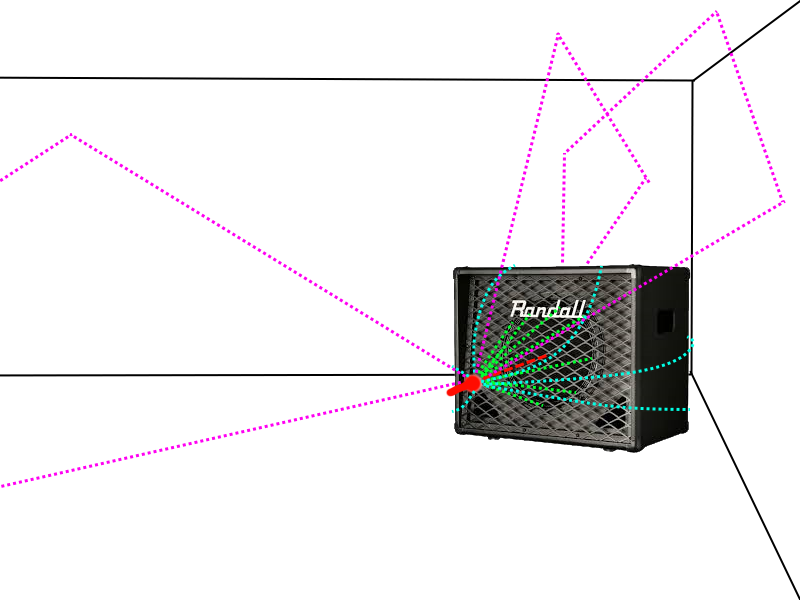
    Most guitar speaker cabinets are open back, meaning in the mid to far field where people typically hear it (so a mic at the rear can't capture a single listening position experience, typical mic recording is done in front of the speaker (you could view this as the listener's position)), there is a near equal but slightly delayed contribution from the rear of the loudspeaker combined with what is arriving from the front (so if you mic the rear, you are not getting the signal that bounces around the room and ends up at the front speaker, delayed and with less amplitude, you are just getting 2 different cab captures). As they are out of phase, there is cancellation and reinforcement that occurs, which gives it a characteristic sound. That is missing in typical guitar recordings because of the way it is recorded. The contemporary approach results in a guitar sound with too much bass and a less distinct upper mid-range. This can easily be remedied using a delay line and some effects channel routing in a typical DAW.

    The whole discussion is looking at recording with one mic in front of the cabinet. The discussion focuses on trying to replicate the sound of the cabinet as perceived by a set of ears, probably a guitarist's, standing in front of the amp. They don't just get the sound from the speaker.

    Excuse the drawings: Even though there are slight delays in the signal reach the microphone for the cone, when you add the delayed and reflected sound things change quite a bit. But we are only talking small amounts of delay.
    When it is a pair of ears in a room, the distance becomes more significant and the reflections, cancellation and reinforcement are spread over a greater time frame.
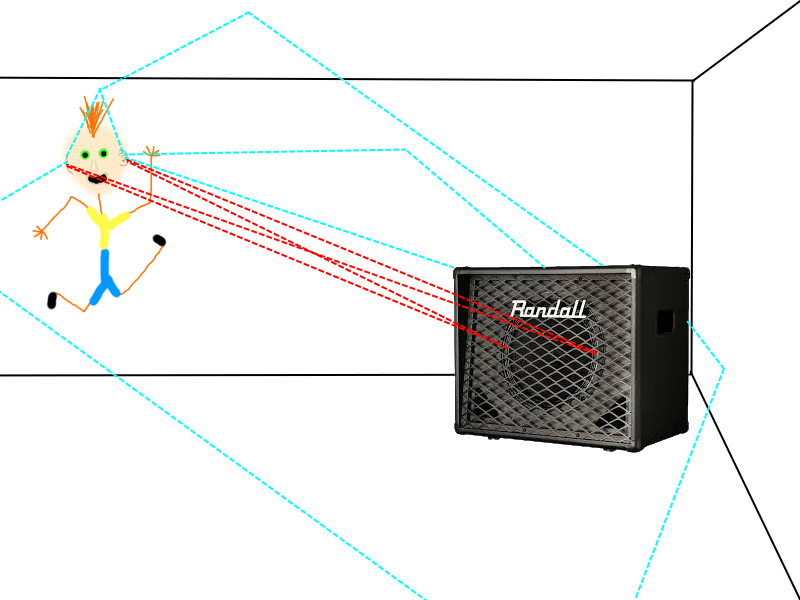
    So, if I had to sum it up, I think he is saying the recorded signal loses perspective of the listener when close miced and the delayed rear signal etc is all within X time frame. To produce a sound that is more typically heard by a listener, such as a guitarist standing further away. the whole rate at which signals hit that microphone have to be extended because no one hears an amp with their ear 1 inch from the cone. At least not for long.

  • wimwim
    edited August 2025

    Next we'll be wringing our hands over the absence the effect of ambient humidity and barometric pressure on the rate of sound transmission and on the sensitivity of the microphone diaphragm. Not to mention the failure to simulate varying degrees of ear wax buildup in the listener's ears, which imparts a subtle filtering effect that removes some of the harshness from the sound.

  • edited August 2025

    @wim said:
    Next we'll be wringing our hands over the absence the effect of ambient humidity and barometric pressure on the rate of sound transmission and on the sensitivity of the microphone diaphragm. Not to mention the failure to simulate varying degrees of ear wax buildup in the listener's ears, which imparts a subtle filtering effect that removes some of the harshness from the sound.

    Probably not, but no doubt someone will have it in their head that we are missing out by not reproducing something.

    I do like mixing in some room mics with the cabinet where available, but I don't think I'll be taking it much further than that.

    These discussions always remind me of the video where the presenter strips away a Telecaster bit by bit until the tone is affected. He ends up with nothing more than a pickup, bridge, nut and strings strung between 2 work benches.

  • @Ailerom said:
    //video//

    That was a more fun watch, had me smiling but it was also interesting. Thanks for the share.

  • When we talk about IR, we talk about recording tones and not tones in the room. Which I think that what he is talking about.

    From what I have seen of the way IR are made, it is made exactly the same way a recording is made for band music. The cab is I a room recorded by a mic. That means rebound from the back are being captured by the mic in front. In the case of Bogren he as actually used setup during band recording session to make ir.

    Maybe I don’t understand his point but if he could make it this week it would be helpful.

  • edited August 2025

    @ecou said:
    When we talk about IR, we talk about recording tones and not tones in the room. Which I think that what he is talking about.

    From what I have seen of the way IR are made, it is made exactly the same way a recording is made for band music. The cab is I a room recorded by a mic. That means rebound from the back are being captured by the mic in front. In the case of Bogren he as actually used setup during band recording session to make ir.

    Maybe I don’t understand his point but if he could make it this week it would be helpful.

    I think the difference with IR captures is they are deliberately short (I haven't seen any longer than 500ms and most I use are under 200ms, most by a lot) to capture nothing but the cabinet tone. The idea being you want to put your own room/reverb on it to mix with your music. A miked cabinet is a recording of a hot mic so it's capturing all the reflections that occur for as long as the mic is on.

    A good way to see that in action is to take a reverb ir file which should be long, as it captures a response of a space. Then shorten it to 10ms. You will here little more than a click. which is what is used to make a cabinet IR. They just play a very short single cycle wave through a cabinet.

  • @Ailerom said:

    I watched that quite some time ago, and wasn’t really surprised by the outcome. When I have changed bad pickups in a cheap guitar, it can make a world of difference, and I’m not sure that any of the other things people suggest as having an impact on tone really make a difference. To me pickups are by far the biggest infliction sound.

  • @Ailerom said:

    @ecou said:
    When we talk about IR, we talk about recording tones and not tones in the room. Which I think that what he is talking about.

    From what I have seen of the way IR are made, it is made exactly the same way a recording is made for band music. The cab is I a room recorded by a mic. That means rebound from the back are being captured by the mic in front. In the case of Bogren he as actually used setup during band recording session to make ir.

    Maybe I don’t understand his point but if he could make it this week it would be helpful.

    I think the difference with IR captures is they are deliberately short (I haven't seen any longer than 500ms and most I use are under 200ms, most by a lot) to capture nothing but the cabinet tone. The idea being you want to put your own room/reverb on it to mix with your music. A miked cabinet is a recording of a hot mic so it's capturing all the reflections that occur for as long as the mic is on.

    A good way to see that in action is to take a reverb ir file which should be long, as it captures a response of a space. Then shorten it to 10ms. You will here little more than a click. which is what is used to make a cabinet IR. They just play a very short single cycle wave through a cabinet.

    Interesting!

  • I managed 16 minutes of the 'Guitars Sound Wrong' video - nice dogs!
    Reminded me of how Alan Parsons would place the mic several feet away to capture the whole sound of the amp.

    I saw the 'Guitar Tone' video above before, but had to watch it again - great video, still surprising! I love how detailed it is.

  • @pbelgium said:
    I managed 16 minutes of the 'Guitars Sound Wrong' video - nice dogs!
    Reminded me of how Alan Parsons would place the mic several feet away to capture the whole sound of the amp.

    I saw the 'Guitar Tone' video above before, but had to watch it again - great video, still surprising! I love how detailed it is.

    He mentions doing another video with a deep dive into the same process. I haven't looked for it though.

  • I am intrigued by the potential of Jacob Collier’s 5-string Taylor Guitar. I think the right option for me
    might be asking a local luthier to replace the nut and bridge hardware to work for 5 strings on a Taylor I bought used in the late 90’s. Probably a lot cheaper than the cost of the actual Taylor Jacob Collier model which retails for $2,800.

    The main benefit for me would be similar to the way Joni Mitchell would change tunings just to discover
    new harmonies and sequences for song writing.

    I like chord voicing that are very open and often ambiguous with intervals that are greater than 3rds.
    Jacob’s 5 strings tuning has 5ths on the bottom 3 and 4ths on the top 2: DAEAD. I can immediately see
    a interesting major or minor chord with a very open voicing just by adding one finger on the middle string making a minor chord on the 1st fret: DAFAD and major on the 2nd fret DAF#AD. You can bar chord this basic pair os shapes and quickly play from song books.

    It will be fun to decide what a useful 7th shape will be. I should probably just take a string off the Taylor and try tuning just 5 of the strings… probably the lower 5 I would guess.

  • wimwim
    edited August 2025

    @McD said:
    I am intrigued by the potential of Jacob Collier’s 5-string Taylor Guitar. I think the right option for me
    might be asking a local luthier to replace the nut and bridge hardware to work for 5 strings on a Taylor I bought used in the late 90’s. Probably a lot cheaper than the cost of the actual Taylor Jacob Collier model which retails for $2,800.

    The main benefit for me would be similar to the way Joni Mitchell would change tunings just to discover
    new harmonies and sequences for song writing.

    I like chord voicing that are very open and often ambiguous with intervals that are greater than 3rds.
    Jacob’s 5 strings tuning has 5ths on the bottom 3 and 4ths on the top 2: DAEAD. I can immediately see
    a interesting major or minor chord with a very open voicing just by adding one finger on the middle string making a minor chord on the 1st fret: DAFAD and major on the 2nd fret DAF#AD. You can bar chord this basic pair os shapes and quickly play from song books.

    It will be fun to decide what a useful 7th shape will be. I should probably just take a string off the Taylor and try tuning just 5 of the strings… probably the lower 5 I would guess.

    [edit] nvm. Brain addled by a couple of nights of very little sleep.

    There's more to accommodating five strings than replacing the nut and bridge. Where you gonna put the extra tuner on a headstock that only has room for four? Would you be able to deal with the significantly smaller string spacing needed to fit the extra string on the neck? Replacing the neck on an acoustic to get a wider fret board and headstock is a big, big deal.

    That doesn't sound like a viable option to me at all.

  • @wim said:
    There's more to accommodating five strings than replacing the nut and bridge. Where you gonna put the extra tuner on a headstock that only has room for four?

    The Taylor I own is a 6-string acoustic guitar. I just want to balance the 5 strings across the neck which
    I suspect might make it more playable for chords.

  • Oh jeez. I totally misread your post. 🙄
    A couple of days of sleep depravation aren't helping.

    In that case, I think the main drawback could be the angle that the strings bend at the nut to get to the tuners. That could be trivial I suppose.

  • Criminy tho. If I could ever have gotten myself a Taylor, the thought of frankensteining it like that makes me cringe.

  • @wim said:
    Criminy tho. If I could ever have gotten myself a Taylor, the thought of frankensteining it like that makes me cringe.

    It’s possible the luthier may have a similar reaction. Basically, it involves changing the nut and selecting
    which of the 6 tuners to attach a string to. On the bridge end the strings go into aligned peg holes and that might make the whole idea unworkable at a reasonable cost since it might require removing the current bridge and building a new one with 5 holes to produce the best spacing and tone.

  • @McD said:
    I am intrigued by the potential of Jacob Collier’s 5-string Taylor Guitar. I think the right option for me
    might be asking a local luthier to replace the nut and bridge hardware to work for 5 strings on a Taylor I bought used in the late 90’s. Probably a lot cheaper than the cost of the actual Taylor Jacob Collier model which retails for $2,800.

    The main benefit for me would be similar to the way Joni Mitchell would change tunings just to discover
    new harmonies and sequences for song writing.

    I like chord voicing that are very open and often ambiguous with intervals that are greater than 3rds.
    Jacob’s 5 strings tuning has 5ths on the bottom 3 and 4ths on the top 2: DAEAD. I can immediately see
    a interesting major or minor chord with a very open voicing just by adding one finger on the middle string making a minor chord on the 1st fret: DAFAD and major on the 2nd fret DAF#AD. You can bar chord this basic pair os shapes and quickly play from song books.

    It will be fun to decide what a useful 7th shape will be. I should probably just take a string off the Taylor and try tuning just 5 of the strings… probably the lower 5 I would guess.

    Why five strings? What’s the thought behind it ?

Sign In or Register to comment.