Loopy Pro: Create music, your way.
What is Loopy Pro? — Loopy Pro is a powerful, flexible, and intuitive live looper, sampler, clip launcher and DAW for iPhone and iPad. At its core, it allows you to record and layer sounds in real-time to create complex musical arrangements. But it doesn’t stop there—Loopy Pro offers advanced tools to customize your workflow, build dynamic performance setups, and create a seamless connection between instruments, effects, and external gear.
Use it for live looping, sequencing, arranging, mixing, and much more. Whether you're a live performer, a producer, or just experimenting with sound, Loopy Pro helps you take control of your creative process.
Download on the App StoreLoopy Pro is your all-in-one musical toolkit. Try it for free today.
Learning FM with NFM
I've been teaching myself FM using Nikolozi's NFM. NFM has a flexible modulation matrix that is similar to Native Instruments FM8, which is why this is often recommended. (Nikolozi is also the developer of Mela, which is great and comes with very cool external FX app too)
Learning FM with NFM has been a lot of fun so far, great app, I highly recommend it!
One thing I was surprised by is that FM synths seem to be more fun to run through effects than analog (?). I still miss not having a filter though, even though it is better for learning FM. When working on patches, I usually have a light reverb running externally.
A few questions:
1) Can I get presets in or out of NFM? It would be great to be able to do this! Even better if they are stored as text, I like to manipulate patches with python.
2) What is the best way to look at some DX7 patches? (NFM does not import DX7 patches). Maybe an app, a webpage, or a particular book?
3) I would appreciate AU app recommendations: filter that works well with NFM? Oscilloscope?
Comments
KQ Dixie can import DX7 patches.
Generally in FM, the effect of a filter is produced by the modulation envelope, since the moodulation level affects the overtone mix, though not linearly. So you don't really need a filter.
auSCOPE X by auDSPr is a very nice 2-channel scope. It can do the tricks you expect from a digital scope, like delayed triggering. And Oscilloscope from Mani Consulting (the blue one) is the smoothest spectrogram. This lets you see the harmonics, and how they vary over time. These are both AUv3.
A filter only really makes sense if it can be controlled like a synth filter (with envelopes triggered by notes for example). And still an external filter won't be able to treat polyphonic voices separately so then it will always be like a single filter in a paraphonic synth.
Loading NFM inside Drambo would give you a lot of options for further processing though.
FM a quite fun synthesis method but takes some time to master...
I'm particularly fond of basic 2OP FM but one 'thing' that many FM synths miss is the control over the start-phase of the operators which would add an additional source of control.
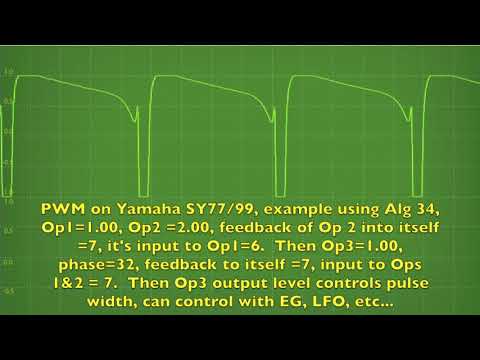
With control over the start-phase of the operators it would be possible to create 'real' pulse-width modulation which without control over the operators start-phase is a no-go. (Yes. I'm a PWM junkie too).
Here's a video with FM PWM done on a SY77/99 synths (Those two synths also have filter for the FM sounds).
But thankfully I'm not a 'FM Purist'
@Samu you are the Swedish Nick Batt in disguise and I claim my 2p!
The book on FM is "FM Theory and Applocations" by John Chowning, published in 1986 by Yamaha. You can find it on line. It explains why FM works, and describes what it's good for.
Yes, in particular often stunning with delay and reverb fx
Probably by the rich overtone spectra and their change with modulation.
KQ Dixie is great for loading DX-7 sysex and in most cases it‘s really close to the original sound.
I often run the same patch in Dixie and a TX-7, each panned to one side of the panorama.
Dixie is also great for realtime tweaking of the old sysex with it‘s interactive curves.
Cool, will pick that up!
Sounds good, will check these out.
I see that makes sense. So if I really want poly FM with a filter, then I need something that has one filter per voice. FM8 has this I think?
That's pretty interesting. Can FM8 or the Yamaha Reface DX do that?
I've looked at that in the past (I actually owned a TX81Z a long time ago, but didn't fully understand it). I found the three Trifonics videos on youtube, they explain most of the basics very quickly.
Cool, thanks for the input.
Bleass FM is also nice for learning FM. Plus some nice touches like the distortion and filter. Only 4ops.
I wish they had the supported other waves not just sines.
Another vote for KQ Dixie. It's the best for dx7 patches.
Haven't spent as much time with NFM but apparently a new version may come in the future.
FM junkie mention? Check
Classic Samu post.
Not an FM purist? A new one for the books! I look forward to more mentions.
Oh, and FM with a filter is cheating. Even as a non-FM purist. It’s just not done.
Exactly. I alluded to that earlier. You use the modulation envelope to control the overtones. No need for a filter.
meh, a filter on an FM synth is fine, especially if it's a multimode filter that's used to emphasize a specific freq band. FM can be very dynamic and percussive, so a filter is useful.
Does anyone have a problem EQing a synth, or putting a sequenced filter after an analog synth?
Anyway, here are some resources:
Modulator>Carrier Interval/Ratio is important.
1.618 is the Golden Mean, dating back to Euclid.
John Chowning, the father of FM synthesis, used it for the modulator>carrier interval/ratio on his FM synth/computer in his 1977 classic called 'Stria'.
You can listen to, and read about 'Stria' here, and read about the Fibonacci Sequence here, and read a technical analysis of 'Stria' here.
If you like those tones, try another remarkably versatile synth like apeSoft Stria here, and ID700 here. ID700 is 'only' 4-op but can do anything from minutes-long evolving soundscapes to IDM/Glitch percussion that radically changes with every trigger. Don't forget about the 'time scaling' knob on the left if it drones on and on.
@StudioES thanks for the Stria details.
Funny thing: I always considered „Stria“ a well sounding name for the Apesoft app, not knowing about that context.
Then Korg cheats big on their Opsix FM: it even contains filters within the modulation path

This is my opinion.
Technically it’s superfluous to even have a subtractive filter in an FM audio flow – you are able to modulate the harmonic content in the same way that a filter can.
In reality though, it’s a handy extra tool to have, in much the same way that we shoehorn delay and reverb and eq into synths, late in the audio flow. Why not. Do some stuff in FM with the operators — simple or whacky — and then if you want, shove it through a subtractive filter later in the audio flow, It’s easy to do, easy to comprehend, so why not have it?
I appreciate you sharing what you did and find it interesting. I was just being tongue-in-cheek in case it wasn’t obvious
nah.. the way how filter cooperates (and adds analog warmth) with FM engine in Elektron Digitone is just amazing .. don't care if it is cheating, just result is amazing .. most warm "analog-like' sounding FM i ever had in my hands ..
nope as i mentioned above. . in case filter is good modeled with "analog" saturation stage, then it can remove digital harshness while still preserving spectrally full and rich sound .. it's the filter why Digitone is superior to any other existing FM synth ..
Thanks, will look at Bleass, but I think the lack of feedback (to directly get waveforms like saw) might be too limiting.
I read that NFM will be integrated into Mela (4?), but that seems like it will be tricky.
Thanks, interesting, will add this to the list of things to check out.
I Liked the filter discussion.
I noticed that some of the sounds I like in FM Player 2 (which is a rompler with some outboard stuff) are using the filter, which seems to be per note.
If you haven't seen these "tutorials" by Element433 on youtube, they present some ratios/intervals and then some cool footage while playing related sounds. They are worth checking out (and also sort of redefine what a tutorial is, as well as looking pretty cool).
I love this guy’s aesthetic.
KQ Dixie is great, thanks for the recs.
Question: anyone know what the detune parameter in DX7/KQ Dixie actually is? Is it just thousandths instead of cents? Or is it more like the detuning in a supersaw, which can not be expressed only as a simple ratio from the note frequency (I think)?
Check this out: https://www.kiraqtech.jp/blog/kq-dixie-en/kq-dixie-manual-en/#frequency
Is it not working again?