Loopy Pro: Create music, your way.
What is Loopy Pro? — Loopy Pro is a powerful, flexible, and intuitive live looper, sampler, clip launcher and DAW for iPhone and iPad. At its core, it allows you to record and layer sounds in real-time to create complex musical arrangements. But it doesn’t stop there—Loopy Pro offers advanced tools to customize your workflow, build dynamic performance setups, and create a seamless connection between instruments, effects, and external gear.
Use it for live looping, sequencing, arranging, mixing, and much more. Whether you're a live performer, a producer, or just experimenting with sound, Loopy Pro helps you take control of your creative process.
Download on the App StoreLoopy Pro is your all-in-one musical toolkit. Try it for free today.
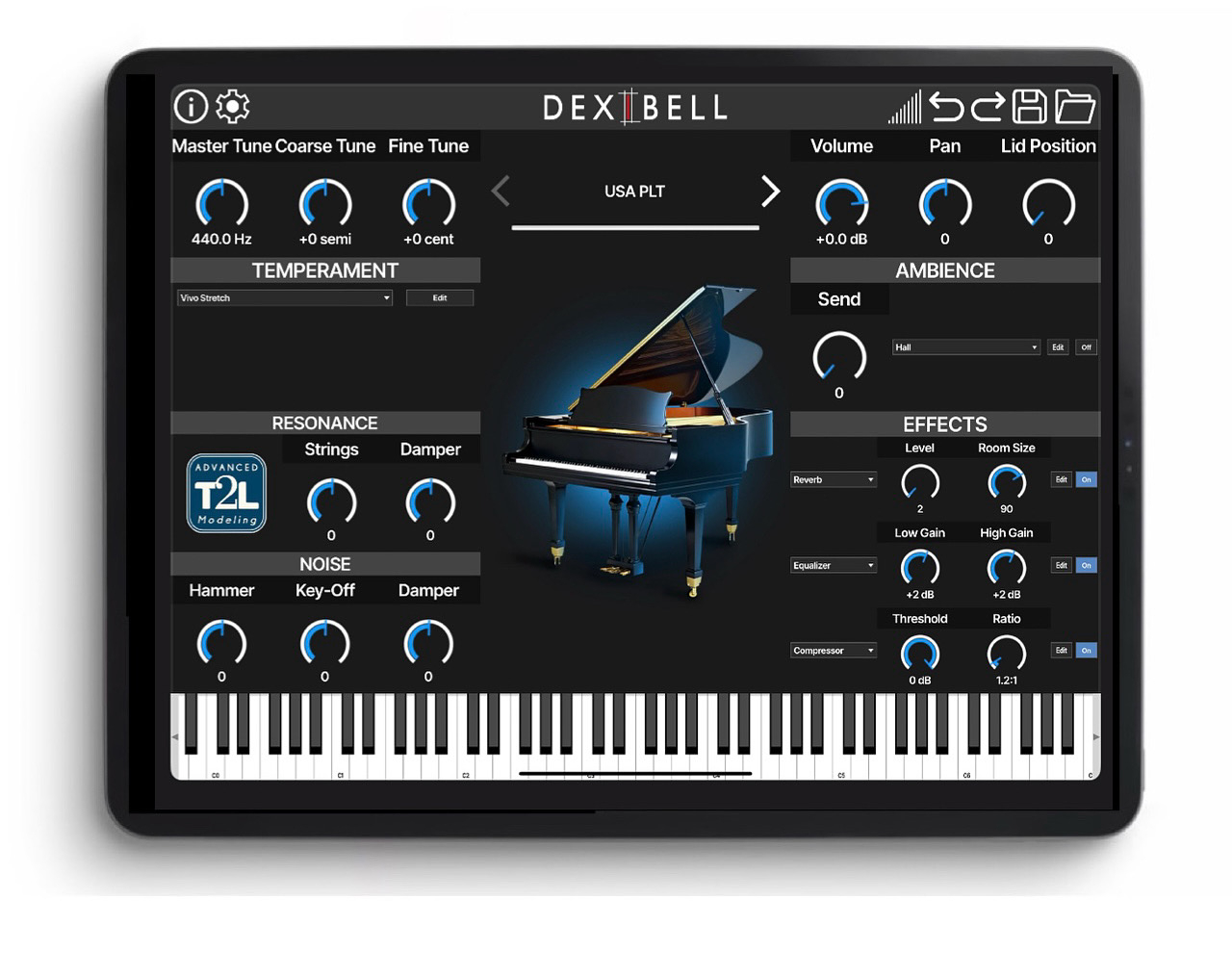
T2L Piano by Proel (Released)

https://apps.apple.com/us/app/t2l-piano/id6747394589
The art of the acoustic piano, now reimagined as a DEXIBELL plug-in.
A Virtual piano that feels and responds like an acoustic instrument, not just in tone, but in spirit.T2L (True to Life) technology represents a hybrid synthesis approach that combines high-resolution Sampling with real-time physical Modeling to reconstruct the full behavior of an acoustic piano at a granular level.
Comments
Hmm no sound demos.
A hybrid physical modeling/sample based piano? I wonder how it compares to Pianoteq.
https://www.dexibell.com/en/t2l-piano/
There are some demos at the bottom of this page.
The hybrid sample/physically modeled is really interesting. I'm really curious what that actually means and what’s going on under the hood. Anyone know the theory behind that?
I’d say this is very good if you like a bit brighter sound than Pianoteq. It interests me for a jazz sound.
I’m sure reverb can be adjusted? Maybe @McD will weigh in.
The tuning section with time period presets is interesting.
Thanks for the link. Sounds pretty good to me (haven’t listened in headphones yet) tho). If the iPad version sounds like this I’ll probably end up getting it. When he changed the lid position it adjusted some of that brightness.
@Dav i noticed that, too. It’s a very good piano, I think.
And 1/2 the price of Pianoteq.
Yep. I noticed the ipad version download is very much smaller than the version used in that video (824Mb vs 5GB). Will be watching out for an iPad version demo…
I’m a recovering “Piano App-aholic”. I have resisted purchased 2 recent piano implementations because I went “All-in”
For “PianoTeq 8” getting all the pianos and instruments it models.
Modeling is really helpful.
PianoTeq 8 is 55MB because all the sounds are based on software algorhythms.
T2L Piano is still an almost Giga-piano in download size: 855MB.
That’s important for anyone fighting storage limits.
Numa Player and the available Salamander Piano are free. Numa Player recently added a $20 “Studio D” piano as an IAP.
(My first new piano abstention).
I think there are real pianists that will want this piano for its sound and ability to adjust parameters for extra benefits. It’s probably worth evaluating against the now forgotten “Ravenscroft 275” (860MB).
Honestly, all these pianos sound like pianos and I rarely sit at a weighted keyboard and try to recall the joys of a real grand.
FYI: At the keyboard forum a member offered this advice on the VST version of the T2L:
The Mac/Windows VST version is 120 USD while the IOS App is $25.
@McD said:
“…the now forgotten Ravenscroft 275” ?
Not forgotten here. That’s the piano I reach for first when I want a realistic piano sound.
The Studio D IAP in Numa is really good also.
Evidently I’m still confused by Pianoteq’s pricing. Isn’t the most basic IAP over a hundred bucks? “Stage” IIRC?
FWIW, I’ve never bought into any of that Pianoteq stuff.
Yes. PianoTeq 8 is premium Desktop pricing without any significant competition so it has this customer base of
Serious keyboard musicians that want to collect all the major hardware implementations of pianos. But overtime,
They also added nylon guitar, harps, mallet percussion, harpsichord, hand pan, steel drum, Epiano, clavichord, etc.
But what intrigued me was the idea of changing parameters on the instrument models. I have most of these instruments in AUv3 versions from all the usual sample based AUv3 Types. But I was very curious to learn what changing the parameters would produce… and it’s pretty cool and the results create instruments that seem to have a physical quality but don’t sound
Like the starting point instrument. They don’t don’t synth based but the technology is purely mathematical.
I ended up spending hours generating instruments that I would label based on what they reminded me of: calliope, chamber orchestra, fretless bass, and so on. Lot’s of time spent tweaking parameters and uploading the resulting “presets” to the Modartt forum for user feedback. But like most “new app” passions I moved on. But I use PianoTeq for all my piano needs
Now and also for the other beautifully rendered instruments.
I happened to have a few hundred dollars in credit card bonus bucks and that made the purchase price less painful and also didn’t alert the CFO of my outrageous spend on music apps that month.
Yeah, I was just confused with Mike saying this was 1/2 the price. @McD
It’s 1/2 the price of the sound packs. Each of those are $50.
I will stick to the Ravenscroft and Pianoteq plug ins. More then enough piano for me.
Is this the full version?
As people mentioned, the download is smaller that vst version..
Are all the pianos there? Im especially interested in the upright sounds..
OK I bit the bullet and here's my short summary:
Overall I think this is the best sounding piano on iOS, imo.
It's ahead of the pianoteq in realism, it's more detailed and varied and less "plastic" than ravenscroft.
I guess this is to date a closest thing to keyscape on ios.
Pros:
Great variety of piano types, decent control over the parameters. Quite natural sound and you can tune it to be more clear or or more dusty to your liking. The lid closing option is basically muting and that paired with velocity settings you can go from bright rock pianos to Felt kinds of tones.
The tuning options offer a great way to get more natural and real world sounds.
Cons and suggestions:
The first piano, USA type, has weird high pitched noise burst when releasing the damper. It gets tamed down when decreasing the damper noise volume, but on default it is annoying.
Also I don't get why piano app programmers don't bother to insert at least 3 round-robin damper noise samples, with frequent pedalling they always get the "machinegun effect"
There are also weird artifacts and resonant noises during key release when playing mid-high staccato or similar. Nothing dealbreaking but you notice it quite fast.
Suggestions-
This is to you but to other piano developers aswell- the key off noises are usually great, but there's a big mistake being made-
For example when playing fortissimo chord with sustaining the keys for 6 seconds- if I release the keys softly after the sustain, it still plays the key off noise samples at the full volume the chord was played.. This results to a loud clank even if I wait the sustain to go quite silent.
This could be fixed by adding a timer to bring down the volume of the off key samples relative to the time the keys are hold down. I know people still can release keys "loudly" and this could be only achieved by reading the velocity of key off sensor, but I guess most midi keys dont have that, so middle of the road approach should be still to bring the volume down when the sound itself has died down.
please let us change the piano type while maintaining the panel settings.. For example I've tuned in quite nice felt piano preset, but I wanna hear it with other piano types. Now it just completely changes the preset.
Also I don't know if its possible with your sampling and modelling tech, but it would be great to set or offset the individual string tuning, like the "condition" slider in pianoteq, so it could detune the keys itself but keep the tuning of the octaves and keys.
For example I love the honky tonk piano sound, but I'd like to decrase the detune effect.
And regarding the tuning options- great set of tunings and customisability, but let us make the custom tuning with sliding the whole keyrange with one swipe.. Right now its possible only with every key individually and it's not the most convinient way..
It would be great to somehow have more control of the envelope aswell, to an extent this can be done with the compressor, but many presets tend to be a bit clanky, the attack and decay are fast but the volume of the sustain too low etc..
Hey, thanks for the detailed report, @mervenca ! If I can get through my bills this week with some play money left over I’m going to pick this up.
Great report, thank you
Anyone using this for some time now and want to share your thoughts? I’m using the Salamander SFZ piano for quite some time now, but really want an upgrade after trying the demo version of Pianoteq. Those pianos feel so good to play! But Pianoteq is a bit above my budget and Dexibell seems to be a nice alternative with its partly modelled engine…
Hi jer4! I’m waiting to hear more reports on this piano also, and have held off purchasing this too. I also use salamander. Are you using the Accurate Salamander SFZ version? Its really a great version, here: https://www.ir.isas.jaxa.jp/~cyamauch/AccurateSalamander/
I also like pianoteq. Have had some good results combining salamander + a pianoteq felt piano. Used the demo version for a long rime, finally went ahead and bought it. If you add a pianoteq felt piano in low volume, it really adds a lot of body to the salamander sound. Here’s a sample of what that sounds like. https://forum.loopypro.com/discussion/67225/georgia-on-my-mind-piano-improv-salamander-pianoteq
Hopefully someone will give some long usage report on 2TL. I just got an itunes gift card for my birthday, and looking for some music apps to buy!
I don’t have an extensive review, but Pianoteq blows this out the water. If I’m going for something not Pianoteq I usually go for Pure Piano or Pure Upright. This is a fantastic piano app, but is the least used of what I have.
@Dav That sounds really good, the layering with Pianoteq is a good way of adding body indeed! Gonna give that a try too, I love layering piano and synth sounds, but never did layer it with another piano. Nice!
Yeah @FizzyLizzy27, Pianoteq really is great! But the demos I’ve seen with the Dexibell are pretty impressive too. As it is the same engine and samples they use in their (very high quality) hardware piano’s, it should be quite good… But no doubts about the quality of Pianoteq!
For example, this video and some other one of Fausto:

Pianoteq is better, as you'd hope for the price, but T2L has the responsiveness of modelling and several tone models to work with. I'd say it's truly excellent value if you don't have/want/need Pianoteq. I bought it out of curiosity and for fun, and enjoy it when I'm playing it - but that doesn't happen often because I usually grab Pianoteq first and then it doesn't let go.
I could not get accurate salamander to load properly in isfizz. Any help would be appreciated - really enjoyed the original salamander and it looks like soundfonts4u website is gone…
@Loups said:
Thanks for sharing your experience @Loups! Good responsiveness is exactly what I’m looking for!
@mjcouche What exactly doesn’t work? It should load like any other sfz instrument