Loopy Pro: Create music, your way.
What is Loopy Pro? — Loopy Pro is a powerful, flexible, and intuitive live looper, sampler, clip launcher and DAW for iPhone and iPad. At its core, it allows you to record and layer sounds in real-time to create complex musical arrangements. But it doesn’t stop there—Loopy Pro offers advanced tools to customize your workflow, build dynamic performance setups, and create a seamless connection between instruments, effects, and external gear.
Use it for live looping, sequencing, arranging, mixing, and much more. Whether you're a live performer, a producer, or just experimenting with sound, Loopy Pro helps you take control of your creative process.
Download on the App StoreLoopy Pro is your all-in-one musical toolkit. Try it for free today.
Comments
This all confirms that iOS users would better be able to access their own files without limitations. App sandboxing to protect data from one app being accessed by another makes perfect sense, but putting the user in a sandbox as well is kinda ridiculous, isn't it? And iCloud doesn't help, except you're a homie with fast internet speeds 😛
@rs2000 AUM and AudioShare were created at a time when iOS was much more restrictive. Things have changed a lot since then. 😎✌🏼
Well, it does make a kind of sense. A "sandbox" amounts to a containerized database/file system. It has to be part of the container that ships with the app, so that it works without external requirements.
That’s what got me wondering about this in the first place. It seems to have been created in a time when it was needed, but the modern OS makes it feel redundant to me and an extra step between AUM recording and iCloud. If I had it when I needed it I might appreciate the utility, but it feels kinda clunky as an AUM dumping ground. Now if I started exporting from other aops into AudioShare that would be different, or if it was integrated into iCloud.
Honestly though knowing it can preview MIDI makes it seem really useful.
I like Audioshare because it's so simple and I'm so used to it. I like to record audio with effects and make loops and it's easy with the AUM/Audioshare combination.
Sure, but as a user, I still don't have acces to it unless the app developer explicitly provided access, which often isn't the case. The only way to access the data (afaik) is to make a full device backup and use third party tools to extract my data. Not fun.
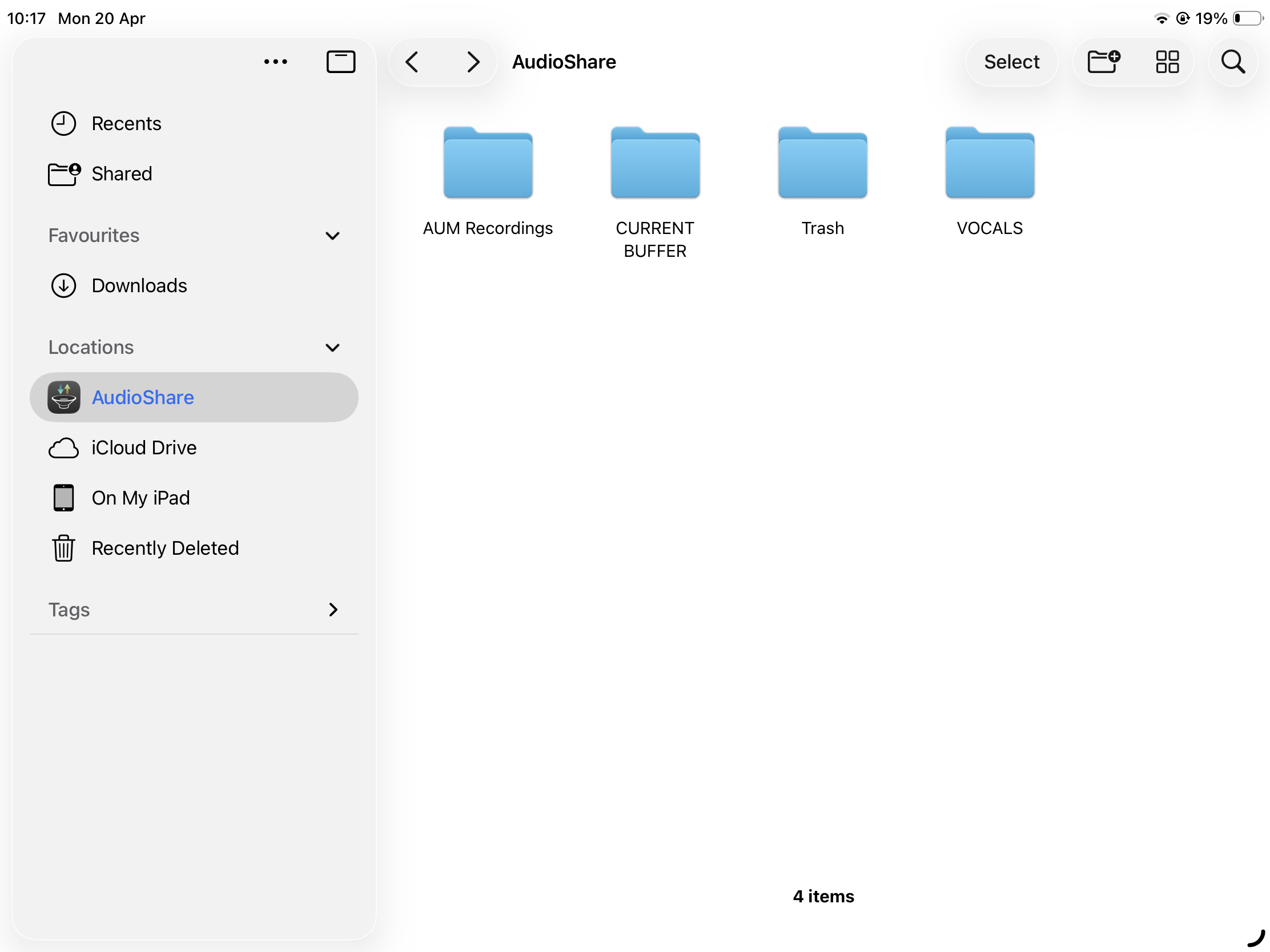
I’m a big AudioShare user as well. I’m a bit confused though as well as @AudioGus (above) when people are saying it’s not available via the files app & it’s in its own box etc. I also have AudioShare switched on as a location in the files app so I can access any AudioShare file pretty much instantly.
One use case I’d forgotten (because I don’t use it much) is as a field recorder. Works well with those Sennheiser Ambeo binaural earbuds, for example, and the recording lands conveniently for use in AUM.
This is true.
Yea, true, i use it as my main field recorder, for miscellaneous sounds and stuff.