Loopy Pro: Create music, your way.
What is Loopy Pro? — Loopy Pro is a powerful, flexible, and intuitive live looper, sampler, clip launcher and DAW for iPhone and iPad. At its core, it allows you to record and layer sounds in real-time to create complex musical arrangements. But it doesn’t stop there—Loopy Pro offers advanced tools to customize your workflow, build dynamic performance setups, and create a seamless connection between instruments, effects, and external gear.
Use it for live looping, sequencing, arranging, mixing, and much more. Whether you're a live performer, a producer, or just experimenting with sound, Loopy Pro helps you take control of your creative process.
Download on the App StoreLoopy Pro is your all-in-one musical toolkit. Try it for free today.
Is there a way to reverse engineer any synth sound?

Aside from sampling, wondering if there are any apps that can help to reverse engineer any sound. Anybody tried something like this?
Comments
Not heard of any apps that do this but with knowledge about different synthesis methods and the type of sounds they can produce it should be possible to re-create the sounds by ear
There was, a long time ago, something called (I think) the AXCEL Re-synthesiser. I’ll check. That was allegedly an analyser and synthesiser system. I’m sure the same sort of complexity could run on an iPad, if that thing could do it back then.
u0421793: I guess this would be done by Fourier analysis and synthesis?
would be awesome to have an app that could do this.
This one: http://www.synthtopia.com/content/2007/06/26/technos-acxel-resynthesizer/
I remember having an issue of Sound on Sound, I'm sure that was in it!
I guess that if there was anything that worked with ANY sound we would have synths that could reproduce ANY sound. But we don't, so anything that does work probably only gets an approximation or will only work with particular kinds of sounds.
Interesting though
Many roads lead to Rome.
Recreate the exact same sound? No.
Sound of a similar kind? With experience Yes.
The fun with resynthesis is that it doesn't work.
In theory you should be able to recreate any sound with sine waves (fft), in praxis I haven't heard anything that does that.
Never try for the perfect sound. It is in the imperfections that we find what we seek
In theory we are able to recreate via fft a precise moment but as we introduce in the equation filters, fx, sampling, filter and fx again adding up to some modulation, any algorithm will be lost
If you are asking if it's possible to replicate a synth sound with proper ear training and general knowledge of how a synthesizer works, yes: it's possible. Now, if you're asking if it's possible to replicate a synth sound in an automated way, with no or minimum user interation by untrained people, the answer is no: there's absolutely no way, and I really doubt it would ever be.
hm, let's say the ultimate goal would be recreate some "real" drums
Physical modeling sounds much more real in comparison to the resynthesis stuff ...
P.S.: get real, folks: current tech strugles even with chord recognition, which deal only with the fundamental harmonics of each note. Computing have a lot to evolve before any automated way of reverse engeneering anything but the simplest monophonic basic sounds (e.g.: a sine, or a triangle) and their fundamental notes.
No
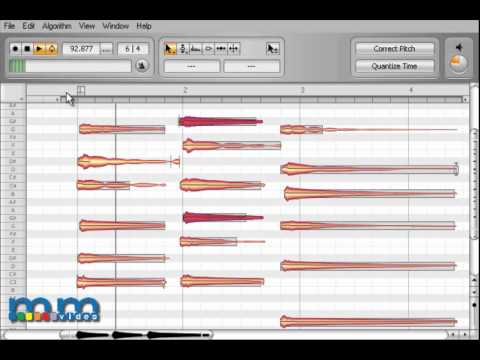
This was impossible a few years ago
I use it daily, @lala: Melo's chord recognition is not as reliable as the vid suggests.
With physical modeling, with time and training, you can recreate about anything. The OP asks about something different though: if there's a way to make the computer listen for you, decide what tweaks to apply and come up with something close to the original. Well, except for perhaps a basic single wave with no modulation, this is still years from happening, perhaps even decades (no exageration).
^^
But it's lets you mess with the plops of single notes of the chord
When it recognize it properly, which it does, say, at three from ten times I'd say.
Is there some particular synth sound you are trying to recreate?
Synthmaster Player has preset expansion packs that do an excellent job of recreating many classic synth sounds. If there is a particular classic sound you are looking for, check out the demos. They are thousands of presets, and many are quite accurate recreations. If it is from some classic record, chances are you'll find it there.
http://www.kv331audio.com
Otherwise, it's a matter of experience, learning what various synth parameters do (filters, envelopes, LFO, etc. )
And even if this chord recognition tech was fully developed, @lala, discussing further about it would be a red herring, since it is to reverse engineering a complex wave just what strugling to strum three chords on a guitar is to play the entire Chopin Nocturnes collection. Got it? Years away with current tech, perhaps even decades.
Yes. To me it's still like neubecker is doing the impossible. ^^
I would have never thought that it's possible.
Hm, I struggle with chords
I can recreate sounds but can't play along with the radio playing.
I can't tell what key and scale its in, so I have no idea what to do, lol
I really like complex multilayered evolving pads/ambient stuff, so I guess we're perhaps a ways off from reverse engineering that.

I do wish there were more pad presets for mitosynth. I can almost make any pad sounds in Thor, but without the combinator that the desktop version uses, it'd be impossible to make something like this:
Layer some other synths to it, just assign them to the same midi channel
In the sound I hear synth strings, choir and pan flute or something
There was a time when I thought there's no way you can change the speed of a performance and not change the pitch, or vice versa. And I didn't realize Melodyne could alter individual pitches of a chord, even in just that one example of it working. What did I know? But an algorhythm that analyzes a complex synth sound so as to reverse engineer it seems tougher. Wouldn't it have to figure out what kind of synthesis so it can choose the appropriate one to work with? Then breaking it down into the components of that kind of synthesis? Then recognizing the dynamic attributes to modulate the parameters over time? I have a hard enough time programming a sound much less seeing what it might take to do all that.
^ think the answer to the original question is yes. Ask here on the forum and someone will sort it out.
Well, kind of, yes and no.
If you present a sound, any sound, you can analyse it in various ways. At the simplest, you can merely envelope follow it, and that gives you how loud the sound goes, over time. If you apply that envelope to another sound, say, a vuvuzela, then arguably you’ve made the vuvuzela ‘sound like’ the presented sound. Of course, it doesn’t sound like it enough to be convincing, but it comes and goes in the same way as the original, so there’s something about it in the new sound.
Now do the same thing but split the analysis into bands, each of a narrow frequency range, and get several envelope tracks from the several envelope followers, and apply those to, well, maybe not a vuvuzela, maybe an ocarina. Or a sine wave, which is more or less the same thing. The output is a lot more like the presented input now. Keep tightening up the bands into lots more, lots narrower bands, and you’re now in the land of spectral analysis / synthesis.
This is how a lot of modern things work without having to discretely chop a sound into effectively dumb unattributed slabs of samples (which a sampler will hungrily go ahead and do for you). The Technos Acxel, basically spectral synthesis. A lot of the Apesoft iOS apps, including Sparkle and others — spectral synthesis. Virsyn Poseidon — also. And there’s others. The point is that it breaks the sound into simultaneous ‘frequency tracks’, hundreds of them, which each drive a sine wave oscillation, hundreds of those too, to put the sound back together without having to store dumb samples. The frequency tracks are just data (starts when, stops when, oh, starts again when, stops again when, and so on).
If you monkey around with that data you can stretch time but keep the frequencies of the sound exactly where they were (or conversely, pitch shift without timebase alteration). You could even apply the frequency tracks to presence or absence of similar frequencies from another input instead of a few thousand free-running sine oscillators. Then you’re effectively doing a vocoder, and if you take a look at Sparkle, that’s what’s going on in there.
So, yes you should be able to analyse a sound in terms of parameters (i.e., parametrically) and just change some parameters and not others, or differently. Doing this to raw dumb samples is not necessarily the best way, as we’re all familiar with the downsides of what happens to processed samples when things turn bad.
However, if what you mean is “can I discern which modules were used to make this sound, and what positions were the knobs in”? No, you shouldn’t be able to, reliably, and that’s more to do with the limitations of the originating synths in the first place. In theory, any synth should be able to make any sound imaginable — that was the lie we were all told in the ’70s by people on telly.
It would be interesting to have an AI approach to analysing a sound and saying “pick this synth, and load this patch I’ve just created”, and I’m not saying that isn’t possible, but it’d be quite likely to suggest some other synth than the originating one (if it was indeed made with a synth!).
Incidentally, I hate maths because I never got any of it to make sense when I was at school, but what I wrote above is related to an FFT - Fast Fourier Transform.
Fourier analysis takes a signal across time and represents it in the frequency domain (i.e. at those times referred to, what frequencies are there in there?). Fourier analysis is all about taking a function (in engineering, music, whatever) and decomposing it into as many necessary of the simplest functions possible. Thus, in sound, we’d take a weird waveform and know that it can be represented using nothing but the correct amount of sine waves of varying amplitudes, and at varying frequencies (usually related, i.e., harmonics). Finding those simplest possible functions is Fourier analysis. An FFT is a fast (it’s in the name) way of computing this sort of stuff, and will give you a bunch of frequency “present or absent” data for each frequency found. Spectral analysis / synthesis usually involves an FFT.
Thanks. Very interesting but mostly over my head. I wonder, though, what the poster of the original question wants the outcome of reverse engineering to be. An app that figures out how the sound was originally created so that it can be loaded into that same kind of synth, as the same or close to the original patch, and then can be played and edited like the original? It seems like this should be possible because the sound being analyzed is a synthesized sound. We don't need to reproduce any sound imaginable, just one that is already the product of synthesis. Yet it seems far-fetched today. Is there any program or method existing that could even attempt this?
Necro because I am a troll.
Actually, I'm curious what the advancements are as of 2020.
FWIW, I remember using Fourier Transformations in Physics in the early 1990s. I am pretty certain this is how software such as Iris 2 works. Also, isn't it the principle of FM synthesis-multiple waveforms of different frequencies, phases and amplitudes varying overtime and superimposed make a much more complex waveform?
I suspect that this problem is very suitable for machine learning.-large existing datasets, comparatively easily trained and in a similar problem domain to speech recognition etc.
Not much happened in the meantime!
The technology is here since decades, we have neural networks and cross-correlation for analysis and judgement of similarity, genetic algorithms for finding the appropriate settings in your synth of choice and of course, the old-school oscilloscope and (FFT) spectrum displays.
I'm sometimes using the display options manually for reverse engineering but it can be quite time-consuming.
Somebody would have to invest the time to write such an app though, and I believe that there are too few potential users to warrant the effort.
If you know a bit about audio DSP and don't fear the OS command line, there's a number of open source tools you could combine to make an app that will more or less create a synth program out of a sample given , but expect to invest quality time to get a satisfactory result.