Loopy Pro: Create music, your way.
What is Loopy Pro? — Loopy Pro is a powerful, flexible, and intuitive live looper, sampler, clip launcher and DAW for iPhone and iPad. At its core, it allows you to record and layer sounds in real-time to create complex musical arrangements. But it doesn’t stop there—Loopy Pro offers advanced tools to customize your workflow, build dynamic performance setups, and create a seamless connection between instruments, effects, and external gear.
Use it for live looping, sequencing, arranging, mixing, and much more. Whether you're a live performer, a producer, or just experimenting with sound, Loopy Pro helps you take control of your creative process.
Download on the App StoreLoopy Pro is your all-in-one musical toolkit. Try it for free today.
Pipes (kind of special tablet for audio)
![[Deleted User]](https://secure.gravatar.com/avatar/2d326a427de386b35a33e0aea545622a/?default=https%3A%2F%2Fvanillicon.com%2F60730df90c4df95da0739958f5410d15_200.png&rating=g&size=200)
Interesting things are evolving these times:
https://www.pipes.rocks
Comments
Nah this seems a bit weird - what can it do thatmy ipad cannot - have to look at a few vids to check in detail
Just a quick comparison and having the required inputs built-in have to be of value for a live performing module: Just plug in USB, MIDI, Audio. On the iPad those inputs require $100-400 worth of external interfaces bussed in over the Lightning connector. This device has a target price around $600-800 I think so it's more rugged and as a whole less expensive than the iPad model but software capabilities matter and have value too.
It will all come down to the sounds it can create and the community that emerges to support sharing additional sounds.
Let's hope this approach works to give us another option for portability and community. I'd love to see it succeed and provide more choice.
Come in at under $500
It will probably be a small success, like their other products.
I guess i can do the same with an iDock and ipad
Can do the exact same things audio inputs midi inputs etc with an iDock i.e Alesis/Focusrite
True. It's both those in one case in a sense. Probably NOT for everyone that loves IOS Apps but might compete with someone that uses Korg Module for example or the Casio Stage Pianos.
Not the player types that hang out here.
It is more aimed at people who want “hardware” wanting to take big multisamples on the road, and it does have lots of midi modifiers built in
It’s also super low latency
I guess so or for music makers who dont mind the price tag I can afford it but aint giving my cash - Not knocking the product but it just aint for me Gonna check if the software is independant or if 3rd party can be installed
TBH, I think someone would be better off getting an audio interface and a used iPad Air 2 or later. With the ecosystem as mature as it is now, it'd have to do something pretty special to be able to compete with iOS capabilities.
With the a12 CPU benchmark showing near-parity with low-to-midrange intel desktop speed, up to 3 times the performance per watt of anything else on the market, it seems like an ideal time for music production big-hitters to take a closer look at the platform.
Adobe is releasing a full version of Photoshop for iOS soon, which I think is part of a trend where we'll see more complex professional apps hit the platform in the coming years.
https://appleinsider.com/articles/18/10/05/apples-a12-bionic-comes-close-to-desktop-cpu-performance-in-benchmarks
One way to avoid Apple’s never ending spiral of obsolescence...
Its a really inter3sting box but in its current form its not much inter3stto me. But maybe if AUM and bram bos apps were available on there...
A lot will depend on the software available and it seems a little sketchy on that.
My concern is mostly the screen which will most definitely be on par with cheaper Chinese tablets and in no way as posh as ipad's.
Also the lack of any controls on the face of it leaves me asking what exactly would I gain over a docked ipad? One massive knob?
Really?
I wish them luck but I'm struggling to find it exciting. I think it's only a matter of time before we have a deluge of screen based android powered sampling groove boxes.
The ipad will always trump them in terms of screen an flexibility though....
Sorry but again these benchmarks says nothing about performance and a stable workflow.
A 5 years old notebook handles still 10 times more f.e.
This could be the substitute when Apple finally wrecked the platform. Bit stepped but if they manage how to virtualize iOS app (or implement JUCE) then I see a winner.
Probably we are going to see similar things from big brands in less than 3 years.
even if they created a new term (ZDL - zero discernable latency) it doesn't make things faster. 4 ms from trigger to Audio is pretty regular today
It’s not something I would buy, I get on okay with my iPad being a sound module for my mpclive. I am interested in the tweakers/midi modifiers though but I am sure a lot of that will be covered by iOS, and etc
I don’t know that 4ms is regular...maybe with very hi end io units? 6-7 seems the norm imho... the fastest thing I know of is apogee symphony coming in at 2ms
That's the trick with the definition: they write 4ms from trigger to audio, not roundtrip (as common today)
You can output synths from iPad with a 64 byte buffer which represents about 1.5 ms, add the same amount for the converter and you're below that value.
RME achieved that with Hammerfall series over 15 years ago under windows xp.
https://www.rme-audio.de/english/techinfo/conf_setup4.htm
It let me record 8 tracks with AMD Athlon k7 and 3 or 4 gb of ram. No ssd, no extra graphics boost... and also I could manage to make work Ms. Pinky (digital vinyl system based in maxmsp) at these low latencies.
I supose modern RME can achieve similar results nowadays...
... or scarlett gen 2 for the affordable side of the spectrum.
Honestly does this thing do audio in at all? Can't find a thing about it.
if You selected 64 as your buffer size, your computer better be a beast, and your daw set up for the tracks you are doing better be minimal with light ass plug ins. 64 as a buffer is really misleading as an option to achieve 1.5ms. Popping and cracking will begin as the complexity of the session increases...period. 256 buffer is where most people are going to stay unless they are running very simplified track/effects combinations or they are working with some super dope Uber computer. Most people are also not dropping more than 300usd for an interface on iOS, hell they bitch and moan over a twenty dollar synth, 300 might cause a nervous breakdown.
Being this is an iOS relative forum for most people, thinking this performance will occur on an iPad is laughable.
And when companies run low latency claims, such as Apogee, they are referring to monitoring from their own hardware mixer and not thru the software. Average round trip for apogee use when software monitoring is going to be 14ms. So it’s going to be a must to monitor thru the hardware’s mixer vs the app.
So are you really going to achieve 1.5 - 4 ms latency on an iOS device during average everyday use with any decent size project...hellnawl! I think you better expect 12-14 ms or use the interfaces low latency mixer in the hardware.
https://support.focusrite.com/hc/en-gb/articles/207546885-Latency-Issues-with-Interfaces
The Scarlett gen 2 is no better, low latency is only achieved thru hardware monitoring thru their own mixer, actual RTL will be determined thru software monitoring and will be nowhere close to 0-4 ms.
I will also say that RME, although not the most affordable, makes a great interface. The baby face pro will get you 7ms round trip latency on a pc or Mac that is properly configured. It will not be as good on iOS...yet anyways. The fastest interface I have personally seen is the apogee symphony MkII achieving 1.35ms round trip! Faster than RME, but not on iOS...
The Pipes thing isn't a DAW, but an instrument - like a synth, edrum, whatever.
They clearly write 'trigger to audio time', which is one way (not roundtrip).
Someone recently checked his Roland e-Drum: audio triggers were sent from a Reaper track to a Steinberg UR22 (outputs connected to trigger-in of the drum module).
The drummy converted the trigger to midi which was sent back to the UR22.
Reaper recorded this midi parallel to the original audio trigger track with 6 ms offset.
In single steps: Asio output, DA conversion on the UR22, trigger to midi conversion on the e-Drum, midi receiving and recording in Reaper. Pretty cool result for a budget setup.
A regular DSP system generates it's audio in less than 1ms after the trigger event.
Monitoring DSP mixers of mid price audio cards have about 1.5 ms latency iirc.
To get away from technical details: my main point wasn't that the unit is flawed, but about the way of buzzword communication.
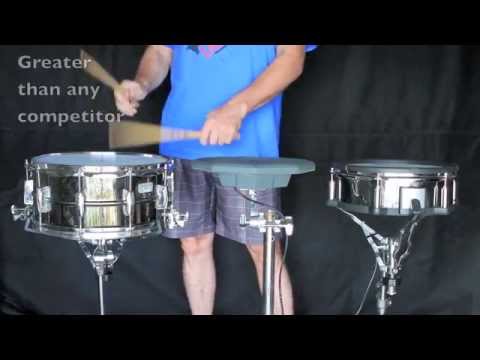
On the PIPES spec page they refer to their Mandala drum module (from which the design originates). It does great drum sounds, but '...with closed eyes you might not be sure if you are hearing the real thing or our Mandala version...' is stretching things a bit far.
In combination with an obviously 'well selected' competitor example this doesn't exactly enforce trust in the unit.
Unsurprisingly the PIPES drum examples are the most convincing, and the unit seems highly focussed on samples - with large library loading as it's strong aspect.
Sound design is based on Pure Data (which has been adressed here a couple of times)
https://www.wikiwand.com/en/Pure_Data
I'm getting 3.98ms round trip with an RME Babyface (original ) @ 24bit/96khz (96 sample buffer) Ableton 10, win 10 (on a pretty average HP pc). The Babyface Pro will shave another 4 or 5ms off that. Havn't tried it with ios yet, but i reckon it would be pretty good...........(also rock solid drivers with all RME interfaces)
How many tracks and how many heavy plugs? And the 7ms roundtrip for babyface pro came direct from their own website...also if you get 3.98 ms of latency from the gen 1, the babyface pro isnt going to shave off 4 or 5ms! You can put money on that horse...
Smh negative latency! Hahaha that aint how it works.