Loopy Pro: Create music, your way.

What is Loopy Pro?Loopy Pro is a powerful, flexible, and intuitive live looper, sampler, clip launcher and DAW for iPhone and iPad. At its core, it allows you to record and layer sounds in real-time to create complex musical arrangements. But it doesn’t stop there—Loopy Pro offers advanced tools to customize your workflow, build dynamic performance setups, and create a seamless connection between instruments, effects, and external gear.

Use it for live looping, sequencing, arranging, mixing, and much more. Whether you're a live performer, a producer, or just experimenting with sound, Loopy Pro helps you take control of your creative process.

Download on the App Store

Loopy Pro is your all-in-one musical toolkit. Try it for free today.

AUv3 StepPoly ARP AU OMG!!!!

1679111217

Comments

  • @SpookyZoo said:

    @MrBlaschke said:

    @SpookyZoo said:
    Unfortunately the SPA automation parameters don’t appear to be exposed for use in AUM.

    What does that exactly mean?
    Does that mean one can not configure MIDI Routing for SPA UNIT inside of AUM via the side menu in AUM?

    @SpookyZoo said:

    I am new to this automation stuff, so please forgive if that question is stupid:
    Can i, for example, send something to (example) CC66 (or whatever number) or are these all predefined and “set for good”?

    @SpookyZoo said:

    • I’ve not checked if these work in the AUv3 or just standalone yet. I’ll report back a bit later.

    Yes, please :smile: Thanks in advance

    Thanks to all you picture posters :smiley:

    I was slightly wrong.

    • Although the ARP settings above don't appear in the 'Midi Control parameters section, they can be controlled via the CCs listed.

    I can confirm these work well.

    These, plus pattern change and latch...

    • Routings to/from StepPoly Unit can be done via the Matrix or next to icon in AUM

    • The Automation appears to be send only, although you can choose which 5 those are by tapping on the tab.

    Would love to see the flow chart that the mess on your desk translates to. Are you recording all this into a DAW?

  • edited June 2018

    @ExAsperis99 said:

    @gonekrazy3000 said:
    As I guessed you can basically make step poly arp do pattern changes on itself. This basically means you can have some of them running at much slower clocks being the “pattern selector” for other instances. Thus theoretically making an entire song in Aum.

    Here’s very early proof:-

    @ExAsperis99 I’ll try and make an actual track now and probably post a video eventually how this works XD

    That's really cool. As an arpeggiator, is SPA somehow lacking as a sequencer? Can you do chords?

    Yup. You can basically set the exact key you want per lane. Just change each Lane from relative to absolute mode and select the tuning you want. You can also click the note name in normal view and slide up and down to select the note desired. There's enough lanes to do some basic chords. Need more lanes ? Run a parallel instance and send it’s midi to the same receiver in AUM.

    Combined with brambos’s apps We basically have a full on Groovebox inside AUM now.

    You can even go into inception levels of step sequencing. Send chords from 1 instance to another that’s running as an arp. Have those arped notes send midi to other arps. While it might sound like garbage it’s amazing you can do so.

  • @gonekrazy3000 said:

    @ALB said:
    Further to the above - so cc# 17 seems to control "Speed" in SPAunit. I'm sure some other controls can be found just by poking around.

    The Audiounit responds to all the Ccs mentioned in the manual. It's pretty much how I got the pattern changes to work in m video above. I just made 1 step poly arp send midi cc 21 to a second instance with both instances running in sequence mode.

    Values 0-15 trigger patterns 1-16 respectively. End result is it can basically automate itself.
    Now the more advanced sequencing experiments can begin :D

    I know I don't need this, but I think I want it. Only thing holding me back is that it looks like a lot of it's functionality is somewhat redundant if you have Rozeta, Modstep, Fugue Machine, etc.

    Yes, I realize it's AUv3, and it appears to be a very sophisticated interface, but what are the real stand out features of this that put it in a category of it's own?

  • edited June 2018

    @skiphunt said:

    @gonekrazy3000 said:

    @ALB said:
    Further to the above - so cc# 17 seems to control "Speed" in SPAunit. I'm sure some other controls can be found just by poking around.

    The Audiounit responds to all the Ccs mentioned in the manual. It's pretty much how I got the pattern changes to work in m video above. I just made 1 step poly arp send midi cc 21 to a second instance with both instances running in sequence mode.

    Values 0-15 trigger patterns 1-16 respectively. End result is it can basically automate itself.
    Now the more advanced sequencing experiments can begin :D

    I know I don't need this, but I think I want it. Only thing holding me back is that it looks like a lot of it's functionality is somewhat redundant if you have Rozeta, Modstep, Fugue Machine, etc.

    Yes, I realize it's AUv3, and it appears to be a very sophisticated interface, but what are the real stand out features of this that put it in a category of it's own?

    You can literally use it for everything. Case in point. Chords from 1 instance being appregiated by another instance:-
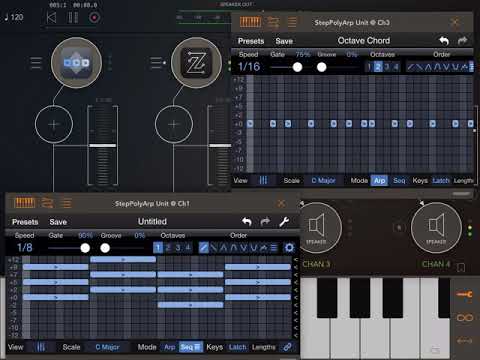
    You can do all sorts of madness with this. It’s basically going to replace some of Rosetta’s elements simply because it’s more complex.

    Another way to put it. It’s like having an infinite number of fugue machines.

    Just recorded a slightly more complex examples. Where 2 instances are listening to the chords in the master instance:-
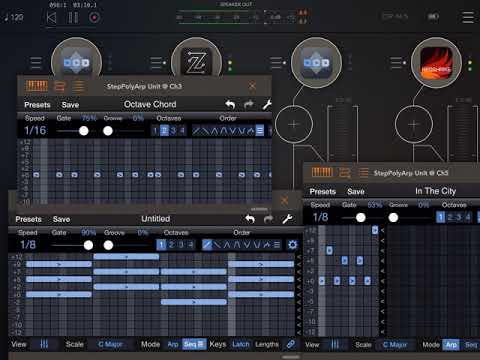
    1 major advantage to using this with AUM is that unlike modstep,fugue machine etc everything is saved in the project itself. It’s a lot easier to restore. Combine this with the fact that you can chain patterns and also that they can trigger each other and you’re reaching into more complex Beatstep Pro territory. With a few interface improvements like being able to set the exact cc value by text input per step this could me my favourite sequencer ever.

    @ExAsperis99 hope you enjoy these 2 :)

  • @skiphunt said:

    I know I don't need this, but I think I want it. Only thing holding me back is that it looks like a lot of it's functionality is somewhat redundant if you have Rozeta, Modstep, Fugue Machine, etc.

    Yes, I realize it's AUv3, and it appears to be a very sophisticated interface, but what are the real stand out features of this that put it in a category of it's own?

    It's really useful/easy. I've gotten more out of the old SPA than any other sequencer, so I'm really looking forward to diving into the AU version. Here comes the weekend...

  • @ALB said:

    @skiphunt said:

    I know I don't need this, but I think I want it. Only thing holding me back is that it looks like a lot of it's functionality is somewhat redundant if you have Rozeta, Modstep, Fugue Machine, etc.

    Yes, I realize it's AUv3, and it appears to be a very sophisticated interface, but what are the real stand out features of this that put it in a category of it's own?

    It's really useful/easy. I've gotten more out of the old SPA than any other sequencer, so I'm really looking forward to diving into the AU version. Here comes the weekend...

    Easy? It looks fairly intimidating to be honest. ;)

  • @skiphunt said:

    @ALB said:

    @skiphunt said:

    I know I don't need this, but I think I want it. Only thing holding me back is that it looks like a lot of it's functionality is somewhat redundant if you have Rozeta, Modstep, Fugue Machine, etc.

    Yes, I realize it's AUv3, and it appears to be a very sophisticated interface, but what are the real stand out features of this that put it in a category of it's own?

    It's really useful/easy. I've gotten more out of the old SPA than any other sequencer, so I'm really looking forward to diving into the AU version. Here comes the weekend...

    Easy? It looks fairly intimidating to be honest. ;)

    As an arp it’s actually pretty easy to use. What I love about it is it’s both fairly simple and also massively deep :smile: in case you missed it I edited my earlier post with 2 videos.

  • @gonekrazy3000 said:

    @skiphunt said:

    @gonekrazy3000 said:

    @ALB said:
    Further to the above - so cc# 17 seems to control "Speed" in SPAunit. I'm sure some other controls can be found just by poking around.

    The Audiounit responds to all the Ccs mentioned in the manual. It's pretty much how I got the pattern changes to work in m video above. I just made 1 step poly arp send midi cc 21 to a second instance with both instances running in sequence mode.

    Values 0-15 trigger patterns 1-16 respectively. End result is it can basically automate itself.
    Now the more advanced sequencing experiments can begin :D

    I know I don't need this, but I think I want it. Only thing holding me back is that it looks like a lot of it's functionality is somewhat redundant if you have Rozeta, Modstep, Fugue Machine, etc.

    Yes, I realize it's AUv3, and it appears to be a very sophisticated interface, but what are the real stand out features of this that put it in a category of it's own?

    You can literally use it for everything. Case in point. Chords from 1 instance being appregiated by another instance:-
    You can do all sorts of madness with this. It’s basically going to replace some of Rosetta’s elements simply because it’s more complex.

    Another way to put it. It’s like having an infinite number of fugue machines.

    Just recorded a slightly more complex examples. Where 2 instances are listening to the chords in the master instance:-

    1 major advantage to using this with AUM is that unlike modstep,fugue machine etc everything is saved in the project itself. It’s a lot easier to restore. Combine this with the fact that you can chain patterns and also that they can trigger each other and you’re reaching into more complex Beatstep Pro territory. With a few interface improvements like being able to set the exact cc value by text input per step this could me my favourite sequencer ever.

    @ExAsperis99 hope you enjoy these 2 :)

    @gonekrazy3000 I know from waaaay back, you're always exponentially down in the trenches of complexity with various routings, etc. I've come a long way, but no where near your overall understanding of complex systems.

    How would you rate the use of SPAU with regard to learning curve and not having to go through the manual several times before you can actually do something useful with it?

    I'm not generally intimated by complexity, and can unlock the keys if I persist... but is this one going to take Modstep level commitment to learn? To be honest, I didn't really find Modstep all that complicated once I dove in. It was just all of the befuddled posts by others that gave me pause even trying.

  • @gonekrazy3000 said:

    @skiphunt said:

    @gonekrazy3000 said:

    @ALB said:
    Further to the above - so cc# 17 seems to control "Speed" in SPAunit. I'm sure some other controls can be found just by poking around.

    The Audiounit responds to all the Ccs mentioned in the manual. It's pretty much how I got the pattern changes to work in m video above. I just made 1 step poly arp send midi cc 21 to a second instance with both instances running in sequence mode.

    Values 0-15 trigger patterns 1-16 respectively. End result is it can basically automate itself.
    Now the more advanced sequencing experiments can begin :D

    I know I don't need this, but I think I want it. Only thing holding me back is that it looks like a lot of it's functionality is somewhat redundant if you have Rozeta, Modstep, Fugue Machine, etc.

    Yes, I realize it's AUv3, and it appears to be a very sophisticated interface, but what are the real stand out features of this that put it in a category of it's own?

    You can literally use it for everything. Case in point. Chords from 1 instance being appregiated by another instance:-
    You can do all sorts of madness with this. It’s basically going to replace some of Rosetta’s elements simply because it’s more complex.

    Another way to put it. It’s like having an infinite number of fugue machines.

    Just recorded a slightly more complex examples. Where 2 instances are listening to the chords in the master instance:-

    1 major advantage to using this with AUM is that unlike modstep,fugue machine etc everything is saved in the project itself. It’s a lot easier to restore. Combine this with the fact that you can chain patterns and also that they can trigger each other and you’re reaching into more complex Beatstep Pro territory. With a few interface improvements like being able to set the exact cc value by text input per step this could me my favourite sequencer ever.

    @ExAsperis99 hope you enjoy these 2 :)

    These are excellent, thanks so much @gonekrazy3000, O Midi Sensei.

  • edited June 2018

    @skiphunt said:

    @gonekrazy3000 said:

    @skiphunt said:

    @gonekrazy3000 said:

    @ALB said:
    Further to the above - so cc# 17 seems to control "Speed" in SPAunit. I'm sure some other controls can be found just by poking around.

    The Audiounit responds to all the Ccs mentioned in the manual. It's pretty much how I got the pattern changes to work in m video above. I just made 1 step poly arp send midi cc 21 to a second instance with both instances running in sequence mode.

    Values 0-15 trigger patterns 1-16 respectively. End result is it can basically automate itself.
    Now the more advanced sequencing experiments can begin :D

    I know I don't need this, but I think I want it. Only thing holding me back is that it looks like a lot of it's functionality is somewhat redundant if you have Rozeta, Modstep, Fugue Machine, etc.

    Yes, I realize it's AUv3, and it appears to be a very sophisticated interface, but what are the real stand out features of this that put it in a category of it's own?

    You can literally use it for everything. Case in point. Chords from 1 instance being appregiated by another instance:-
    You can do all sorts of madness with this. It’s basically going to replace some of Rosetta’s elements simply because it’s more complex.

    Another way to put it. It’s like having an infinite number of fugue machines.

    Just recorded a slightly more complex examples. Where 2 instances are listening to the chords in the master instance:-

    1 major advantage to using this with AUM is that unlike modstep,fugue machine etc everything is saved in the project itself. It’s a lot easier to restore. Combine this with the fact that you can chain patterns and also that they can trigger each other and you’re reaching into more complex Beatstep Pro territory. With a few interface improvements like being able to set the exact cc value by text input per step this could me my favourite sequencer ever.

    @ExAsperis99 hope you enjoy these 2 :)

    @gonekrazy3000 I know from waaaay back, you're always exponentially down in the trenches of complexity with various routings, etc. I've come a long way, but no where near your overall understanding of complex systems.

    How would you rate the use of SPAU with regard to learning curve and not having to go through the manual several times before you can actually do something useful with it?

    I'm not generally intimated by complexity, and can unlock the keys if I persist... but is this one going to take Modstep level commitment to learn? To be honest, I didn't really find Modstep all that complicated once I dove in. It was just all of the befuddled posts by others that gave me pause even trying.

    It’s easier than modstep imho. If you could tame that beast SPA will not take you very long to learn at all!

    At its core It’s a programmable arp that lets you use the standard up,down,up down, etc modes that Rosetta’s arp lets you use. What separates it is the fact that you can even determine your own arp movements like play note 1 then wait 2 steps than play note 3 from the receiving chord etc. If you own any of the ice gear synths the arps inside them is very similar albeit not as versatile since in step poly arp you can choose to hold notes for longer as well on a step by step basis.
    Like. First note plays and release immediately but second note is held twice as long etc.

    It is also a step sequencer that you can choose what note to select per lane. In step sequencer mode it obeys the host transport. So play/pause AUM and all instances will start stop from the beginning. Each instance can have up to 16 patterns of 32 steps each. Patterns can be set to say play pattern 1 (x) number of times before moving to next pattern. This is all without any extra routing.

    Now once you dig really deep.... there is no arpegiator/step sequencer hybrid in existence that is as versatile even on pc/Mac . I’ve been waiting for this to go AU since au first came out for IOS. I can safely say I’m extremely pleased so far :) now if only he released a vst version so I could use it In Ableton directly on my pc......

  • @gonekrazy3000 said:

    @skiphunt said:

    @gonekrazy3000 said:

    @skiphunt said:

    @gonekrazy3000 said:

    @ALB said:
    Further to the above - so cc# 17 seems to control "Speed" in SPAunit. I'm sure some other controls can be found just by poking around.

    The Audiounit responds to all the Ccs mentioned in the manual. It's pretty much how I got the pattern changes to work in m video above. I just made 1 step poly arp send midi cc 21 to a second instance with both instances running in sequence mode.

    Values 0-15 trigger patterns 1-16 respectively. End result is it can basically automate itself.
    Now the more advanced sequencing experiments can begin :D

    I know I don't need this, but I think I want it. Only thing holding me back is that it looks like a lot of it's functionality is somewhat redundant if you have Rozeta, Modstep, Fugue Machine, etc.

    Yes, I realize it's AUv3, and it appears to be a very sophisticated interface, but what are the real stand out features of this that put it in a category of it's own?

    You can literally use it for everything. Case in point. Chords from 1 instance being appregiated by another instance:-
    You can do all sorts of madness with this. It’s basically going to replace some of Rosetta’s elements simply because it’s more complex.

    Another way to put it. It’s like having an infinite number of fugue machines.

    Just recorded a slightly more complex examples. Where 2 instances are listening to the chords in the master instance:-

    1 major advantage to using this with AUM is that unlike modstep,fugue machine etc everything is saved in the project itself. It’s a lot easier to restore. Combine this with the fact that you can chain patterns and also that they can trigger each other and you’re reaching into more complex Beatstep Pro territory. With a few interface improvements like being able to set the exact cc value by text input per step this could me my favourite sequencer ever.

    @ExAsperis99 hope you enjoy these 2 :)

    @gonekrazy3000 I know from waaaay back, you're always exponentially down in the trenches of complexity with various routings, etc. I've come a long way, but no where near your overall understanding of complex systems.

    How would you rate the use of SPAU with regard to learning curve and not having to go through the manual several times before you can actually do something useful with it?

    I'm not generally intimated by complexity, and can unlock the keys if I persist... but is this one going to take Modstep level commitment to learn? To be honest, I didn't really find Modstep all that complicated once I dove in. It was just all of the befuddled posts by others that gave me pause even trying.

    It’s easier than modstep imho. If you could tame that beast SPA will not take you very long to learn at all!

    At its core It’s a programmable arp that lets you use the standard up,down,up down, etc modes that Rosetta’s arp lets you use. What separates it is the fact that you can even determine your own arp movements like play note 1 then wait 2 steps than play note 3 from the receiving chord etc. If you own any of the ice gear synths the arps inside them is very similar albeit not as versatile since in step poly arp you can choose to hold notes for longer as well on a step by step basis.
    Like. First note plays and release immediately but second note is held twice as long etc.

    It is also a step sequencer that you can choose what note to select per lane. In step sequencer mode it obeys the host transport. So play/pause AUM and all instances will start stop from the beginning. Each instance can have up to 16 patterns of 32 steps each. Patterns can be set to say play pattern 1 (x) number of times before moving to next pattern. This is all without any extra routing.

    Now once you dig really deep.... there is no arpegiator/step sequencer hybrid in existence that is as versatile even on pc/Mac . I’ve been waiting for this to go AU since au first came out for IOS. I can safely say I’m extremely pleased so far :) now if only he released a vst version so I could use it In Ableton directly on my pc......

    That about does it. I use Rozeta pretty much on everything now. And it's just so easy to get there with it. No muss, no fuss.

    I'm going to ponder SPAU a bit, and evaluate how much I'd really use it. But, your endorsement of it with these details is good enough for me. Thanks!

  • Yeah to the person who said it will replace the Rozeta bassline and arpeggiator...love brambos, love Rozeta, but it sure is nice to be able to change the gate length on a bassline instead of just having punctuated notes with little sustain.

  • @ExAsperis99 said:

    @gonekrazy3000 said:

    @skiphunt said:

    @gonekrazy3000 said:

    @ALB said:
    Further to the above - so cc# 17 seems to control "Speed" in SPAunit. I'm sure some other controls can be found just by poking around.

    The Audiounit responds to all the Ccs mentioned in the manual. It's pretty much how I got the pattern changes to work in m video above. I just made 1 step poly arp send midi cc 21 to a second instance with both instances running in sequence mode.

    Values 0-15 trigger patterns 1-16 respectively. End result is it can basically automate itself.
    Now the more advanced sequencing experiments can begin :D

    I know I don't need this, but I think I want it. Only thing holding me back is that it looks like a lot of it's functionality is somewhat redundant if you have Rozeta, Modstep, Fugue Machine, etc.

    Yes, I realize it's AUv3, and it appears to be a very sophisticated interface, but what are the real stand out features of this that put it in a category of it's own?

    You can literally use it for everything. Case in point. Chords from 1 instance being appregiated by another instance:-
    You can do all sorts of madness with this. It’s basically going to replace some of Rosetta’s elements simply because it’s more complex.

    Another way to put it. It’s like having an infinite number of fugue machines.

    Just recorded a slightly more complex examples. Where 2 instances are listening to the chords in the master instance:-

    1 major advantage to using this with AUM is that unlike modstep,fugue machine etc everything is saved in the project itself. It’s a lot easier to restore. Combine this with the fact that you can chain patterns and also that they can trigger each other and you’re reaching into more complex Beatstep Pro territory. With a few interface improvements like being able to set the exact cc value by text input per step this could me my favourite sequencer ever.

    @ExAsperis99 hope you enjoy these 2 :)

    These are excellent, thanks so much @gonekrazy3000, O Midi Sensei.

    you're welcome :smile:

  • edited June 2018

    @ExAsperis99 said:

    Would love to see the flow chart that the mess on your desk translates to. Are you recording all this into a DAW?

    Ha, trust me, I’ve tried but I think it’s impossible!

    The setup has taken time to come together but it’s just about sweet right now. Digitakt, X-Station, Aum, Audiohub, and Zoom Live Track L-12 are the main components. Pretty much a one button start/stop for all hardware/apps. Individual Midi control templates for all on the X-Station, even the Strymons (connected via the Mios). Super happy with my Jam desk these days. :) Record audio into either AUM or the Zoom. Can also feed any audio back into either the Digitakt for Sampling or the MonoStation for audio mangling.

    All Midi recorded into Cubasis.

    Here’s a quick insta just to show the desk mess...

  • @gonekrazy3000 said:

    @skiphunt said:

    @gonekrazy3000 said:

    @ALB said:
    Further to the above - so cc# 17 seems to control "Speed" in SPAunit. I'm sure some other controls can be found just by poking around.

    The Audiounit responds to all the Ccs mentioned in the manual. It's pretty much how I got the pattern changes to work in m video above. I just made 1 step poly arp send midi cc 21 to a second instance with both instances running in sequence mode.

    Values 0-15 trigger patterns 1-16 respectively. End result is it can basically automate itself.
    Now the more advanced sequencing experiments can begin :D

    I know I don't need this, but I think I want it. Only thing holding me back is that it looks like a lot of it's functionality is somewhat redundant if you have Rozeta, Modstep, Fugue Machine, etc.

    Yes, I realize it's AUv3, and it appears to be a very sophisticated interface, but what are the real stand out features of this that put it in a category of it's own?

    You can literally use it for everything. Case in point. Chords from 1 instance being appregiated by another instance:-
    You can do all sorts of madness with this. It’s basically going to replace some of Rosetta’s elements simply because it’s more complex.

    Another way to put it. It’s like having an infinite number of fugue machines.

    Just recorded a slightly more complex examples. Where 2 instances are listening to the chords in the master instance:-

    1 major advantage to using this with AUM is that unlike modstep,fugue machine etc everything is saved in the project itself. It’s a lot easier to restore. Combine this with the fact that you can chain patterns and also that they can trigger each other and you’re reaching into more complex Beatstep Pro territory. With a few interface improvements like being able to set the exact cc value by text input per step this could me my favourite sequencer ever.

    @ExAsperis99 hope you enjoy these 2 :)

    Dham.. Thanks.. The Chords setup is sick...

  • edited June 2018
    The user and all related content has been deleted.
  • @tja said:

    @gonekrazy3000 said:
    With a few interface improvements like being able to set the exact cc value by text input per step this could me my favourite sequencer ever.

    And with this, you say that you prefer if over modstep?

    But it has only so many steps ... it´s a step sequencer, not a piano roll sequencer.

    Also, did you check Quantum?

    i own quantum. its amazing. but i find Spa easier to use.
    modstep + Aum is still my favorite daw replacement. but till it gets midi au support for the time being im mostly doodling just inside aum. i've been playing with my hardware beatstep pro a lot so the fact that Spa actually seems to be more a more advanced version of it intrigues me greatly.

  • @SpookyZoo said:

    @ExAsperis99 said:

    Would love to see the flow chart that the mess on your desk translates to. Are you recording all this into a DAW?

    Ha, trust me, I’ve tried but I think it’s impossible!

    The setup has taken time to come together but it’s just about sweet right now. Digitakt, X-Station, Aum, Audiohub, and Zoom Live Track L-12 are the main components. Pretty much a one button start/stop for all hardware/apps. Individual Midi control templates for all on the X-Station, even the Strymons (connected via the Mios). Super happy with my Jam desk these days. :) Record audio into either AUM or the Zoom. Can also feed any audio back into either the Digitakt for Sampling or the MonoStation for audio mangling.

    All Midi recorded into Cubasis.

    Here’s a quick insta just to show the desk mess...

    Wow. A midi setup that can be seen from space.
    I just claimed some desk space for a digitakt and a laptop, but so far nothing is connected. (Digitakt driving several synths in the ipad, though, is pretty cool.)
    I’m waiting for a long weekend to dive in.

  • edited June 2018

    @ExAsperis99 said:

    @SpookyZoo said:

    @ExAsperis99 said:

    Would love to see the flow chart that the mess on your desk translates to. Are you recording all this into a DAW?

    Ha, trust me, I’ve tried but I think it’s impossible!

    The setup has taken time to come together but it’s just about sweet right now. Digitakt, X-Station, Aum, Audiohub, and Zoom Live Track L-12 are the main components. Pretty much a one button start/stop for all hardware/apps. Individual Midi control templates for all on the X-Station, even the Strymons (connected via the Mios). Super happy with my Jam desk these days. :) Record audio into either AUM or the Zoom. Can also feed any audio back into either the Digitakt for Sampling or the MonoStation for audio mangling.

    All Midi recorded into Cubasis.

    Here’s a quick insta just to show the desk mess...

    Wow. A midi setup that can be seen from space.
    I just claimed some desk space for a digitakt and a laptop, but so far nothing is connected. (Digitakt driving several synths in the ipad, though, is pretty cool.)
    I’m waiting for a long weekend to dive in.

    Ha, yeah. I remember seeing your “Buying Hardware Today Don't Try to Talk Me Out of It” thread! :)

    Digitakt won!

  • Loving this!
    Reminds me of a souped up Fugue Machine :)

  • Yes, it's so versatile. And this man can code. If only he made more apps.
    SPA also makes an excellent drum sequencer + has random and probability.

    It'd be good to share some presets for different setups eventually. eg drum app mappings, chords etc :)
    I'm not sure how far off chorpolypad unit is from release but that's going to pair well with this too.

  • It’s amazing all this can be had on your iPhone...

  • Sorry if I missed it but is there a Doug link to use for purchase yet?

  • edited June 2018

    @TheVimFuego said:

    @Kühl said:

    @tja said:

    @Ivan_Dj said:

    @tja said:

    @Ivan_Dj said:

    @echoopera said:
    Really loving this updated version...really really nice workflow options now :)

    Is out now?

    Since the OP, i think ;)

    I mean in AU mode :)

    Yes, me too :)

    That´s also the title of this topic.

    This release was a shock to me. I was working all night last night with the old StepPolyArp. I actually sat and wished for an auv3 version. What is the probability for a wish like that coming true in a real universe? Almost zero. I’ve concluded that we live in a simulation. We are The Sims. Now, let’s play :smile:

    My working days appear to be more Call Of Duty but with more collateral damage and PTSD.

    Will I buy this thing? Yes, probably, big fan of the original and don’t mind supporting the dev in future endeavours. Given the original is 8 years old I don’t think a paid upgrade is unreasonable.

    In other news my new guitar has shipped after being on a 2 month backlog, I am in an uncommonly good mood.

    Yo man, I’m an guitarist emeritus, due to a ruined hand, but still interested in gear :smile:
    What kinda beauty are you waiting for?

  • @wim said:

    @tja said:

    @wim said:
    What I really wish is there was a “tip the developer” IAP in every app.

    I am trying to get @analog_matt to add that, but no reply so far.
    And yes, all of our so much loved developers should add to such a button!

    I doubt very much that's allowed by Apple. But I wish it was.

    I’ve seen apps where you can buy ‘coins’ that don’t do anything except ‘tip’ the developers

  • edited June 2018

    Seems to be a new feature, ‘Sequencer Memory’ (Page 37 in the manual) that reverts to the memorized note.. and is not a bug...

  • @RajahP said:
    Seems to be a new feature, ‘Sequencer Memory’ (Page 37 in the manual) that reverts to the memorized note.. and is not a bug...

    What does this actually do? Recall the original after randomization?

  • The user and all related content has been deleted.
  • And, I would like to add, a very kind and responsive developer. I reported an issue with midi not being received in a specific standalone situation. He exchanged several emails and now the fix is already online. Many points for that.

Sign In or Register to comment.