Loopy Pro: Create music, your way.
What is Loopy Pro? — Loopy Pro is a powerful, flexible, and intuitive live looper, sampler, clip launcher and DAW for iPhone and iPad. At its core, it allows you to record and layer sounds in real-time to create complex musical arrangements. But it doesn’t stop there—Loopy Pro offers advanced tools to customize your workflow, build dynamic performance setups, and create a seamless connection between instruments, effects, and external gear.
Use it for live looping, sequencing, arranging, mixing, and much more. Whether you're a live performer, a producer, or just experimenting with sound, Loopy Pro helps you take control of your creative process.
Download on the App StoreLoopy Pro is your all-in-one musical toolkit. Try it for free today.
Comments
MIstyping!! graphics....
Lol Thanks again, I thought I was going to be initiated into the inner Circle of modular for a moment then!
x1,000,000
midi out is so much wanted ! i love the arp100 sequencer and want to run it to so many synths!
Hello, been running miRack for a while now with hardware, es-9 in my case, and I must say that it’s wonderful. The auv3 makes it possible because even if it hasn’t got more than 2 Ins or outs, I can use different instances for different patches. The only time I really miss multiple outs is for sequencing multiple voices from the same sequencer, like marbles for instance.
Fantastic work
Yeah love all those new road map ideas but I'm hoping that midi out is higher up the list too
@Carnbot ,Totally agree, midi out and multiple audiocv channels out, will totally open up miRack for all use.
@mifki or anyone else ... what’s the easiest way to create a Wet/Dry control for a miRack audio effect?
I can create the two parallel audio chains (processed and unprocessed) easily enough between the Audio In and Out modules, but I’m fairly new to miRack and am not sure how to easily blend between two audio signals with a single Wet/Dry knob or slider control. I went through the module library and tried a few things but didn’t find a way that worked well.
Also hoping to be able to expose that Wet/Dry control inside AUM so it can be controlled via MIDI.
If anyone would point me in the right direction I’d be grateful
Does it have to be within the miRack patch, or can it be for wet/dry for the whole patch?
If you need wet/dry for the whole thing then I'd just put it on a track with a bus as the input, then put a bus send on whatever channels you want to send through miRack. The balance between the original signal and the bus signal is your wet/dry. Just map the same control, but in opposite directions to those faders.
somethig like this... then you can map AU parameter to TAC1 slider and control this parameter from within AUM or other host app
it simpy routes audio in tomyour effect chain but also to A input of x-fader, then output of your chain goes to B input of x-fader and output from x-fader goes to audio out
There are two x-faders for left and right channel and TAC module to control both xfaders simultaneously by one "knob"
Btw. beware, by default TACT-1 "rate" value is not completely zero, even though it looks like it is, which leads do slow reaction of touch area... just turn it all the way down to zero and reaction on changed value will be immediate
@mifky this is intentional or bug ? i mean TACT-1 default rate non zero value
Thanks ... I could do it with AUM bus sends but am trying to do it within miRack so I can assign the AUM parameter dial to Wet/Dry to control it easily within a track effects chain in AUM.
Thanks ... this is close to one of my attempts, with the TACT1 slider but I hadn’t included the XFade module, but it looks to be a good solution
Just checking in this week to say... ya know... um... MIDI OUT. Lol
@mifki
It’s half-done I’d say, so not too long left.
Btw, midi out-waiting people, can you post your workflows for it? Want to make sure everything is covered.
@mifki If miRack got MIDI out, I'd use it in midi fx slots in AUM, and use it to sequence other AU synths or miRack AU instances. If miRack midi AU supported sending out CV to midi CC, that would be even cooler, because it would be possible to send LFOs to AU parameters as MIDI CC.
basically using all those mirack sequencers to sequence auv3 synths in aum and hopefully some of the modulation sources to control auv3 synths as well
same as above, workflow would be using in aum, and would want to be able to convert at least 3 cv/gate pairs (8 would be better for drums though) to midi notes in order to sequence other auv3 apps. And also cv to midi cc for modulating auv3 apps basically turns all au apps into one big modular synth.
It would be great if square lfo’s or triggers above a certain threshold (ie 3 volts) could generate a note on (gate) just as they can with CV. That way one could still use lfo’s and pulse dividers to drive midi.
Ideally a single instance of miRack could send on all 16 channels simultaneously. Personally, it’s unlikely that I’d use all 16 at once, I’d probably be using up to about 6 channels, but it would certainly be nice to have all channels available.
Valley Topograph is unique trigger source for both drums and synths. I would love to combine it with some logic modules inside MiRack alongside with Drambo outside the rack.
@mifki Like the others i would love to use the miRack sequencers and generators to drive several other AU synth.
I can imagine several modules to achieve this goal:
Having separate modules with output channel selector allows to generate midi for several synth (or a single mpe one) and using the same channel allows to generate polyphonic midi.
Yes, the latter might use-case generate duplicate note-on/off message (same note on same channel output by multiple modules) but one either can filter these on the host side (using scripts) or use the miRack logic and comparator modules to suppress the duplicate triggers on the miRack side.
I would both have it controlling midi cc on other effects and soft synths in AUM. But most use for me will be controlling modulating my Roland se-02, jp-08 Hardware synth with midi cc making them modular. I mainly use audio in/out with es-9 to eurorack, so I still only have 2 channels out for modulation and cv, but with this I can send midi to Covariant, and convert it to cv. So I think it’s great, a bit of hassle but it works. The fast cv has to go to the audio out. I would prefer mor audio outputs for cv and gates, but midi is also important.
Sequencing AU and Hardware.
Currently exploring generative music and randomisation with virtual modular and a Mono-station, but can only do it via VCV (the resource-hog) running on a big-ass laptop.
@mifki Yeah controlling other AU synths and effects and hardware, but also controlling other instances of miRack modules too.
Also I hope multi-midi AU output can be considered an option at some point... not enough apps use this yet and miRack is ideal because you could have lots of different midi outputs from one rack instance and then these would show as different output ports in AUM and you wouldn't need to use midi channels very much.
This is mee dreaming out loud. In the wait for more audio outputs to use with dc coupled interface like es-9 and 8.
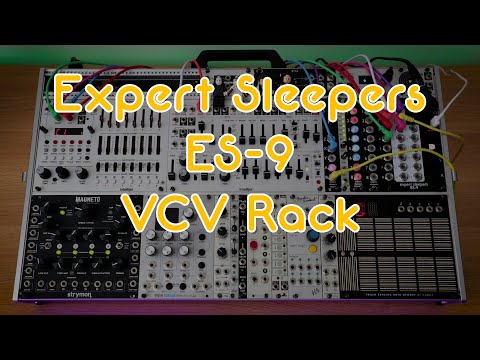
One thing that i would think would be extremely cool was if expert sleepers vcv plugins were available for mirack, they are avaliable as open source on https://github.com/expertsleepersltd/vcvrack-encoders .
They only need two outputs, and it would be easy to rout it right in AUM. With them we could get via the es5 expander 8 gates or like 8 lfos through the 8cv expander really easy.
I know you have a lot to do, so this is more like a wishful thinking.
regards Bobb
@mifki
just want to say “ in Apematrix “. basically the same workflow as people seem to use in aum..
wouldn’t like the underdog underrepresented... but any road, if it goes out to the beta crowd I will be able to give it a whirl and give you a holler if any hiccups.
Sorry I'm lost here. @RockySmalls, are you talking about ES modules, like @bobbfett?
@bobbfett Are you saying that ES encoder modules are useful even now with two channel IO? I read their docs but couldn't clearly understand how to use them. I'd appreciate an explanation what connects where and what you get.
Sorry for not being clear. The es-5 Expander uses channels 7 and 8 from the es-9, so yes, you only need two channels to get 8 gates from the es-5, and you can expand es-5 even further with esx8cv and more. I don’t know exactly wich two channels it is on es-8, but something similar.
Here’s a tutorial on windows.