Loopy Pro: Create music, your way.
What is Loopy Pro? — Loopy Pro is a powerful, flexible, and intuitive live looper, sampler, clip launcher and DAW for iPhone and iPad. At its core, it allows you to record and layer sounds in real-time to create complex musical arrangements. But it doesn’t stop there—Loopy Pro offers advanced tools to customize your workflow, build dynamic performance setups, and create a seamless connection between instruments, effects, and external gear.
Use it for live looping, sequencing, arranging, mixing, and much more. Whether you're a live performer, a producer, or just experimenting with sound, Loopy Pro helps you take control of your creative process.
Download on the App StoreLoopy Pro is your all-in-one musical toolkit. Try it for free today.
Comments
@Ailerom
Whoa, nothing cool like that! B-50 bass
@wim
Ya it’s very odd and it sucks. Hoping a future firmware update will solve my issues (already spoke with Sonicake support and got nowhere).
What model / OS version of iOS device?
I really like the body shape. You've prompted me to go checking out their bass line up.
@wim
It’s an old iPad Pro from 2017, runs iPadOS 17.something
@Ailerom
I did some perusing too when checking out your guitar. They make some wild stuff. Tbh, I bought my bass on Craigslist YEARS ago for like 20 bucks (needed a beater, it had a ska checkered strap literally screwed into it haha) so I always assumed Ltd was a low end company. But Dayum!
You serious dude !!!?
You had a carpenter too and didn’t tell me
I just sold mine
That's a (sad) first for me. I've never seen or heard of a strap screwed to a guitar. That's public flogging territory for me.
I thought I mentioned it. Which SC did you have? Probably the SC-607B I originally wanted? If I recall correctly it came in purple, but I was after the black. The telecaster version is a massive guitar. Heavier than my old Les Paul.
So true. A bent over nail is much more effective since you can more easily remove the strap.
Any thoughts on Legator guitars?
Has anyone bought/used a Blue Chip Guitar Pick. The sound has me very interested.
Just bought one - I’ll let you know haha
I had the ESP stef B8 ($5600 e body )Tokyo custom shop but I just traded for my Aristides
I just picked it up from the shop: added split coil and it sounds so much better clean in single coil mode
The the problem was it was a three-way toggle switch and I needed a five way blade really so I got to be creative, and what I did was, I picked a push pull pot and I brought it to the tech and I asked them to install it to activate split coil mode and he did just that and he only charged me for the pot that I picked . unfortunately, it sticks out of the body because the body is literally less than an inch thin, but it sounds amazing nonetheless and I could always have it done more seamlessly if I really wanted it to, but it’s just an instrument and it’s meant to be played, and that’s exactly what I’m doing with it
That's the one I originally wanted but the 7 string. The SCT style is very nice though.
I'm not sure why I never tried before but bringing up my little Laney (from a few days ago) got me thinking. So, I plug through the headphone jack to my cheapish Behringer Mixer (2 iPads and the computer goes through it) and god damn it sounds pretty good, a different zing so to speak. The ESP mics on the Ltd is great and no preamp is needed but I still wanted to try. I might record something, we'll see.
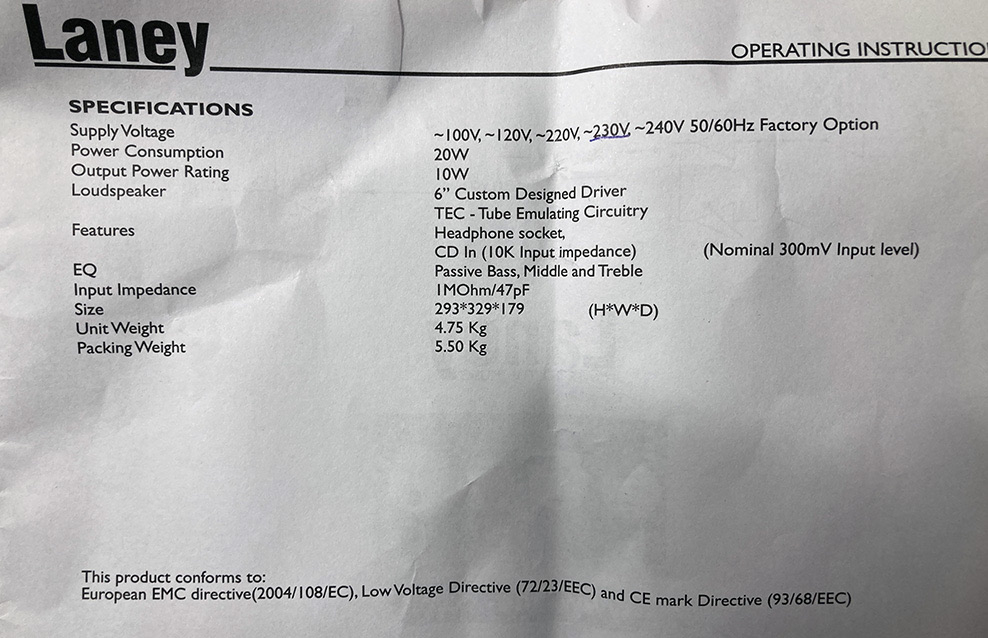
Here's the data for the Laney, I think it means 10W but you can hardy touch the volume, clean is a 2 and if I use the drive I have to go down to 1.
And the Tele is what I wanted but they didn’t have an 8 string version - so I got that one - doesn’t matter in any case, as it was traded but I’m so glad I got it because the guy who traded with me practically threw the exact guitar I really really wanted at me and paid for $300+ shipping costs just to make sure he would get it - so a 2 year build time and wait, and stress and frustration all avoided (ofc at the cost of being the second owner but that doesn’t bother me)- anyway ESP makes the best wood guitars to me though, can’t top their custom shop, and my 7 string is the ESP Ohmura signature custom shop actually. I still have and will always keep my 6 string and 7 string esp custom shops.
Actually I’m totally done with guitars, meaning no more buying , trading or selling.
how do you guys approach recording electric guitar in DAWs?
Effect chain: do you stick to the common pedal chain theory of eq - comp - gain/boost/distortion - modulation - reverb/delay ? Or are there different orders when it comes to iOS/auv3s?
Amp/cab sims: are these “required”? I know that NAM/IR is really big these days. And where in the effect chain do you put them? The end? In the middle/after the gain stages? After chorus/phase/modulation? Maybe even in the beginning of the signal?!
Any tips, tricks, and strats (no pun intended) you’d like to share, maybe even some reccs of some can’t miss apps. Basically just curious how everyone else is tackling guitar into iOS.
Just so I’ve got a flexible setup for both home into DAW (quiet/silent) or gigs and practice I run a “normal” pedalboard into an amp sim in Cubasis or a real amp depending where I am. I really should experiment more with signal chain in the DAW but I’ve spent a few years getting the sounds I want with pedals
Favorite ampsim?
As far as I've been taught you should never record distortion direct i.e as clean guitar signal as possible is best and whatever effects (distortion included) are then put on the recorded track. AUM makes this a bit tricky as in all "real" DAWs: effects don't get recorded until you bounce(freeze) the track.
When I first approached guitar into iOS this concept gave me so much trouble. “Why are none of the effects…?!” But then it clicked and made so much sense. With only the clean guitar recorded, you can go to town with effects after you hit stop. Kinda like the difference between recording keyboards into a looper (audio) and recording into something like helium (midi). Much prefer the latter.
I’m currently struggling with the ampsim aspects and where they should go in the signal chain. Hours of changing placements (start of the chain, middle of the chain after gains, end of the chain) and trying to convince myself what sounds the best. And I’m sure it comes down to “personal preference/what sounds best to you”, but just trying to get a feel for a general consensus (google wasn’t much help). Hell, there were even moments where I’m like “this kinda sounds better without any ampsim at all!” Haha
I hear you, recording guitar in particular is very difficult in my small experience and I never get them (guitars) to sound good in the end product (the mix). It also comes down to my playing I'm afraid, being consistent in tone and string contact is so much harder than one thinks. This is the main reason I haven't many recorded project with real guitars. It's a fucking pain. 😅
Nembrini has me covered. I make noisy post-punk/noise rock. Their Hivolt 103 (HiWatt) has recently replaced the MRH810 (Marshall) for me.
I’ve never had anything in the amp-loop, I’ve always put all fx in front of the amp - dirt->modulation->delay. If I went totally software I’d try something post-amp but I’m happy with the sound I get. I do have a channel strip with eq, compression and a touch of reverb for “ambience” after the amp sim. It’s a very traditional flow guitar->fx->amp->production.
I have tried recoding the clean sound and adding fx after but I got so hung up with the infinity of choices I preferred to record with fx and commit to the sound. I think it also alters the way you play - responding to the level of feedback, how hard you dig in to the strings etc. I’d love to be more experimental but this works for me
Neat thanks, I lean more to the cleaner tone side of things, but I’ll check out nembrinis other amps and see what works for me
!
//img//
That's a really beautiful design, and talk about metalhead huh: aluminium neck if I understood it right, how is that to play?
Beautiful
Thanks and thx squishy and @mistahG
Yes it’s indeed
Pairing the Rick Toone™ tremolo with the Element™ aluminum neck allows for seasonal stability, across continents and climates. Perfect, consistent, string action in changing temperature and humidity conditions. No adjustments required. String action is also consistent — even during radical tremolo use and it transposes 7 semi tones in tune so chords transpose with the trem. It also disassembles and comes apart in minutes and is rebuilt in minutes. It’s literally the greatest electric guitar ever made objectively speaking Whcih is why I waited literally almost two decades for it along with the time to build, queue of customers and cost, but I really waited and dreamed of this so it’s hard to beleive it’s actually finished- actualy until it’s in my hands this isn’t even real to me lol
@yellow_eyez - that is a beautiful design. I love looking at every part of it.
@squishy, there are no rules other than if you capture the sound you like. However, my approach is simple: replicate the pieces of what I would do live in software. For me that comes down to pre-amp FX > amp > amp FX (amp style reverb mainly) > cabinet > (post FX) > room (reverb).
My pre-amp FX mainly included distortion and WAH, but in software rarely I'll have noise reduction and/or compression in front of those. So that's where I put those now.
My amp has built-in reverb and chorus, so I'll usually have at least a touch of spring reverb or something there just for that vibe.
To me a cabinet simulation is critical. I don't think any software amp sims sound good without it, except maybe for bass.
I like my modulation FX (chorus, phaser, echo, etc) after the cab, but really, they should go where they work best - just like in a real rig. The exception would be for any pitch shifting. I don't want to try to pitch shift distorted sound. So that would go before the amp for me. I didn't mention that because I rarely use pitch shifters - can't stand the sound usually.
I usually like my delays next. I prefer to echo the whole sound, not to echo the clean sound then distort the wet sound and echos with the amp. Again, the picture in my head is how it would work in the real world. If there was some imaginary echo chamber I was playing in, I think that's the way it would work.
Lastly comes room reverb. I usually think of that in the context of everything else sharing the same "space", so that goes on a send, and other instruments are also being sent there to one degree or another.
All that is a very long winded way of saying: for me, I just imagine the real world situation, and try to replicate it in software. But that's just how I like to look at it. I'm no tone or recording expert by any stretch of the imagination.