Loopy Pro: Create music, your way.
What is Loopy Pro? — Loopy Pro is a powerful, flexible, and intuitive live looper, sampler, clip launcher and DAW for iPhone and iPad. At its core, it allows you to record and layer sounds in real-time to create complex musical arrangements. But it doesn’t stop there—Loopy Pro offers advanced tools to customize your workflow, build dynamic performance setups, and create a seamless connection between instruments, effects, and external gear.
Use it for live looping, sequencing, arranging, mixing, and much more. Whether you're a live performer, a producer, or just experimenting with sound, Loopy Pro helps you take control of your creative process.
Download on the App StoreLoopy Pro is your all-in-one musical toolkit. Try it for free today.
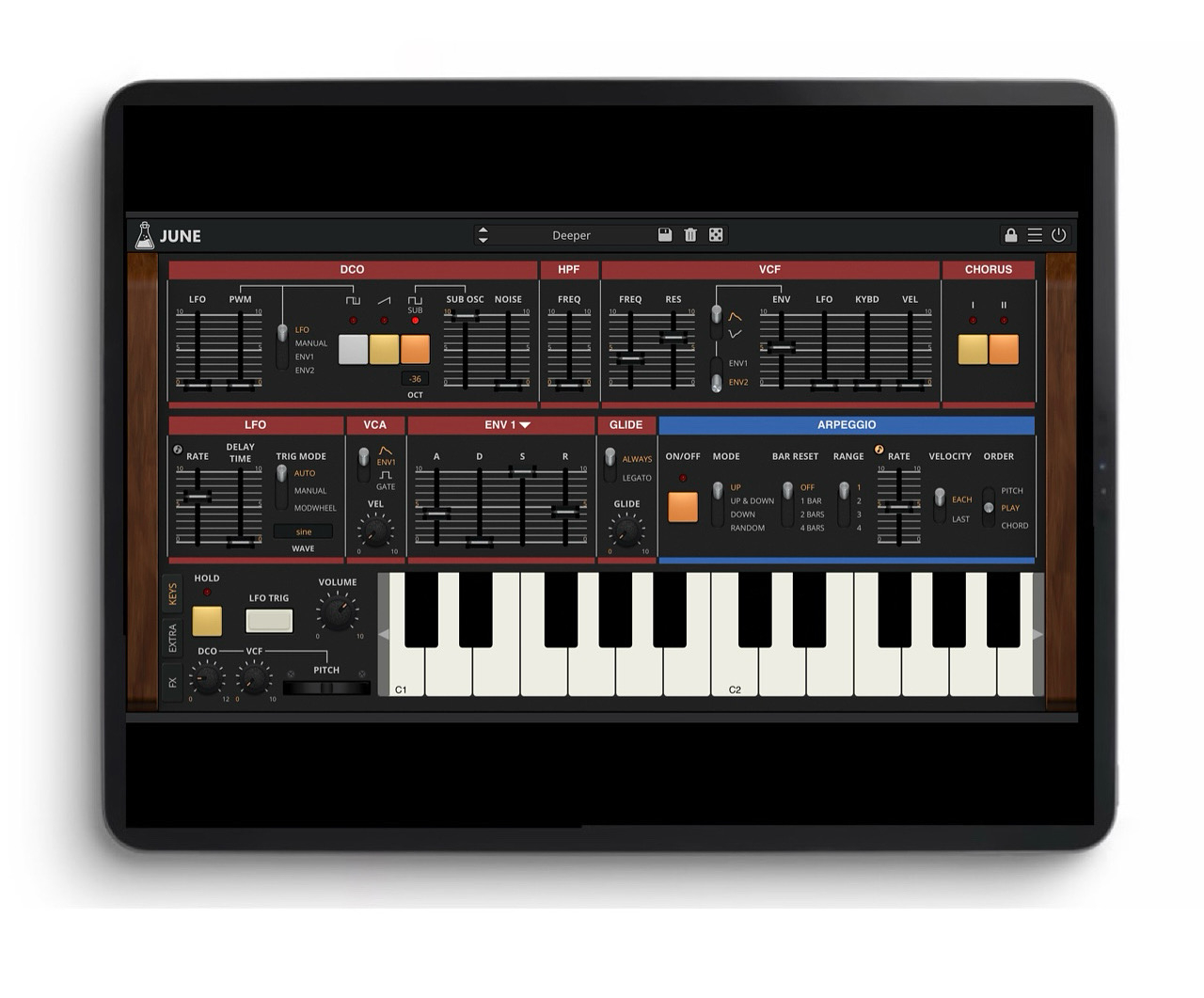
JUNE by AudioThing (Released)

https://apps.apple.com/us/app/june-analog-synth/id6748565545
JUNE is a faithful emulation of the Roland
JUNO-60, one of the most iconic polyphonic analog synthesizers from the early 1980s.
We spent months living with the original, studying every quirk and charm, from the warm, steady DCO to the silky filter and that unmistakable chorus, then modeled its circuits in detail to bring its soul into software.
Available as AUv3 and Standalone
Comments
Weird timing. @Matt_Fletcher_2000 absolutely killed it J6, Tal-U has had some 2025 updates.
J6 at the very least is inspired by the Juno (and others) and not a clone/emulation, and they were very upfront about it. Absence of PWM is probably the most obvious aspect.
Not super dumb, this is the same exact question I had haha. Thanks for posing it, excited to learn more 🤙
I'd say it is a key aspect in the sense that being a very simple synth almost anything that's missing is important. Regarding how TAL and AudioThing differ: no idea and I'm pretty sure I wouldn't be able to tell sound-wise. We're both on the same side of the Crayola box
Watch my video! It’s a comparison of many of the key aspects of June and TAL-U-NO-LX: oscillators, filters, chorus, unison. I had limited time to prep for this, I didn’t compare the PWM but there’s already loads in this video for you to get an idea about which you’d prefer.
I will! A minor comment on looks alone: I think I prefer AT's UI, which is not surprising given their track record
Excellent video from @Gavinski great comparison.
Potatos potatoes, it sounds great but I so much whished Audiothing would have choosen a synth to ‘emulate’ we don’t already have sort of twice already. I am going to mention it again, like others have done in the past: Prophet 5, that would have been a stellar choice, NO competition on iOS.
If their teaser from a few months ago pans out, we'll probably see Cherry Audio's P-10 at some point in the future
And in the middle of September I bought TAL for a full price. Great timing 😄
When there's TAL already, not seeing a need for this.
Juno60 is the new Minimoog, too many clones.
Ah yeah, although I forgot to mention it in the video, there's not much in the difference between the UIs but I also prefer Audiothing's UI. I didn't compare names in the video, haha, but I was also thinking about that and I'm not crazy about either name tbh. June, I get the reference but I dunno, gives me auntie vibes. While TAL-U-NO-LX is a pain in the arse to type 😁
If you care about mpe, you won't regret that purchase. If you don't care, maybe it's a reason to start caring and realize how great mpe is!
if u-no, u-no 🥁 (I'll see myself out now)
I prefer this one to TAL (I own both). This one is universal and has lots of little quirks, in AudioThing style, like the different chorus models, the unison and the built-in FX rack. But I’m a real sucker for that Juno sound, maybe I’ll try making some synthwave!
I'm going to buy June, even though I already have TALuno 60 and J6: I'm just into the architecture and the sound. (EDIT: I also like the other Audiothing apps that I've purchased, and have found them to sound good, look good, and work well on iOS.)
But a Prophet-5, a CS-80, or a Jupiter 8 would be instant buys for me too.
I was just thinking, why can’t there be a prolific array of Prophet emulations to choose from. I feel like Juno’s covered.
Interface seems well-adapted for the iPhone.
How is the CPU load vs TAL?
In the original machine the sub oscillator is derived by a simple flip flop divide circuit which give the sub oscillator a distinct locked in sound when used with the sawtooth oscillator.
The TAL didn’t get this right. This one does. Makes a huge difference to bass tones.
How to test. Create an init patch with just a sawtooth. Switch on the sub with the sub fader down and slowly pull up the fader. It’s night and day.
I am a self confessed Juno obsessive and have owned several over the years. This is the most accurate on iOS. The Softubes one is the most accurate on desktop.
Thanks, that's good to know.
Thanks - yes I noticed that June sounds far better in that setup - pretty sure I demoed this specific combo and compared them in my vid (though I had no idea which one was more authentic in that regard)
While I didn't do any in-depth comparisons with TAL during JUNE beta it does feel like it uses a lot less CPU.
Here's 4 instances of JUNE in Cubasis just for fun using some of my presets that are included...
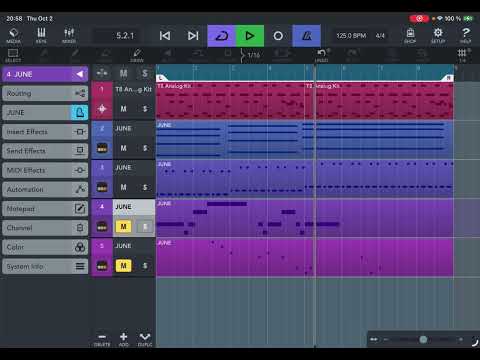

...I make every synth do the 'Chip Dance' at some point
Just want to reiterate something I wrote in the pinned comment of my video regarding the filter comparison. I used an external LFO, but should really have used the internal LFOs to avoid the stepping that causes. Funny thing is that it didn’t cause that stepping in TAL-U-NO, which presumably uses some kind of interpolation or another technique to smooth out the steppiness of midi CC messages to the filter. That’s a handy feature btw, especially for AUM users (no internal modulation system in AUM compared to ApeMatrix or many other hosts) but it has pros as well as cons. If you look at the comment section of the video, there are a few interesting comments on this topic by a viewer called Silent Stillness. Worth a read. Anyway, I since checked what June filter sweeps sound like when done using June’s internal filter: smoother. I don’t think there’s much difference in the filter modeling, apart from the aforementioned interpolation or whatever it is in Taluno.