Loopy Pro: Create music, your way.
What is Loopy Pro? — Loopy Pro is a powerful, flexible, and intuitive live looper, sampler, clip launcher and DAW for iPhone and iPad. At its core, it allows you to record and layer sounds in real-time to create complex musical arrangements. But it doesn’t stop there—Loopy Pro offers advanced tools to customize your workflow, build dynamic performance setups, and create a seamless connection between instruments, effects, and external gear.
Use it for live looping, sequencing, arranging, mixing, and much more. Whether you're a live performer, a producer, or just experimenting with sound, Loopy Pro helps you take control of your creative process.
Download on the App StoreLoopy Pro is your all-in-one musical toolkit. Try it for free today.
Comments
I posted an explanation on the Beepstreet forum so I’ll just paste that here. Cheers.
The process I’ve been attempting to use is quite simple really. After feeding it the rules from the Drambo Docs, I asked Gemini to write me a processor shader of a dancing circle shape with various parameters.
I then applied this processor several times to different parts of the cat image (just one image, not broken up or layered), with a different gate/velocity sequencer or LFO driving each one. Mixer for background and drum on different layers.
The important parameter the processor shader needs is blur/falloff so that the dancing circle isn’t just a hard edged distortion on the incoming image texture. I don’t know whether there’s a more elegant way of doing this, it is the main flaw in the system (the distortions even when blurred are like lens distortions) but I know nothing about the coding intricacies and possibilities.
I’ve been experimenting a bit today with making an adjustable dancing line instead of a circle which is probably a better, more flexible approach ultimately?
Essentially, I’m trying to rig the image texture using a processor shader skeleton underneath.
Thanks for the heads up!
Super helpful, thx!
Thank you.
🙏🏾
These are very cool.
The colorful Drambo logo is a good starting point for abstracts! Now that you’ve mentioned it, it’s fun to spot remnants of the logo here and there in those colorful images. Nice!
Thank you @Gravitas 🙏
@bleep, thanks! You're right, it's a great starting point as it contains all of the primary colors (color theory?)
Edit: here's the project file with the visuals only. (I have a version with my music that I haven't quite finished yet) but happy to share the visual rack here if anyone would like to have a play with it.
Wait. So that’s not a real moving body of water?
Nope, just math formulas
@dendy you got some love from SeedToStage in his Ableton Link Audio video
Trying out some glass reflection using some basic shapes over a background image.
Wow @Muireb that looks amazing!
+1
The glass reflection is awesome.
ooo .. thanks for head up .. that's nice .. really great to hear i affected some people's workflow in positive way
Tried to recreate Substrate from this Processing gallery, using the Drambo Visual Scene module: http://www.complexification.net/gallery/
An important detail.
The programmer has this on their website.
"I believe all code is dead unless executing within the computer. For this reason I distribute the source code of my programs in modifiable form. Modifications and extensions of these algorithms are encouraged."
@bleep
That's quite the find.
I'm sure the dRambo community will enjoy those, I know I will after first glance.
Thank you.
Thanks, and thanks for the great quote you found there. Let’s try some more …
Good find indeed @bleep
I'm trying to navigate that site on the iPad, but can't seem to find any code. I'm assuming I'd need to have a PC with Java installed?
Inspired by @Muireb's video here
I tried some texture mapping myself.
No where near @Muireb's video however looks promising for future imagery.
Thank you @Muireb for the inspiration.
For instance with Substrate, click on either Small, Medium, or Large, and then you will find a source code link there. No Java needed.
I asked my LLM whether it was necessary to dl this file and drag it to the chat, rather than seeing if the llm could do that part just by browsing from the link. It suggested that I keep doing it this way, to ensure we start from the same page, so to speak.
I was inspired as well. I had GPT pro refine the "glass" Raymarcher preset a bit. The colors of the background image play a big part in the overall effect I think. Try changing the background to different images or shaders.
Also play with these new Raymarcher module params, especially "Prism, Internal, Focus, Lens"
Here's a couple project files to play with:
Thanks! I see the "source code" link now.
@Edward_Alexander awesome, those worked a treat.
Perfect for playing with.
Thank you.
@pedro 's crystallized Rhombicosidodecahedron (dang that's a mouthful lol)
Here's a screenshot using the Scene module thanks to @pedro 's code.
@Muireb liked your idea so much I had to try it myself (yours looks better, though)
I love the look, and the little edges like a stained glass window
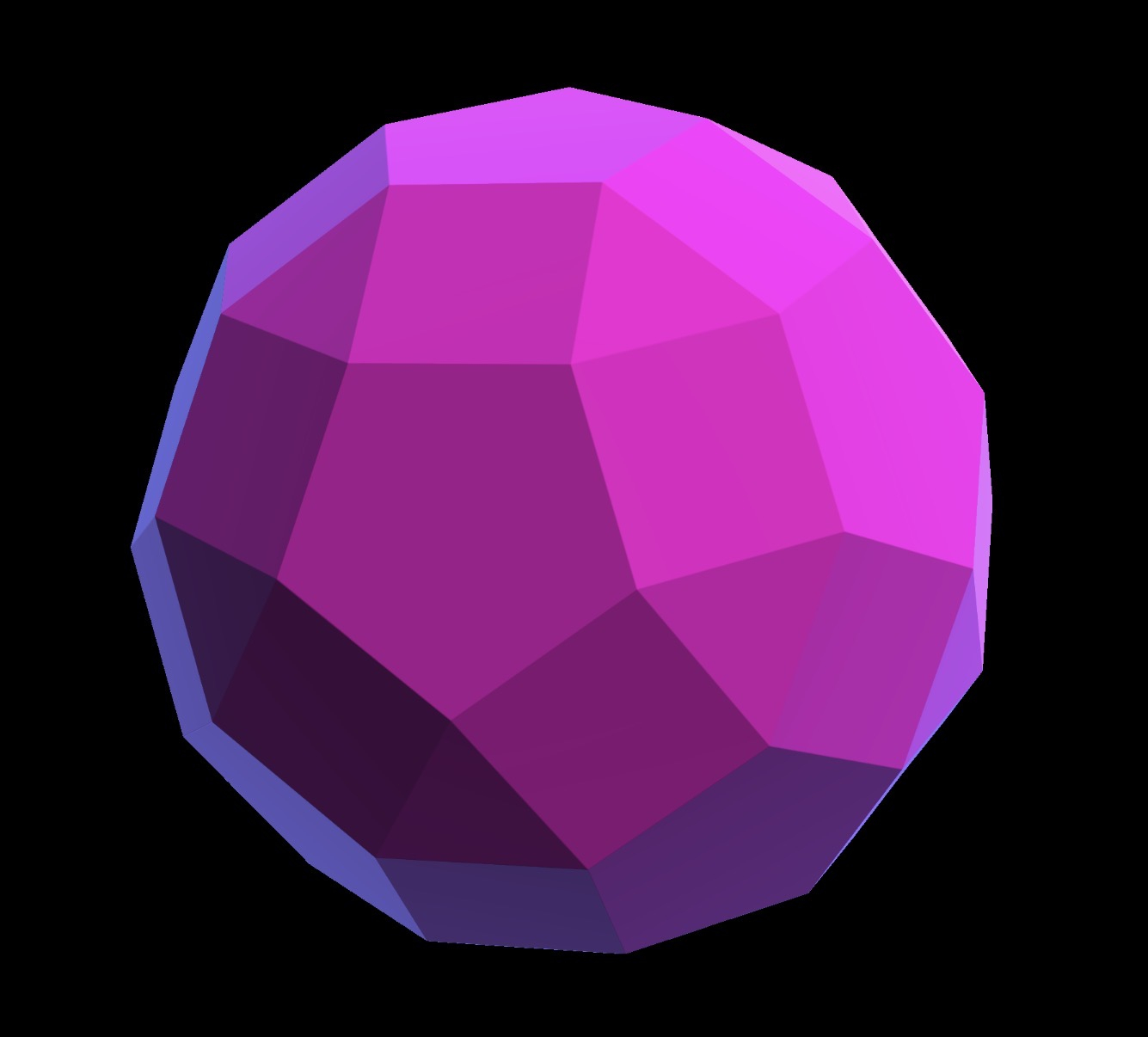
But that is not a Rhombicosidodecahedron I’m afraid 😅
A rombhi (for short) only has faces that are regular triangles, squares or pentagons. Point your LLM its error and ask it to fix it (worked for me)
No @pedro that is your file, unchanged. You’re just seeing though it to the other side. Look at the project file.😌
Very nice, is that from the terrain shader?
I ported this one too, that might interest you (it has a CC license though)