Loopy Pro: Create music, your way.
What is Loopy Pro? — Loopy Pro is a powerful, flexible, and intuitive live looper, sampler, clip launcher and DAW for iPhone and iPad. At its core, it allows you to record and layer sounds in real-time to create complex musical arrangements. But it doesn’t stop there—Loopy Pro offers advanced tools to customize your workflow, build dynamic performance setups, and create a seamless connection between instruments, effects, and external gear.
Use it for live looping, sequencing, arranging, mixing, and much more. Whether you're a live performer, a producer, or just experimenting with sound, Loopy Pro helps you take control of your creative process.
Download on the App StoreLoopy Pro is your all-in-one musical toolkit. Try it for free today.
Comments
My guess is if the pitch changes happen out of time with the notes being played, and the synth has portamento, you could get bendy sounds from that.
Not with midi. A midi note is a midi note. It has one channel, one note number, and a velocity. Trigger, pitch, and velocity are a single event. It's impossible for a midi note to arrive any other way.
You could get bendy sounds from a mono synth with portamento if you had overlapping notes though.
I know how MIDI works, I just don’t know how Drambo works.
The transpose module puts out midi. Drambo has no bearing on how midi is treated.
Anyway, this isn't really an important side bar to the discussion. I don't mean to be so pedantic. I'll leave it.
One octave means a "voltage" increase of 0.125 in Drambo's pitch signal.
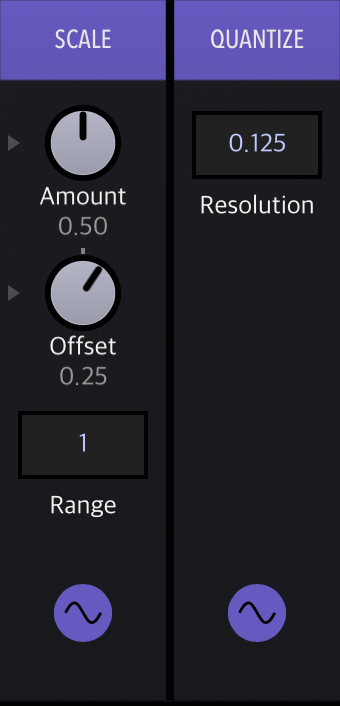
All you need is a quantize step width of 0.125 in the Math => Quantize module.
I didn’t read the whole thread, but you don’t really need signals over 1.0 in drambo everything works in that range, what you need is scaling
For instance pitch goes from 0 to 1 over 8 octaves, so an octave = 1/8 = 0.125 like @rs2000 mentions
And since you can deconstruct a midi note using midi2cv, then manipulate the components, and reconstruct it again with note generator, you have full control.
For example portamento can be had with a slew limiter for the pitch signal in between tge deconstruct and reconstruct modules. And remember it’s polyphonic
I made several patches using this and several random techniques some time ago. I can look that up although I will probably look at them and think “what were you thinking” and rebuild them all over again
Where should the quantize module fit in in this?
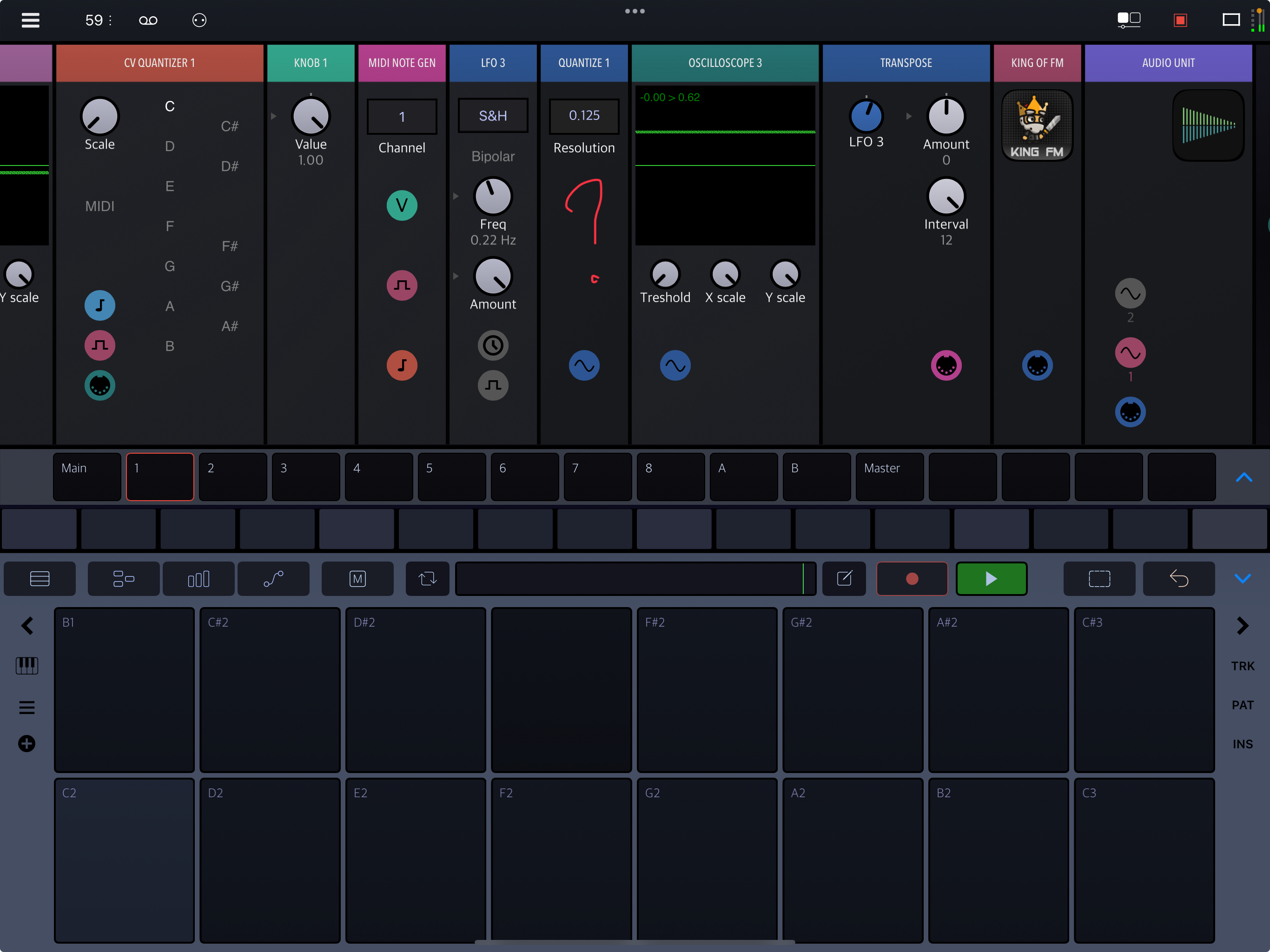
This works as intended, thank you!
But everytime you guys come up with new solutions with new modules, my brain just short circuits when thinking at the sheer possibilities possible using these new modules. Like this Meta Randomizer. It's awesome!
I don't mean to say this in a negative way, it's truly great, I feel like my 5yo in front of his lego box. Keep 'em coming!!
Thanks a lot to everyone to contribute to this
Contributed to what? You’re not nearly done buddy. You’re at the beginning of a beautiful journey. The procession hasn’t even left the church.
Get back here!
Aye, aye 🫡 I wish I could stop the time and take a 2 months long deep dive without any real life responsibilities.
@oscillotus you and me, bud
Edit: as you were 😅
That depends on what exactly you want to achieve. If you want to transpose the output of MIDI Note Gen by random octave amounts (which could make sense, musically) then I would suggest to move the MIDI Note Gen to the left of Transpose, add a Math => Add module to the right of Quantize, then connect the first input of the adder to the CV Quantizer's pitch output, the second input to the Quantizer output and finally connect the Pitch input of MIDI Note Gen to the output of the adder.
Now you have a CV Quantized pitch that is randomly transposed by octaves at LFO speed.
I will try this, thanks!
Is it possible to create an lfo with an asymmetrical square shape. Something like pulse width? I know I can draw one with the graphic envelope, but I'd like to be able to modulate the pulse width with another lfo.
If you have the WaveTable IAP for Drambo you can use the WaveTable LFO to do some pretty weird stuff, including pwm...
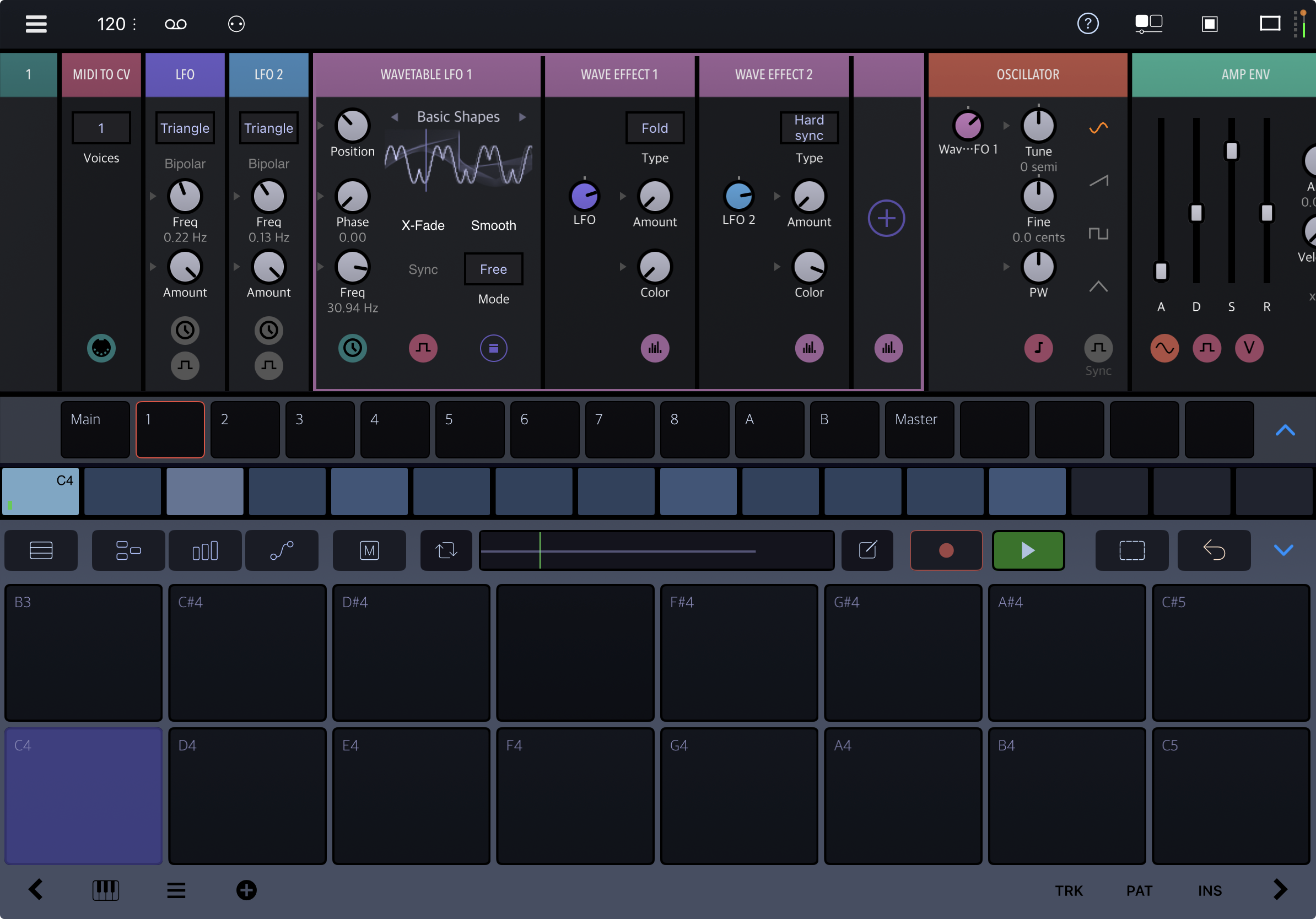
Interesting. Can it be slow like an lfo? I tried an oscillator, but it was too fast, even with a pulse divider...
Is 0.01 Hz slow enough?
If not then you can probably type in a smaller value as well
Yes, and wavetables aren't really good for PWM, that's why Drambo's wave effects have a PWM wavetable effect on board.
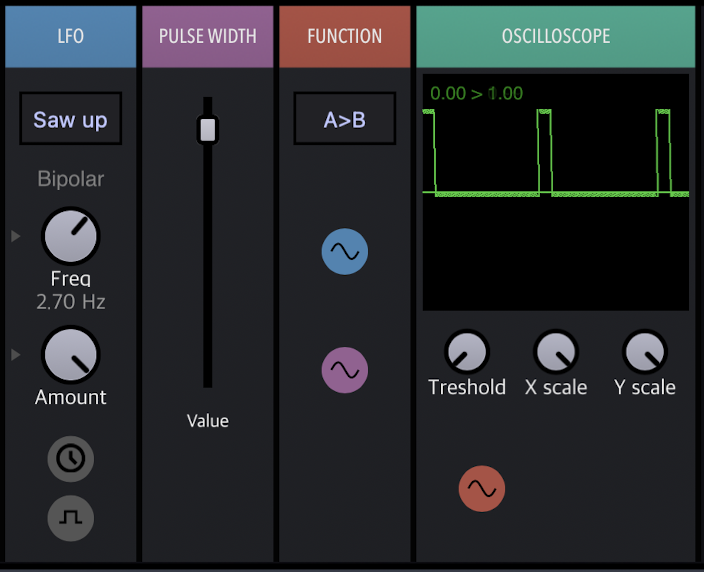
But there's another easy way to achieve this:
Oh, and use a knob instead of the slider to be able to modulate it.
Perfect, thanks!! I have the Wavetable IAP, so I'll have some fun with it!
This works exactly as I would like, easy to modulate. This is great! Thanks a lot
Is there a way to select the octave range that comes out of a CV Quantizer? The scale button seems to widen the range, but what if I'd like to have only 3 and 4?
You can use the scale and offset module from the math section before the quantizer fed with the pitch signal with scale on the quantizer all cranked up. Use offset to find the lowest note you want and then scale to find the highest. I like mapping the offset and scale parameters to an xy-pad.
I was just about to post this 😊
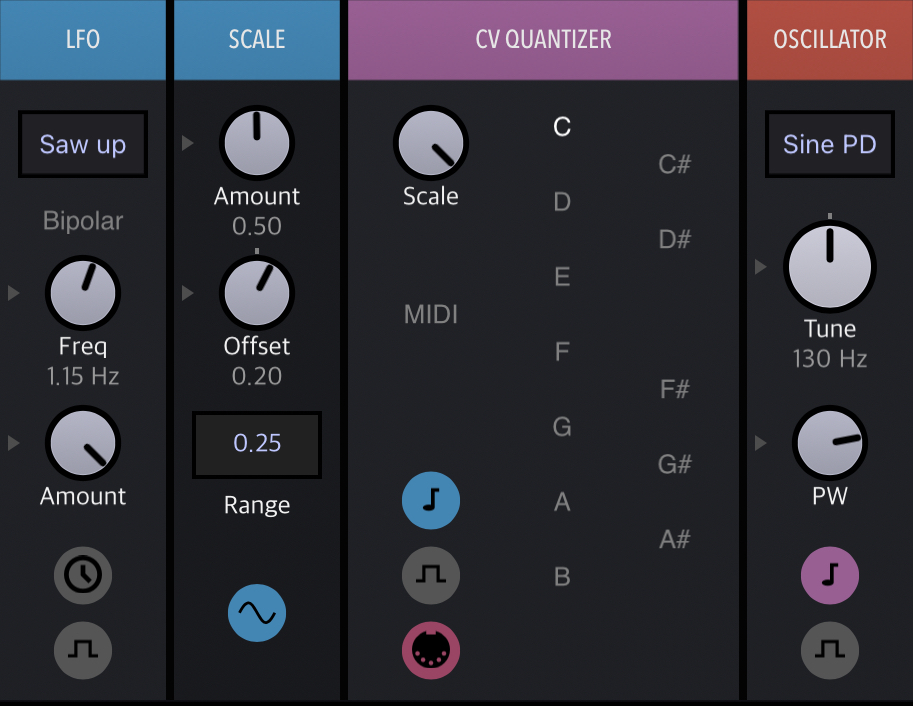
Oh, confining the range, good idea to make sure you get 2 octaves.
This works nicely!
So, when I put the "pwm" knob all the way to 1, I get sustained notes. The CV quantize module gets notes fed from a S&H lfo. From my understanding, there needs to be a close gate signal so I get note changes, so I need to nudge the "pwm" knob just a bit. Is there a way to keep the notes completely sustained and have notes changes? Also, sometimes, even though the gate doesn’t close, I get note changes. Not often, but it happens. Why's that?
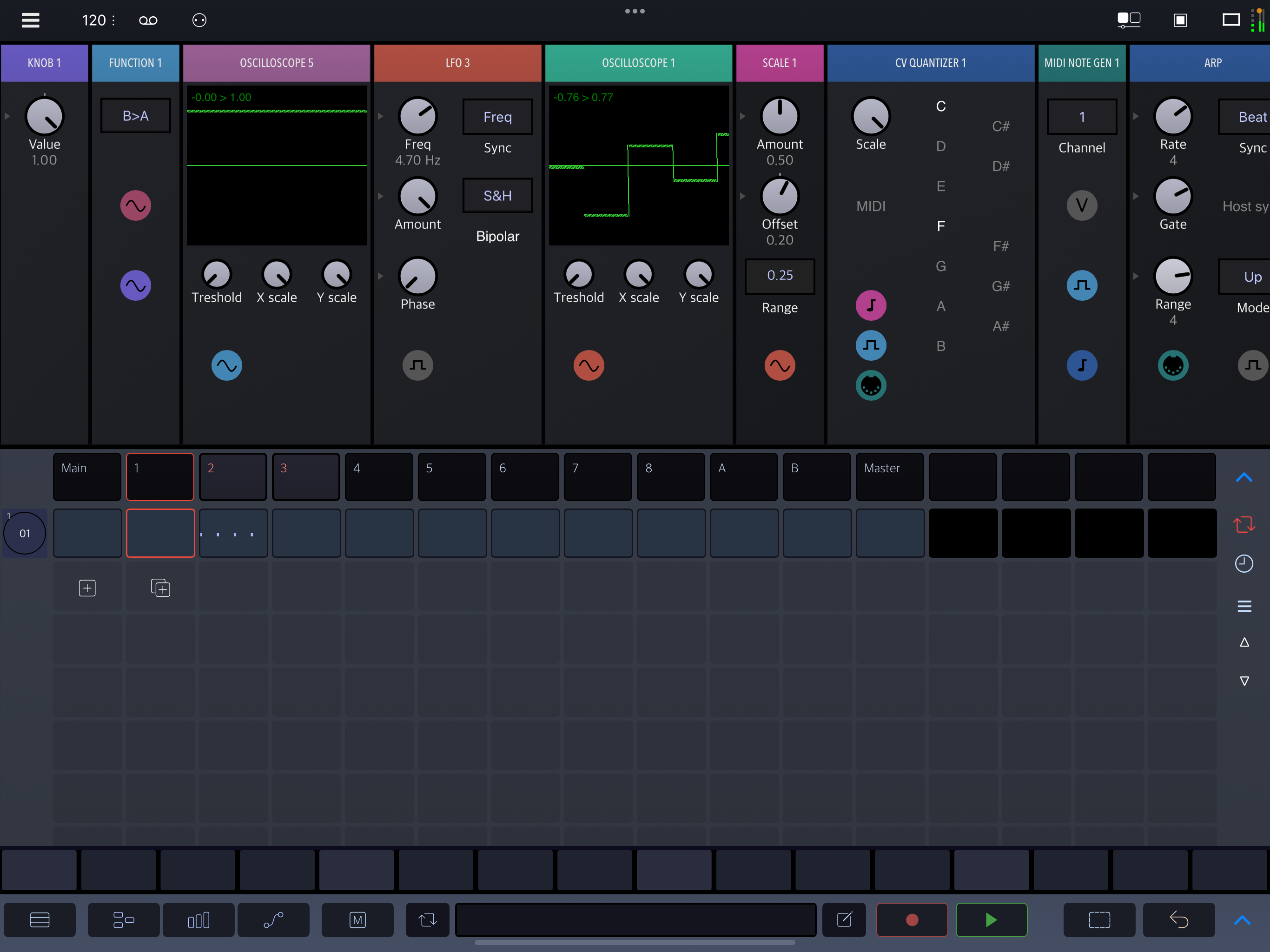
Not exactly sure what you’re after, but if you want notes to “hold” you could use the Latch module.
I want to use the "pwm" knob (knob 1) performatively but would like to have note changes even when it's turned up to 1 (gate open). It messes a bit with the arp at the end when I use even just a small gate close signal (knob 1 to 0.99). On the other hand, I don't dislike the fact that the notes don't change when I don't use the arp. So it's more of a curiosity question of what is possible in case I'd need it.
Sounds like you're up to something great!
Thanks! I try to get a better understanding of how the modules work mainly by using oscilloscopes and experimenting around. It's pretty fun to watch the signals!
So many nuggets of drambo wisdom in here to unpack! Just wanted to pop in and say thanks to everyone contributing. Super helpful 🤙